RAPIDKNOWHOW® POWERPOST · JOSEF DAVID
One signal. One decision. Measurable value.
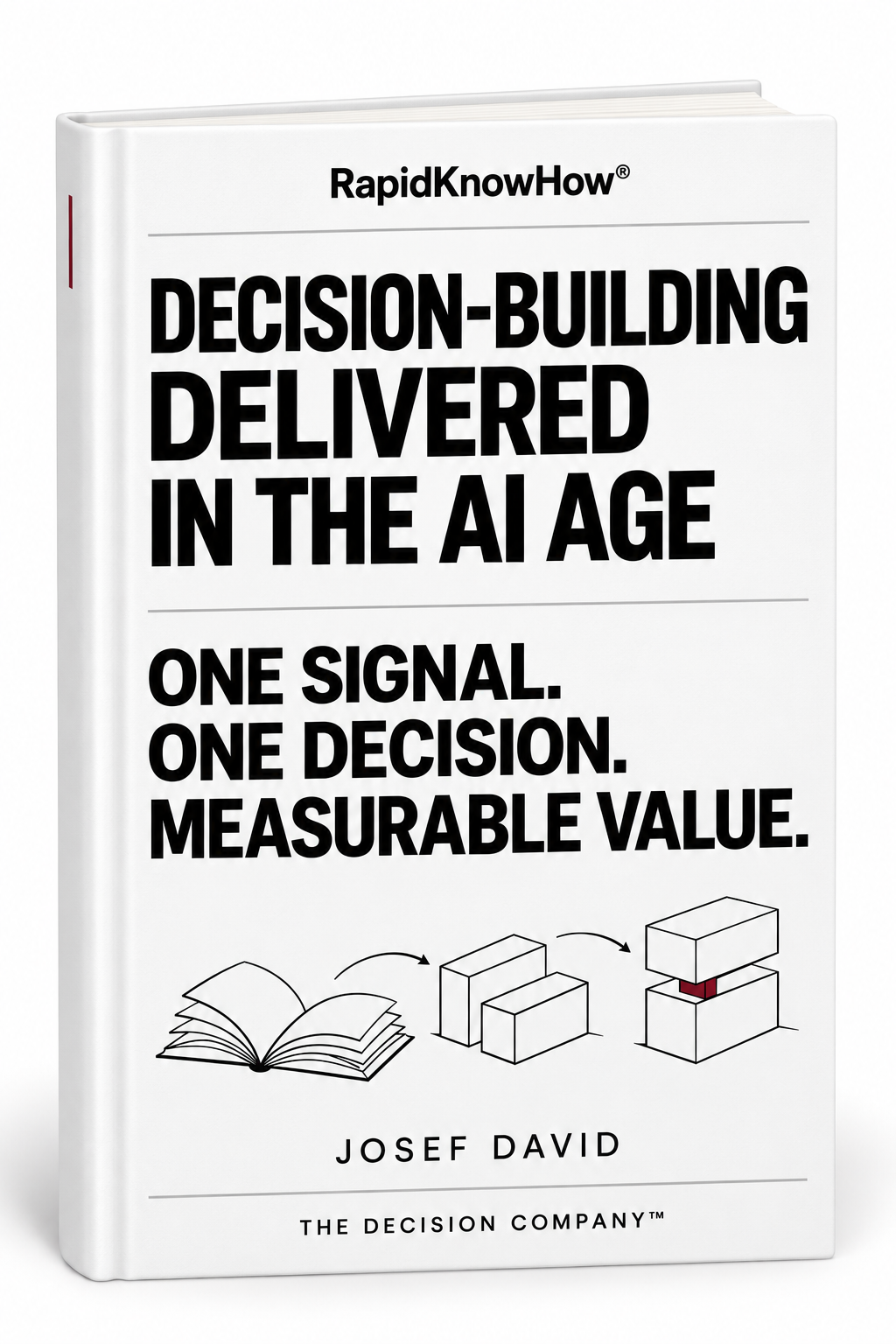
AI can generate answers in seconds. Leaders still have to decide what matters, choose a course of action and prove whether it worked. The flagship book RapidKnowHow® — Decision-Building Delivered in the AI Age develops a practical method for doing exactly that.
This PowerPost introduces the method. Explore the complete RapidKnowHow® PowerBook — Decision-Building Delivered in the AI Age: ten concise chapters, illustrative cases, a decision worksheet, an action checklist and a 90-day implementation path.
The issue: more information can leave the decision unchanged
A dashboard highlights a problem. A team requests another analysis. AI produces options. Meetings multiply. Yet the customer still waits, cash remains tied up or the project misses its next milestone.
The missing link is a clear decision with an accountable owner, a small number of actions and a defined result. Information becomes useful when it changes what someone does.
The RapidKnowHow® decision-building method
SIGNAL → PROBLEM → ONE DECISION → TOP 3 ACTIONS → MEASURABLE RESULT
- Recognize the signal. Identify a meaningful deviation from the expected result. Compare it with a baseline and check the underlying evidence.
- Define the problem. Find the constraint that prevents progress. Separate an observed fact from an assumption about its cause.
- Make one decision. State the chosen action, who owns it and when it will be reviewed. Record the trade-off and the reason for choosing it.
- Execute the top three actions. Give each action an owner, a deadline and a visible deliverable. Keep the work focused enough to finish.
- Verify the result. Compare the outcome with the baseline. Decide whether to continue, adapt or stop. Preserve the lesson for the next case.
Give AI a defined job
Use AI to organize evidence, compare options, challenge assumptions and draft a decision brief. Ask it to identify missing information and explain what would change its recommendation.
Check important claims against reliable sources. Keep confidential information within approved systems. The responsible person makes the decision and verifies the outcome.
A useful AI prompt: “Using the evidence below, identify the main constraint. Separate facts from assumptions. Compare three feasible options against our objective. Draft one decision with an owner, three actions, a review date and a measurable result. Flag missing evidence.”
An illustrative case: cash collection
Suppose a business notices that overdue invoices are rising. The first response might be to contact every customer. A closer review shows that many invoices are held up by unresolved billing disputes.
The decision: Prioritize disputed invoices and resolve the underlying billing issues before expanding general reminders.
The top three actions: Assign an owner to each disputed invoice; agree the correction or supporting evidence with the customer; review resolution and cash receipt every week.
The result to verify: Track disputed balances resolved, overdue balances collected and time to resolution against the starting baseline. Record actual cash received separately from promises to pay. This is an illustrative example, not a reported customer result.
Start with one decision today
Choose one problem that is holding back a useful result. Write a short decision brief answering these questions:
- What result do we want, and by when?
- What signal and evidence show that action is needed?
- What is the main constraint?
- What single decision will we make, and who owns it?
- What are the top three actions?
- What measure and review date will tell us whether it worked?
Repeat the cycle when the evidence changes. A decision is a commitment to act and learn, not a claim that uncertainty has disappeared.
From reading to action
The book brings this sequence together with practical tools, illustrative cases and an implementation path. Its purpose is to help leaders turn useful knowledge into decisions, actions and results they can verify.
Your next step: select one signal, make one decision and begin the top three actions.
OPEN THE RAPIDKNOWHOW® COMMAND CENTER
Explore RapidKnowHow® Action Guides →
Josef David · RapidKnowHow®
THE DECISION COMPANY™
RapidKnowHow® — THE DECISION COMPANY™
Industrial Gas Leadership 2030
PROVE VALUE. THEN SCALE.
Watch the 60-second roadmap: 10 strategic actions for DACH and CEE, 2026–2030.
Start with ONE customer challenge. Use the Industrial Gas Action Guide to turn your first action into a measurable result.
RapidKnowHow® — Leading Industrial Gas Opportunity Signal Identifier in DACH & CEE