
Industrial Gas | From the value chain to sustained free cash flow
Decision. Start with a paid cylinder-rental and return pilot at one manufacturing site, then offer an annual site licence once the customer verifies a recurring cash benefit.
The first customer is a DACH or CEE manufacturer with a material cylinder-rental bill, frequent movements between work areas and a plant manager who can authorize returns. The innovation connects the physical cylinder register to supplier return records, rental invoices and payments. The customer buys a way to stop paying for cylinders it no longer needs and keep those charges from coming back.
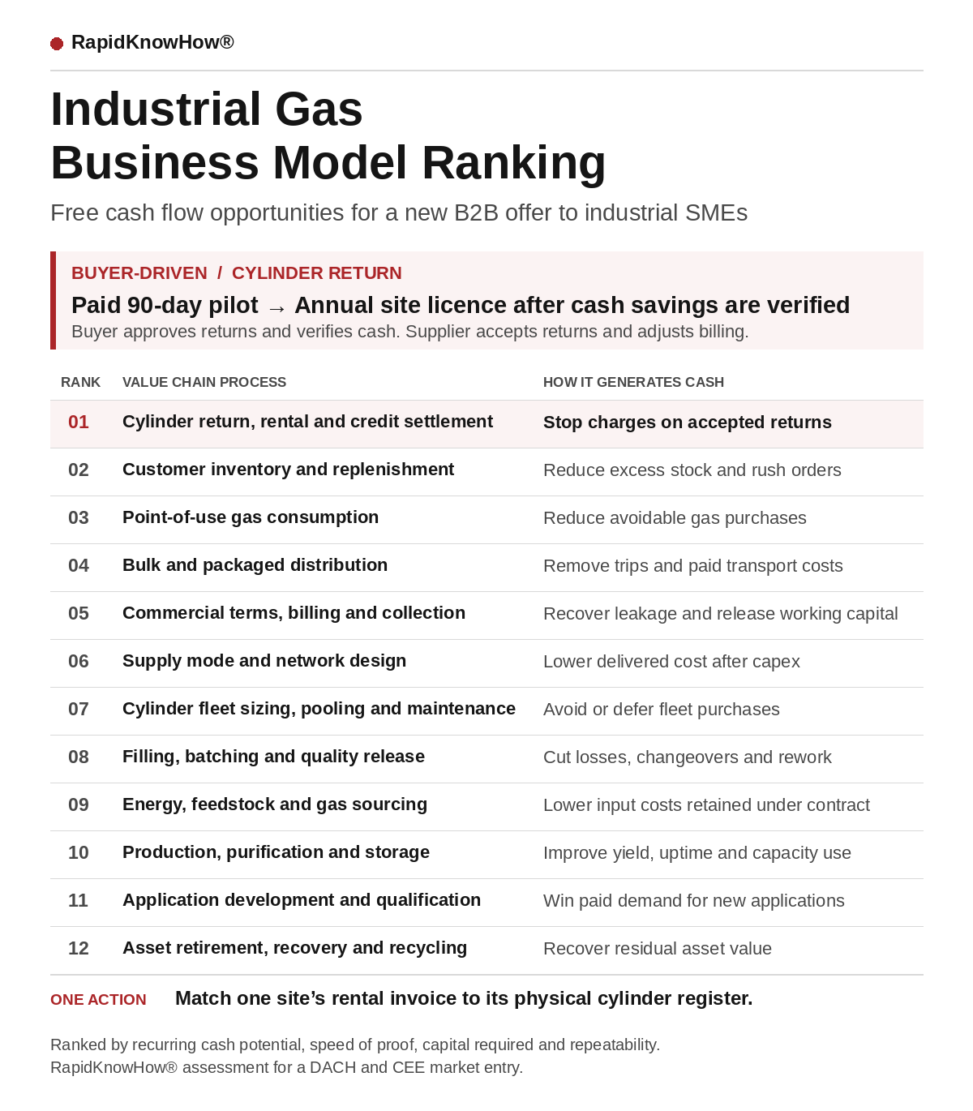
1. Rank the entire value chain by the opportunity to generate cash
This ranking is for an independent B2B innovator entering through industrial SMEs. It weighs recurring customer cash potential, speed of proof, capital required and the ability to repeat the offer across sites. It is a commercial judgment based on the evidence below. The order can change for an incumbent that already owns plants, fleets and pipelines.
| Rank | Process | How it can generate free cash flow |
|---|---|---|
| 1 | Cylinder return, rental reconciliation and credit settlement | Stop recurring rental payments on accepted returns and recover eligible overcharges. The buyer can trace the improvement from the cylinder ID to the payment record. |
| 2 | Customer inventory and replenishment | Reduce excess stock and emergency deliveries while preserving an agreed supply buffer. This makes the initial saving repeatable. |
| 3 | Point-of-use gas consumption | Reduce avoidable gas purchases by addressing leaks, purge losses or excessive consumption per unit produced. A metered site with high gas spend could move this to first place. |
| 4 | Bulk and packaged distribution | Improve drop sizes, route density and pickup scheduling. The strongest case requires enough stops in one cluster to remove actual trips or fleet costs. |
| 5 | Commercial terms, billing and collection | Improve rental and delivery terms, prevent invoice leakage and resolve disputes. Faster collection can release working capital once. Sustained cash improvement requires a lasting change in costs, margins or cash tied up. |
| 6 | Supply-mode selection and network design | Move from cylinders to bulk liquid, on-site generation or pipeline when demand and reliability justify it. Compare delivered cost, installation and exit costs, backup supply and incremental capex. |
| 7 | Cylinder fleet sizing, pooling and maintenance | Increase turns per cylinder and avoid or defer fleet purchases. Pooling needs compatible assets and agreed ownership and return rules. The fleet owner captures the capex benefit. |
| 8 | Filling, batching and quality release | Reduce changeovers, rework and filling losses. Higher throughput creates cash when the operator can sell the additional output or remove a cash cost. |
| 9 | Energy, feedstock and purchased-gas procurement | Lower electricity, feedstock and sourcing costs. The benefit depends on who pays the bill and how the supply contract passes costs through. |
| 10 | Production, purification, liquefaction and storage | Improve yield and uptime or add capacity against contracted demand. Plants and pipelines can generate substantial long-term cash, with significant capital committed before the benefit arrives. |
| 11 | Application development and qualification | Win paid demand through a better industrial process or a specialty gas application. Cash depends on qualification, customer adoption and a commercial commitment. |
| 12 | Asset retirement, recovery and recycling | Recover residual asset value and reduce disposal costs. These benefits are generally episodic, making this a weaker basis for an annual offer. |
2. What the documented public cases show
Cylinder return has a credible cash mechanism. Orca Scan reports that UK manufacturer Lawrence David cut its active cylinder inventory from more than 500 to 180 and estimated savings of £20,000 per month in rental and recovery costs. It is a vendor-published customer case, so the amount is a reported estimate. In Austria, Messer already offers barcode-based cylinder tracking, stock-age alerts and reordering. Together, these cases point to a specific opening for RapidKnowHow®: use existing records across suppliers where available, close out returns and prove what changed on the buyer’s bill. orcascan.com
Bulk replenishment is a credible second offer. Air Liquide documented using remote tank telemetry, demand forecasting and inventory routing to decide when and how much liquid gas to deliver. This supports a cluster-based offer where the buyer or supplier can demonstrate fewer emergency deliveries or lower paid transport costs. ORMS Today
On-site supply can be the better model at industrial scale. Linde reports typical on-site contracts of 10–20 years with minimum purchase requirements and price escalation provisions. In Stade, Germany, Air Liquide announced a renewed long-term supply agreement with Dow alongside nearly €40 million in asset modernization. That model fits a supplier with a committed anchor customer, the capital to build or upgrade assets and the ability to operate them over the contract term. sec.gov
3. The best business model recommended by RapidKnowHow®
Sell a fixed-fee 90-day proof pilot. Convert to an annual site licence when the customer verifies that the saving recurs.
The plant manager owns cylinder availability. Procurement confirms rental terms, return conditions and credits. Finance approves the baseline and verifies the difference in payments. RapidKnowHow® supplies the reconciliation method, return workflow and monthly exception review. Existing supplier portals and barcode records can provide the inputs.
The first paid pilot must prove two things. The customer retains a positive cash benefit after fees and implementation costs. RapidKnowHow® can collect enough to cover setup, support and delivery costs. A one-time clean-up can justify the pilot. The annual licence needs a recurring job, such as catching new idle rentals, controlling replenishment and resolving billing exceptions before they repeat.
4. Prove the cash before scaling
Start with one site and one supplier. Match the rental invoice against the physical register. Identify idle cylinders that can be returned under the contract, preserve the agreed operating reserve, and obtain supplier acceptance. Verify the reduced rental charges through subsequent invoices and payments. Adjust the baseline for changes in production volume, rental rates and billing periods. Track one-off credits, working-capital releases and avoided capex separately from recurring savings. Management verifies the result.
For illustration, 100 accepted returns at €6 per cylinder per month would reduce rental payments by €600 a month once the charges stop. If the reduction applies for nine months in year one, gross savings are €5,400. Deduct €1,800 for the pilot, €1,500 for the licence, €900 for incremental operating costs and €300 for pickup. That leaves €900 in first-year incremental cash before tax under those assumptions. With a full year of recurring savings and the same licence and operating costs, the annual benefit would be €4,800 before tax. The figures are illustrative inputs for deciding whether a site is worth piloting.
ONE job → ONE strategy → ONE action → ONE verified result
Reduce avoidable cylinder rental payments → close the loop between physical returns and billing → reconcile one site’s rental invoice against its cylinder register → verify the reduction in cash paid, after costs and with supply availability maintained. – Josef David
RapidKnowHow® — THE DECISION COMPANY™
Industrial Gas Leadership 2030
PROVE VALUE. THEN SCALE.
Watch the 60-second roadmap: 10 strategic actions for DACH and CEE, 2026–2030.
Start with ONE customer challenge. Use the Industrial Gas Action Guide to turn your first action into a measurable result.
RapidKnowHow® — Leading Industrial Gas Opportunity Signal Identifier in DACH & CEE