
●
RapidKnowHow® — THE DECISION COMPANY™
ONE JOB → ONE STRATEGY → ONE ACTION → ONE VERIFIED RESULT
HomeCare Leadership
Poland 2030
Lead ONE cluster. Verify the cash. Then expand.
Build a respiratory-care business around reliable patient care,
funded demand and disciplined use of capital. Compare three
growth strategies before committing your next investment.
For: HomeCare owners, healthcare executives,
investors and medical-gas partners evaluating growth in Poland.
READ THE STRATEGY POWERREPORT ↓
A decision simulation, with assumptions visible.
No claim of verified savings or guaranteed market leadership.
●
POWERREPORT · 3 NOVEMBER 2026
ONE cluster first: the route to test
The strategic question:
How can a Polish respiratory HomeCare operator grow while
protecting care continuity, cash flow and returns on capital?
1. ONE JOB — Convert demand into funded, reliable care
On 28 October 2026, SOL reported acquiring 100% of Wentimed,
a Polish mechanical-ventilation and palliative-care operator
with 2025 revenue exceeding PLN 40 million. The announcement
signals further consolidation around an established healthcare
group. It does not establish local market shares, buyer savings
or a change in reimbursement.
Funding must be checked separately. In its response dated
27 April 2026, Poland’s Health Ministry stated that increasing
contracted home-ventilation funding depends on available
NFZ resources. More patient demand cannot automatically
be booked as funded growth.
2. ONE STRATEGY — Compare cash and capital
Start with the same hypothetical operator generating
€10 million annual revenue. Compare its possible
2030 position under three strategies.
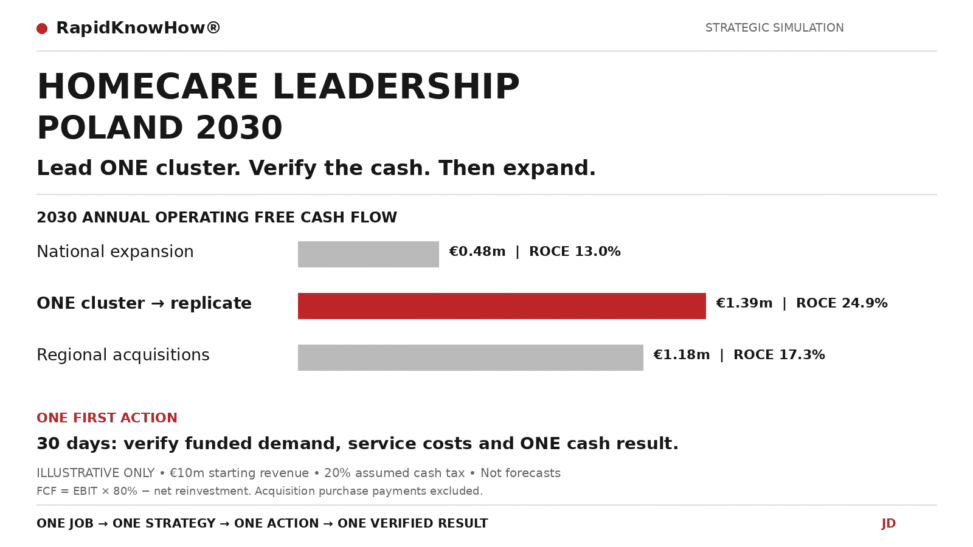
All figures below are illustrative assumptions, not forecasts
for SOL, Wentimed or the Polish market. Amounts are € million.
| 2030 measure | National expansion | ONE cluster → replicate | Regional acquisitions |
|---|---|---|---|
| Annual revenue | 13.00 | 16.00 | 20.00 |
| Operating margin | 8% | 14% | 13% |
| Operating profit: EBIT | 1.04 | 2.24 | 2.60 |
| Average capital employed | 8.00 | 9.00 | 15.00 |
| Annual net reinvestment | 0.35 | 0.40 | 0.90 |
| Annual operating FCF | 0.48 | 1.39 | 1.18 |
| ROCE | 13.0% | 24.9% | 17.3% |
FCF = EBIT × 80% − net reinvestment, using an assumed
20% cash tax rate. Net reinvestment = capital expenditure
− depreciation + increase in working capital.
ROCE = EBIT ÷ average capital employed, including
acquisition goodwill where applicable. Annual operating
FCF excludes acquisition purchase payments; a full
acquisition appraisal must include them.
Assessment:
the cluster strategy wins under these inputs because it
assumes better margins and lower capital needs than an
acquisition programme. Shorter journeys, greater equipment
utilisation and coordinated service delivery are potential
sources of that advantage. They must be demonstrated locally.
Different reimbursement, staffing or collection assumptions
can change the ranking.
Cash stress test:
30 additional collection days on €16 million annual credit
revenue would absorb approximately €1.32 million in working
capital: €16m × 30 ÷ 365. This is a one-time cash requirement,
almost equal to the simulated annual cluster FCF.
3. ONE ACTION — Establish a 30-day cluster proof
Evaluate Silesia as ONE candidate cluster. Confirm funded
demand, clinical staffing, referral pathways and service
coverage before selecting it.
-
Week 1 — Baseline.
Review contracts, invoices, collections, equipment
utilisation, service costs and care-quality measures. -
Week 2 — Map.
Identify hospitals, referral pathways, providers,
supplier ownership and funded capacity. Distinguish
independent alternatives from brands under common ownership. -
Week 3 — Act.
Select ONE measurable improvement: resolve eligible overdue
invoices, redeploy idle equipment, or reduce avoidable
logistics expenditure. -
Week 4 — Verify.
Reconcile the result to bank receipts or actual expenditure
avoided, deduct implementation costs and check that
care quality is maintained.
Qualified clinical teams retain treatment decisions.
AI may support scheduling, equipment tracking and invoice
checks within the operator’s approved data and clinical controls.
4. ONE VERIFIED RESULT — Prove value before replication
Record the baseline, action, responsible owner, cash evidence
and quality measures. Distinguish recurring operating
improvement from a one-time working-capital release.
Forecast savings and higher sales alone do not
constitute verified cash.
A 30-day assessment can establish feasibility and verify
a first result. It cannot by itself prove national
leadership or sustainable annual FCF.
RapidKnowHow® commercial role
Provide a paid, neutral assessment for ONE operator and
ONE cluster: strategy comparison, cash baseline,
first-action plan and verification record. Set scope,
fee and data access in a separate agreement.
Licence the repeatable method after the pilot demonstrates value.
ONE strategic decision:
evaluate a paid Polish respiratory-care cluster pilot
before committing to national expansion or acquisitions.
Define your ONE first action
Write one sentence:
“For [operator] in [cluster], we will improve [cash measure]
from [verified baseline] within [agreed period], while
maintaining [care-quality measures].”
Assign ONE accountable owner. Confirm funded scope and the
evidence needed to verify the result before starting.