
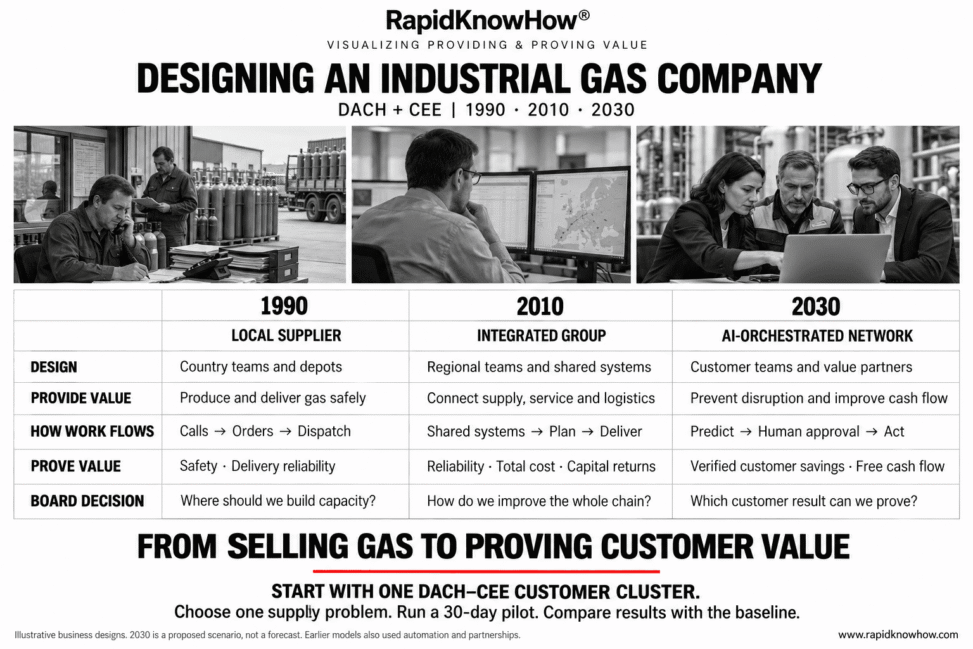
Improve the entire value chain. Increase verified Free Cash Flow.
Industrial gas purchasing decisions influence more than the gas invoice. They affect inventory, asset rentals, deliveries, production speed, finishing, rework and supply reliability.
The objective is to optimize the total cost of the entire industrial gas value chain while maintaining required quality, safety and availability—and convert improvements into verified Free Cash Flow.
The buying organization orchestrates. Technical specialists validate. RapidKnowHow® enables. Evidence proves the value.
1. Manage ONE connected system
The process follows a complete chain:
Specify → Contract → Supply → Store → Distribute → Use → Recover / Return → Reconcile → Improve → Verify FCF
Each decision affects other stages. A lower gas price may increase total cost if it requires larger stocks or creates additional processing work. A higher-priced supply option may improve the economics if its wider benefits exceed its additional costs.
Compare alternatives using the same accepted output, operating conditions and service requirements.
2. Establish the baseline
Start at ONE site with ONE application or supply system.
Document actual consumption, expenditure, operating performance and assets over a representative period.
| Baseline element | What to establish |
|---|---|
| Gas purchases | Quantities, specifications, prices and charges |
| Supply and logistics | Deliveries, emergency orders and handling |
| Storage and assets | Owned assets, rented assets, stocks and reserve requirements |
| Distribution | Losses, leaks and maintenance expenditure |
| Application | Gas, energy, consumables and time per accepted unit |
| Quality | Finishing, rework, scrap and inspection results |
| Cash | Payments, working capital and capital expenditure |
Keep allocated accounting costs separate from expenditure that can actually change. Avoid counting the same expense in more than one category.
3. Determine intervention points across the chain
The red dots in the process identify candidate intervention points. The priority depends on evidence from the site.
| Stage | 🔴 Candidate intervention | Result to verify |
|---|---|---|
| Specify | Match purity, pressure and supply mode to actual requirements | Lower expenditure with acceptable application performance |
| Contract | Evaluate gas, rental, delivery charges and commitments together | Lower comparable contractual cash cost |
| Supply | Match replenishment to consumption and delivery lead times | Fewer avoidable deliveries and emergency purchases |
| Store | Right-size stocks and rented assets against reserve requirements | Lower rental charges or a measurable working-capital release |
| Distribute | Address evidenced losses and unnecessary handling | Reduced purchases or avoidable handling expenditure |
| Use | Test application settings and gas supply together | Lower total cash cost per accepted component |
| Recover / Return | Return unnecessary assets; assess recovery economics | Charges stopped or purchases reduced |
| Reconcile | Match invoices to contracts, deliveries and asset records | Corrected charges and eligible amounts recovered |
| Improve | Standardize proven changes and review performance | Benefits sustained over time |
| Verify FCF | Reconcile operational benefits with actual cash movements | Incremental Free Cash Flow supported by evidence |
4. Select ONE intervention with system-wide value
Choose an opportunity that has:
- A measurable baseline.
- A credible explanation of how the intervention changes performance.
- A practical test and accountable owner.
- An identifiable route to cash.
- Acceptable effects on quality, safety and supply reliability.
The largest visible expense is not automatically the best intervention point. A smaller change to replenishment information or return rules may influence several recurring costs.
ONE Objective → ONE System → 🔴 ONE Intervention Point → ONE Action → ONE Verified Result
5. Demonstrate the application benefit
Consider a welding or thermal-cutting application.
The proposed intervention is a coordinated adjustment of gas supply and machine settings, validated by the responsible technical specialists.
The hypothesis is:
Faster processing + less spatter or dross → less finishing and rework → lower total cost per accepted component.
Test the current process against the proposed process on comparable work. Measure the complete cycle through inspection and acceptance.
A faster cutting or welding operation provides little overall benefit if it increases downstream finishing, rejection or congestion.
The relevant measure is the total process result.
6. Translate operational improvement into cash
Operational benefits and cash benefits require separate verification.
| Operational improvement | When it becomes a cash benefit |
|---|---|
| Less gas consumed | Comparable gas purchase expenditure falls |
| Less finishing time | Paid overtime, outsourcing or other avoidable expenditure falls |
| More production capacity | Additional profitable output is sold, delivered and paid for |
| Fewer rented cylinders | Contractual rental charges actually stop |
| Lower inventory | Cash invested in inventory is released |
| Better billing accuracy | Incorrect payments are prevented or recoveries are received |
Time saved becomes available capacity first. Its cash value depends on what the organization does with that capacity.
Do not count both labour savings and additional production benefits when they rely on the same released hours.
7. Verify incremental Free Cash Flow
Use a defined period and a consistent baseline.
Incremental FCF = incremental operating cash benefit − implementation cash costs − incremental cash taxes − additional net working capital − additional capital expenditure.
A reduction in net working capital contributes cash. Distinguish this one-time release from recurring operating improvements.
Adjust the comparison for material changes in production volume, product mix and input prices. Report clearly whether each benefit is:
Estimated → Trial-demonstrated → Cash-verified
A projected saving is a decision input. A cash-verified result is evidence of value delivered.
8. Sustain and compound the result
After verification, incorporate the successful intervention into operating rules:
- Assign ownership.
- Maintain the information needed for decisions.
- Set appropriate review intervals.
- Monitor quality and reliability alongside cost.
- Recheck invoices and actual expenditure.
Expansion to another application or site requires confirmation that its conditions support the same improvement.
Compounding comes from retaining proven gains and adding further verified improvements over time.
ONE immediate action
At ONE site, establish the baseline for ONE industrial gas application. Select its strongest evidenced intervention, conduct ONE controlled trial and verify the resulting cash effect.
Optimize the whole value chain. Act at ONE intervention point. Prove ONE Free Cash Flow result. -Josef David
RapidKnowHow® — THE DECISION COMPANY™
Industrial Gas Leadership 2030
PROVE VALUE. THEN SCALE.
Watch the 60-second roadmap: 10 strategic actions for DACH and CEE, 2026–2030.
Start with ONE customer challenge. Use the Industrial Gas Action Guide to turn your first action into a measurable result.
RapidKnowHow® — Leading Industrial Gas Opportunity Signal Identifier in DACH & CEE