
Build reserves that strengthen one another. Intervene when losses begin to reinforce one another.
A person can earn more while becoming less healthy, less connected and more dependent. Another can have modest income yet steadily improve their security, freedom and ability to act.
The difference lies partly in how their five wealth stocks interact:
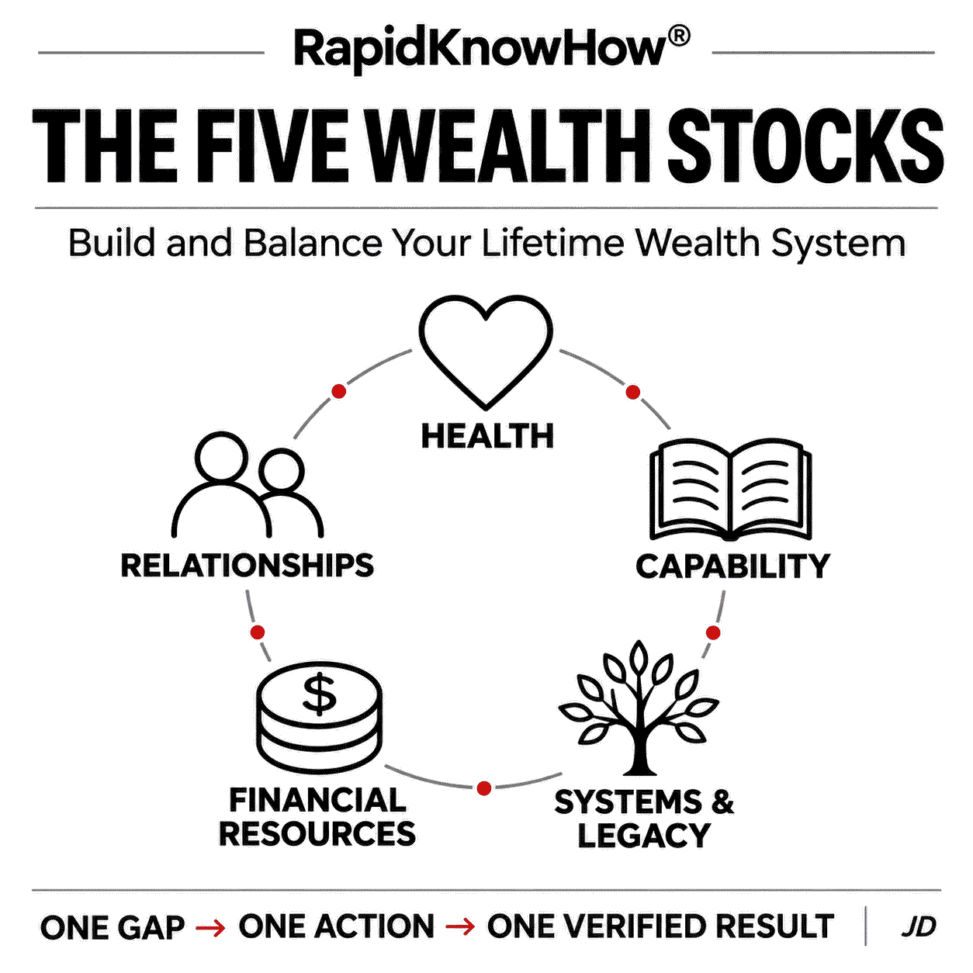
Financial Resources • Relationships • Health • Capability • Systems & Legacy
Each stock is a reserve built over time. Daily actions either replenish it or draw it down. Together, these reserves influence how well we absorb setbacks, pursue opportunities and help others.
Life balance means maintaining sufficient reserves across all five stocks—and preventing progress in one from repeatedly exhausting another.
1. The five stocks—and what changes them
| Wealth stock | What accumulates | What replenishes it | What depletes it |
|---|---|---|---|
| Financial Resources | Accessible reserves and financial capacity | Retained income, controlled commitments, productive use of resources | Spending beyond means, losses, excessive fixed commitments |
| Relationships | Trust, mutual understanding and dependable support | Attention, reciprocity, honest communication, fulfilled promises | Neglect, conflict, broken commitments, repeated one-sided demands |
| Health | Physical and mental capacity to function and recover | Rest, suitable activity, nourishment and appropriate care | Persistent overload, inadequate recovery, harmful habits |
| Capability | Knowledge, practical skills and judgment | Learning, application, feedback and reflection | Disuse, obsolete knowledge, avoidance of feedback |
| Systems & Legacy | Reliable routines, documented know-how and transferable arrangements | Simplification, maintenance, documentation and teaching others | Neglect, unnecessary complexity and dependence on one person |
These stocks differ in how quickly they change. Cash can disappear in days. Trust may take years to rebuild. A useful routine can begin today, but its benefits accumulate through repetition.
The same action can replenish one stock while draining another. Extra work may increase income while reducing recovery and family time. Its total effect depends on duration, intensity and the reserves available.
2. The virtuous cycle: progress creates capacity for further progress
Consider a person who develops one useful skill and applies it to a customer problem.
Applied capability → better customer result → stronger trust → more dependable income → greater financial breathing room → time for recovery and learning → stronger capability.
This is a reinforcing feedback loop: improvement helps produce further improvement.
| Connection | How the benefit can travel |
|---|---|
| Capability → Financial Resources | Useful skills create results that customers or employers value. |
| Relationships → Capability | Trusted people provide feedback, introductions and opportunities to learn. |
| Financial Resources → Health | Financial breathing room can make rest and care easier to arrange. |
| Health → Capability | Greater functional capacity supports concentration, practice and execution. |
| Systems & Legacy → All five stocks | Reliable routines reduce repeated work, missed commitments and avoidable demands. |
None of these connections is automatic. Higher income strengthens reserves only when some is retained. More free time helps recovery only when it is used accordingly. Knowledge becomes capability through application.
The leverage point is often the action that converts an available resource into a useful result.
Illustrative case: the independent professional
A consultant repeatedly prepares proposals from scratch. Work spills into evenings, follow-ups are missed and income is irregular.
The consultant creates one reusable proposal structure and a fixed weekly follow-up routine.
The immediate result is less repeated work. Over time, reliable follow-through may improve customer trust and commercial outcomes. Time saved can support recovery, relationships or further skill development.
ONE action: Standardize one recurring task.
ONE verified result: Measure the time saved and missed follow-ups before and after the change. Confirm any additional paid business separately.
The routine starts the improvement. Deliberately reinvesting its benefits sustains the cycle.
3. The vicious cycle: depletion creates further depletion
The same connections can transmit deterioration.
Financial pressure → excessive commitments → inadequate recovery → more errors and missed promises → damaged trust → fewer opportunities → greater financial pressure.
This is also a reinforcing feedback loop. Here, deterioration feeds further deterioration.
| Starting pressure | Response that can amplify it | Wider consequence |
|---|---|---|
| Low financial reserves | Accept every assignment, regardless of capacity | Overload and unreliable delivery |
| Relationship conflict | Avoid difficult conversations | Growing uncertainty and weaker trust |
| Low energy | Postpone recovery and continue at the same pace | Reduced capacity for ordinary demands |
| Capability gap | Avoid feedback or unfamiliar work | Fewer learning opportunities |
| Unreliable routines | Rely on memory and personal effort | More omissions and dependence on one person |
The visible symptom may occur in a different stock from the underlying cause.
Low income might reflect an outdated skill, weak customer relationships or an unreliable delivery process. Relationship strain might reflect excessive commitments rather than a lack of goodwill.
Adding effort without finding the connection can intensify the problem.
4. The balancing cycle: detect a gap and correct it
Virtuous and vicious cycles reinforce change. A balancing loop responds to a gap between the current position and an acceptable level.
For example:
Reserve falls below a chosen minimum → review commitments → reduce avoidable outflows → reserve begins to recover → reduce the corrective effort when sufficient capacity returns.
The same principle applies across the five stocks.
| Stock under pressure | Early signal | Possible corrective action |
|---|---|---|
| Financial Resources | Accessible reserves repeatedly decline | Review recurring commitments and set a realistic recovery plan. |
| Relationships | Important conversations are repeatedly postponed | Restore one dependable conversation or shared routine. |
| Health | Ordinary demands increasingly exceed recovery capacity | Adjust demands and seek appropriate assessment where needed. |
| Capability | The same performance gap keeps recurring | Practise one relevant skill with feedback. |
| Systems & Legacy | Tasks fail whenever one person is unavailable | Document and transfer one essential process. |
Balance is an active process of correction. It does not mean giving every stock equal time or equal attention.
A temporary priority can be sensible. It becomes damaging when temporary depletion becomes the permanent operating model.
5. Why good intentions fail: delays, limits and dependency
Three system effects deserve particular attention.
Delayed feedback. Overwork may produce income immediately while its costs emerge later. Learning takes time before it improves results. An action can therefore look successful—or unsuccessful—too early.
Limits to growth. A growing business may eventually exceed the owner’s time and energy. Further growth then requires better processes, delegation or a different scope of work.
Dependency. External support can prevent immediate harm. But if it repeatedly replaces the development of capability, income or reliable routines, the underlying weakness may persist.
The practical response is to connect relief with rebuilding:
Stabilize the immediate situation → restore capacity → take one productive action → verify progress → adjust support as circumstances allow.
6. Find the leverage point across the five stocks
The most depleted stock needs attention, but it does not always contain the strongest intervention point.
Ask:
- Which reserve is declining?
- What recurring inflow or outflow explains the decline?
- Which feedback loop keeps reproducing it?
- What action could interrupt that loop without exhausting another stock?
- What evidence would show that the action worked?
A simple weekly review makes the connections visible.
| Stock | One practical indicator | Direction |
|---|---|---|
| Financial Resources | Accessible reserve relative to essential monthly spending | Improving / Stable / Declining |
| Relationships | Important commitments kept and unresolved concerns addressed | Improving / Stable / Declining |
| Health | Capacity for daily activities and recovery, supported by relevant clinical measures | Improving / Stable / Declining |
| Capability | A useful task performed better or more independently | Improving / Stable / Declining |
| Systems & Legacy | Essential tasks completed reliably without repeated personal intervention | Improving / Stable / Declining |
These indicators serve different purposes. They should not be combined into a single score that allows strength in one stock to conceal serious depletion in another.
7. ONE action to restore a constructive cycle
ONE JOB → ONE STRATEGY → ONE ACTION → ONE VERIFIED RESULT
Apply the RapidKnowHow® principle as follows:
- ONE JOB: Name the recurring pressure—for example, “My work commitments repeatedly consume my recovery and family time.”
- ONE STRATEGY: Change the mechanism creating the pressure.
- ONE ACTION: Remove, simplify or transfer one recurring commitment.
- ONE VERIFIED RESULT: Confirm the capacity recovered and check its effect on delivery, income and relationships.
Review the immediate result first. Then monitor whether the wider benefits emerge over the following weeks.
Time saved is a verified result. Better health, stronger relationships or increased income require their own evidence.
Conclusion: protect the reserves that make future progress possible
A virtuous cycle develops when gains in one wealth stock help replenish others. A vicious cycle develops when depletion spreads and reproduces itself.
The aim is to create a system in which useful work generates resources, relationships provide mutual support, health supports participation, capability improves results, and reliable systems preserve what has been built.
SEE THE CYCLE → FIND THE LEVERAGE POINT → TAKE ONE ACTION → VERIFY THE RESULT → REINVEST THE GAIN.
RapidKnowHow® — Build wealth that sustains your life. – Josef David