
RapidKnowHow® — THE DECISION COMPANY™
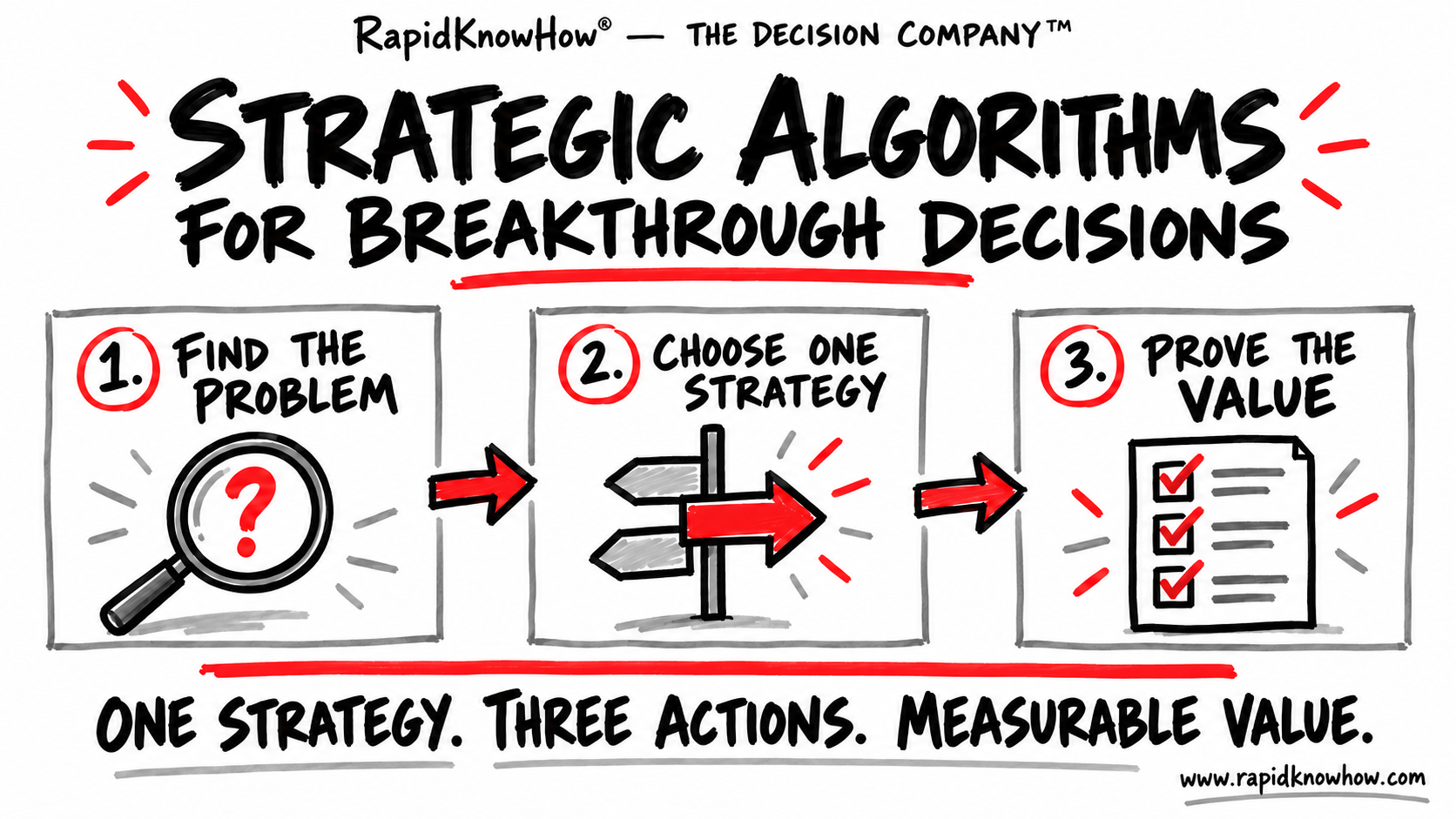
TURN YOUR CRITICAL BUSINESS PROBLEM INTO ONE CLEAR STRATEGY, THREE ACTIONS AND A MEASURABLE RESULT.
You face a decision that matters: release trapped cash, win a customer, protect a critical flow or grow a proven business. Your opportunity is to identify the obstacle, compare the credible options and commit resources to a result you can verify.
01 · The reader opportunity
Start with one critical problem and a named decision owner. Define what must improve, why it matters now and the evidence you already have. A breakthrough strategy earns its value through a material improvement in the business: cash, contribution margin, customer performance, supply continuity or repeatability.
RapidKnowHow® helps owners, boards and business leaders develop breakthrough strategies by combining industrial experience, proprietary decision systems and AI-assisted analysis. Start with one critical problem, select the strongest opportunity and prove the value through accountable action.
02 · What a strategic algorithm means
A strategic algorithm is a repeatable sequence of questions, comparisons, decisions and verification. It can be delivered through a worksheet, an Action Guide or an interactive decision system. It does not have to be software.
SIGNAL → INTERPRET → DECIDE → ACT → VERIFY → COMPOUND
- SIGNAL: Identify an observable change and its source.
- INTERPRET: Translate it into a specific customer or operating problem. Separate facts from assumptions.
- DECIDE: Compare credible alternatives, including improving the current arrangement. Choose one strategy, owner and success measure.
- ACT: Assign the Top 3 actions, each with an owner and deadline.
- VERIFY: Compare the result with the baseline, account for costs and obtain reviewer confirmation.
- COMPOUND: Preserve and repeat the method when the evidence supports it.
The visitor journey makes that logic simple: CHOOSE CHOKEPOINT → ONE DECISION → TOP 3 ACTIONS → RESULT. Supporting facts and calculations remain available when needed.
03 · First application: industrial gas, cryogenic containers and on-site supply
Illustrative decision case — no customer outcome is claimed. A DACH or CEE manufacturer needs more dependable gas supply at an acceptable total cost. Compare improving existing supply, changing the cryogenic storage and delivery arrangement, and assessing an on-site production option.
Measure total cost per usable gas unit using comparable volume, purity, pressure, availability and contract periods. Include energy, transport, rental, losses, maintenance, backup, investment and transition costs where applicable. The cheapest unit price alone does not establish the best strategy.
ONE DECISION: Select the option with the strongest evidenced value that meets the site’s technical, safety, service and investment requirements.
- Establish the baseline: Finance and operations collect invoices, usage, delivery, loss and interruption records. Agree the measure and comparison period.
- Compare feasible options: Procurement and engineering obtain comparable supplier proposals, define backup requirements and validate the investment case.
- Prove the next practical change: The accountable site owner runs a bounded pilot or completes the investment decision gates, with weekly evidence review.
A 90-day proof can test operational improvements or readiness. A new on-site installation may require a longer commissioning period. Set proof timing to the actual work.
04 · RapidKnowHow’s concrete offer
Choose the guide that matches your current job. You can enter at the relevant stage.
- Find the Cash Gap™ — €299: establish the cash baseline, rank the gaps and select three actions.
- Make the Board Decision™ — €1,500: compare the options and document the decision, owner and proof mandate.
- Start the 90-Day Cash Proof™ — €3,500: use the charter, 12-week action rhythm and evidence records to assess the value case.
These are self-guided PDF Action Guides. Consulting, facilitation, implementation and independent verification are not included. Your leadership team adapts the guide to the case and owns execution and review. Product pages provide the current price and purchase terms.
05 · How to measure the value
Record the baseline, actual change, implementation cost, measurement period and evidence source. Keep recurring cost savings, one-time working-capital release and estimated risk reduction separate. Do not add overlapping benefits. For the combined customer–supplier case, do not count a price transfer as newly created value.
Verified result: The named reviewer confirms the evidence and the agreed measure. Until then, label the result as a target, estimate or unverified observation.
For RapidKnowHow®, track qualified cases, guide purchases, customers who complete the decision record and documented outcomes shared with permission. Publish verified cases before claiming market leadership. A useful algorithm must help the reader make and execute a better decision; downloads and page views alone do not establish that value.
06 · One decision. Top 3 actions. Your next result.
ONE DECISION: Apply the method to the critical business problem you can meaningfully influence now.
- Choose your chokepoint and write the baseline.
- Compare the options and assign three actions with owners and deadlines.
- Review the evidence and decide whether to stop, improve or repeat.
RapidKnowHow® contributes industrial judgment made repeatable. ChatGPT supports research, analysis and content creation; leaders check the evidence and retain responsibility for decisions. The method is designed to improve decision quality and execution. Outcomes depend on the facts, choices and implementation.
Explore RapidKnowHow® Action Guides →
ONE STRATEGY. THREE ACTIONS. MEASURABLE VALUE.
RapidKnowHow® — THE DECISION COMPANY™
Industrial Gas Leadership 2030
PROVE VALUE. THEN SCALE.
Watch the 60-second roadmap: 10 strategic actions for DACH and CEE, 2026–2030.
Start with ONE customer challenge. Use the Industrial Gas Action Guide to turn your first action into a measurable result.
RapidKnowHow® — Leading Industrial Gas Opportunity Signal Identifier in DACH & CEE