THE GAS DOES NOT ACT ALONE. PRESSURE CHANGES EVERYTHING.
Imagine a diver standing on a boat.
He takes a breath.
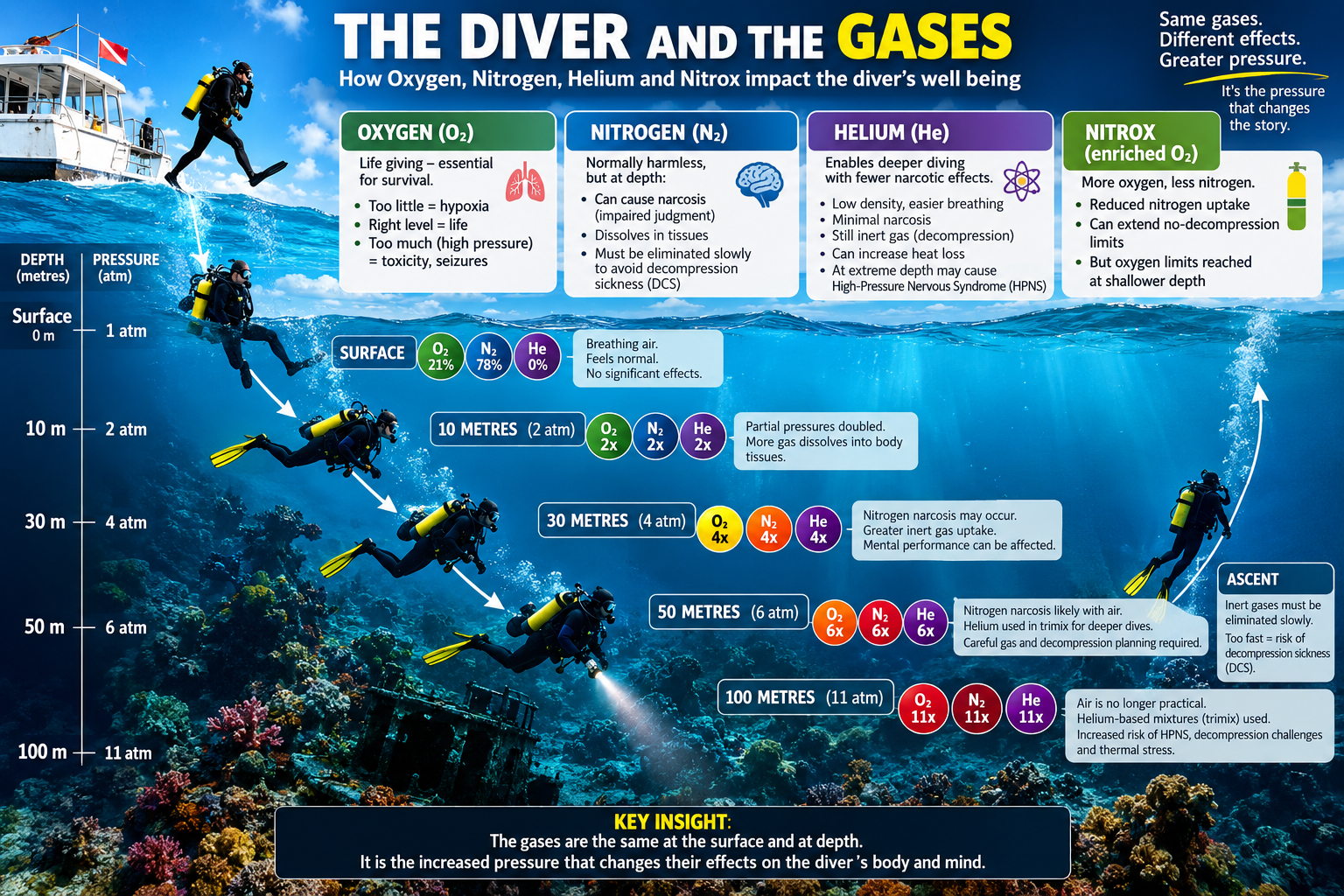
At the surface, ordinary air contains approximately 21% oxygen and 78% nitrogen. Oxygen sustains life. Nitrogen appears almost irrelevant.
Then the diver enters the water.
With every metre of descent, pressure increases.
The percentage of each gas may remain unchanged — but its partial pressure increases.
That changes how gases interact with the diver’s body and brain.
01 — DESCENT: PRESSURE CHANGES THE SYSTEM
At the surface:
0 m → approximately 1 atmosphere
At 10 metres:
10 m → approximately 2 atmospheres
At 30 metres:
30 m → approximately 4 atmospheres
The deeper the diver goes, the greater the pressure.
DEPTH → PRESSURE → GAS PARTIAL PRESSURE → HUMAN EFFECT
This is the key to understanding diving gases.
02 — OXYGEN: LIFE WITH A LIMIT
Oxygen keeps the diver alive.
Too little oxygen causes hypoxia.
But increasing oxygen partial pressure also creates a limit. At sufficiently high partial pressure, oxygen can become toxic to the central nervous system and may cause severe neurological effects, including seizures.
TOO LITTLE OXYGEN → HYPOXIA
RIGHT RANGE → LIFE
TOO MUCH OXYGEN UNDER PRESSURE → TOXICITY
The important question is not simply: “How much oxygen?”
It is:
HOW MUCH OXYGEN × WHAT PRESSURE × HOW LONG?
03 — NITROGEN: THE SILENT PASSENGER
At the surface, nitrogen seems harmless.
But as the diver descends, nitrogen partial pressure increases. More nitrogen dissolves into body tissues.
At greater depth, nitrogen can affect the nervous system and produce nitrogen narcosis.
Possible consequences include impaired judgment, slower reactions, overconfidence, confusion, anxiety and reduced mental performance.
Then comes another challenge. During ascent, the nitrogen absorbed by the body must be released progressively.
If decompression is inappropriate, bubbles can form in tissues and circulation. This can contribute to decompression sickness.
DESCENT → ABSORPTION
DEPTH → NARCOSIS
ASCENT → ELIMINATION
INADEQUATE DECOMPRESSION → BUBBLE RISK
04 — NITROX: LESS NITROGEN, MORE OXYGEN
Nitrox is oxygen-enriched air.
Increasing the oxygen percentage reduces the percentage of nitrogen. That can reduce nitrogen exposure for a given dive profile.
But the benefit produces another constraint: more oxygen means the oxygen partial-pressure limit is reached at a shallower depth.
Nitrox therefore does not simply mean “dive deeper.”
LESS NITROGEN EXPOSURE → BUT A STRICTER OXYGEN DEPTH LIMIT
Every gas mixture creates its own operating envelope.
05 — HELIUM: THE DEEP-DIVING ENABLER
At greater depths, nitrogen narcosis and breathing-gas density become increasingly important.
Helium offers another solution. It is much less narcotic than nitrogen and considerably less dense.
It can therefore be used in breathing mixtures such as Trimix for deeper technical diving.
HELIUM → REDUCED NARCOTIC EFFECT → LOWER GAS DENSITY → DEEPER OPERATING RANGE
But helium also introduces new challenges, including decompression complexity, increased heat loss, thermal management and very-deep-diving neurological effects such as High-Pressure Nervous Syndrome.
Again, there is no perfect gas. There is only the appropriate gas mixture for the operating conditions.
06 — THE HIDDEN GAS: CARBON DIOXIDE
The diver continuously produces carbon dioxide through metabolism.
CO₂ must be efficiently removed through breathing. Heavy work, increased breathing resistance or inadequate ventilation can cause carbon dioxide to accumulate.
That can rapidly impair the diver’s physical and mental performance.
GET OXYGEN IN → GET CO₂ OUT
07 — ASCENT: THE SYSTEM MUST UNWIND
Eventually the diver turns toward the surface. Pressure begins to fall.
The gases dissolved in body tissues must now leave the body progressively. This makes the ascent a critical part of the dive.
DESCEND → PRESSURE RISES → PARTIAL PRESSURES RISE → INERT GASES ENTER TISSUES → PHYSIOLOGICAL EFFECTS INCREASE → ASCEND → PRESSURE FALLS → INERT GASES LEAVE TISSUES → RETURN TO SURFACE
THE DIVER’S GAS SYSTEM
OXYGEN — O₂
Life
Insufficient → hypoxia
Appropriate range → supports life
Excessive partial pressure → toxicity risk
NITROGEN — N₂
Inert gas
Increasing depth → narcosis
Absorbed into tissues
Decompression requirement during ascent
NITROX
More oxygen + less nitrogen
Reduced nitrogen exposure
Potentially longer no-decompression limits
Shallower oxygen operating limit
HELIUM — He
Low-density, low-narcosis inert gas
Supports deeper diving
Reduces nitrogen narcosis
Introduces decompression, thermal and extreme-depth considerations
CARBON DIOXIDE — CO₂
Produced by the diver
Must continuously be removed
Accumulation can rapidly reduce performance and safety
THE AHA MOMENT
The diver is not simply carrying cylinders.
The diver is operating inside a dynamic physiological system:
DEPTH → PRESSURE → PARTIAL PRESSURE → GAS ABSORPTION → BODY + BRAIN RESPONSE → TIME → ASCENT → RECOVERY
THE GAS IS NOT SIMPLY GOOD OR BAD.
THE RIGHT GAS, AT THE RIGHT PARTIAL PRESSURE, AT THE RIGHT DEPTH, FOR THE RIGHT TIME, DEFINES THE OPERATING ENVELOPE.
The deeper the human goes, the smaller the margin for unmanaged complexity.
CONTROL THE GASES → CONTROL THE DIVE → PROTECT THE DIVER.
RapidKnowHow® — THE DECISION COMPANY™
NEXT → THE HUMAN AND THE GASES™ POWERBOOK
Turn the 10-episode series into one practical 21-page PowerBook + Action Guide with the Human + Gases MASTER, decision worksheet, 10-day plan and action checklist.
POWERLICENSE — Apply THE HUMAN AND THE GASES™ beyond one reader
For organisational, training, consulting or partner use, explore the RapidKnowHow® licensing route. Scope, rights and fees are agreed separately.
Educational overview only. Diving gas selection, decompression and exposure limits require appropriate professional training, equipment and dive planning.
RapidKnowHow® — THE DECISION COMPANY™
Industrial Gas Leadership 2030
PROVE VALUE. THEN SCALE.
Watch the 60-second roadmap: 10 strategic actions for DACH and CEE, 2026–2030.
Start with ONE customer challenge. Use the Industrial Gas Action Guide to turn your first action into a measurable result.
RapidKnowHow® — Leading Industrial Gas Opportunity Signal Identifier in DACH & CEE