
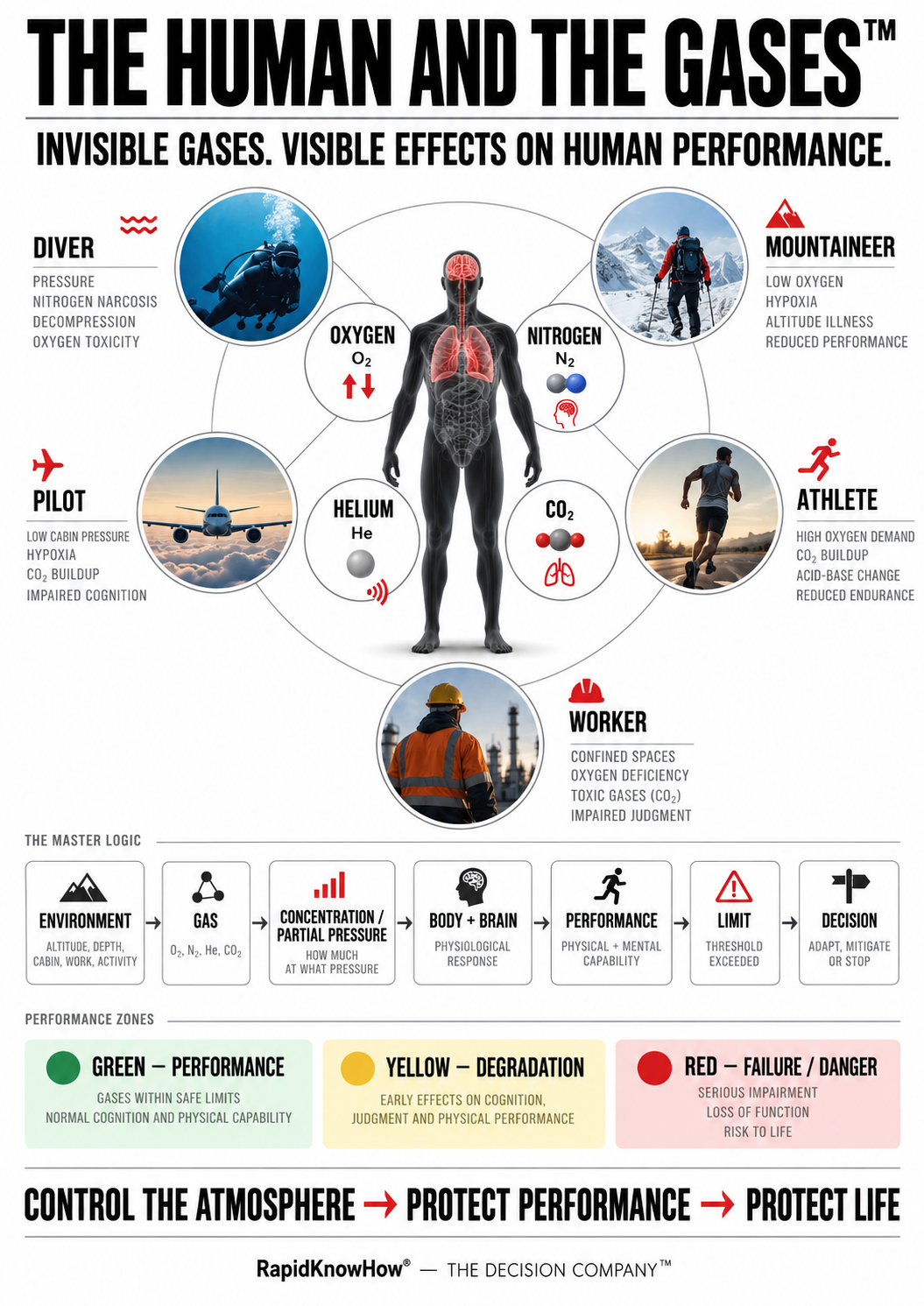
THE AIR STILL CONTAINS OXYGEN. BUT THE HUMAN CAN NO LONGER USE IT AS EASILY.
A mountaineer begins at sea level. The air contains about 21% oxygen. He feels strong, alert and coordinated.
Then he climbs.
The oxygen percentage remains almost the same, but atmospheric pressure falls. That means the partial pressure of oxygen falls, so less oxygen is driven from the lungs into the blood.
ALTITUDE → LOWER PRESSURE → LOWER OXYGEN PARTIAL PRESSURE → LOWER BLOOD OXYGEN → LOWER HUMAN PERFORMANCE
01 — THE INVISIBLE CHANGE
Nothing about the mountain air necessarily looks dangerous. Yet the operating environment has changed.
At around 3,050 metres / 10,000 feet, inspired oxygen partial pressure is only about 69% of the sea-level value. Acute exposure can reduce arterial oxygen saturation significantly.
The body responds immediately: breathing increases, heart rate may rise, and the circulatory system works harder to deliver oxygen.
02 — THE BRAIN IS THE CRITICAL USER
The human brain is highly dependent on oxygen.
As hypoxia develops, performance can deteriorate through:
- slower reactions
- poorer judgment
- reduced concentration
- impaired coordination
- headache and fatigue
- euphoria or an unjustified sense that everything is fine
This creates a dangerous paradox:
THE PERSON WHOSE JUDGMENT IS DETERIORATING MAY ALSO BE THE PERSON DECIDING WHETHER TO CONTINUE.
03 — ALTITUDE IS NOT THE ONLY VARIABLE
Human performance at altitude depends on more than height alone.
ALTITUDE × RATE OF ASCENT × TIME × PHYSICAL WORK × TEMPERATURE × FATIGUE × INDIVIDUAL RESPONSE
Two people at the same altitude can therefore perform very differently.
04 — ACCLIMATIZATION: THE BODY ADAPTS
The body can partially adapt to moderate hypoxia, but adaptation takes time.
During the first several days at altitude, ventilation increases and other physiological adjustments develop. Some adaptation continues over weeks and months.
This creates a second operating principle:
THE HUMAN SYSTEM CAN ADAPT — BUT NOT INSTANTLY.
05 — WHEN PERFORMANCE BECOMES A DECISION PROBLEM
The critical issue is not simply whether the mountaineer can continue moving.
The real question is whether he can still:
- recognize risk
- calculate correctly
- coordinate movement
- communicate clearly
- make disciplined decisions
As oxygen availability falls, the margin between performance and failure narrows.
THE HUMAN OPERATING ENVELOPE
GREEN — PERFORMANCE
Adequate oxygen delivery. Normal judgment, coordination and endurance.
YELLOW — DEGRADATION
Fatigue, headache, slower reactions, poorer judgment, reduced coordination.
RED — FAILURE / DANGER
Severe hypoxia, marked impairment, collapse, loss of consciousness or life-threatening altitude illness.
THE AHA MOMENT
The mountaineer is not merely climbing a mountain.
He is progressively changing the pressure surrounding his body.
THE OXYGEN PERCENTAGE STAYS ALMOST THE SAME.
THE OXYGEN PRESSURE DOES NOT.
And therefore:
ALTITUDE CHANGES OXYGEN DELIVERY → OXYGEN DELIVERY CHANGES HUMAN PERFORMANCE → HUMAN PERFORMANCE CHANGES DECISION QUALITY.
THE RAPIDKNOWHOW® HUMAN + GAS RULE
CONTROL THE ENVIRONMENT → PROTECT OXYGEN DELIVERY → PROTECT PERFORMANCE → PROTECT LIFE.
RapidKnowHow® — THE DECISION COMPANY™
NEXT → THE HUMAN AND THE GASES™ POWERBOOK
Turn the 10-episode series into one practical 21-page PowerBook + Action Guide with the Human + Gases MASTER, decision worksheet, 10-day plan and action checklist.
POWERLICENSE — Apply THE HUMAN AND THE GASES™ beyond one reader
For organisational, training, consulting or partner use, explore the RapidKnowHow® licensing route. Scope, rights and fees are agreed separately.
Educational overview only. High-altitude travel and climbing can involve serious medical risk. Appropriate preparation, acclimatization and professional guidance are essential.
Sources
CDC Yellow Book — High-Altitude Travel and Altitude Illness.
Federal Aviation Administration — Hypoxia and Human Performance at Altitude.
RapidKnowHow® — THE DECISION COMPANY™
Industrial Gas Leadership 2030
PROVE VALUE. THEN SCALE.
Watch the 60-second roadmap: 10 strategic actions for DACH and CEE, 2026–2030.
Start with ONE customer challenge. Use the Industrial Gas Action Guide to turn your first action into a measurable result.
RapidKnowHow® — Leading Industrial Gas Opportunity Signal Identifier in DACH & CEE