
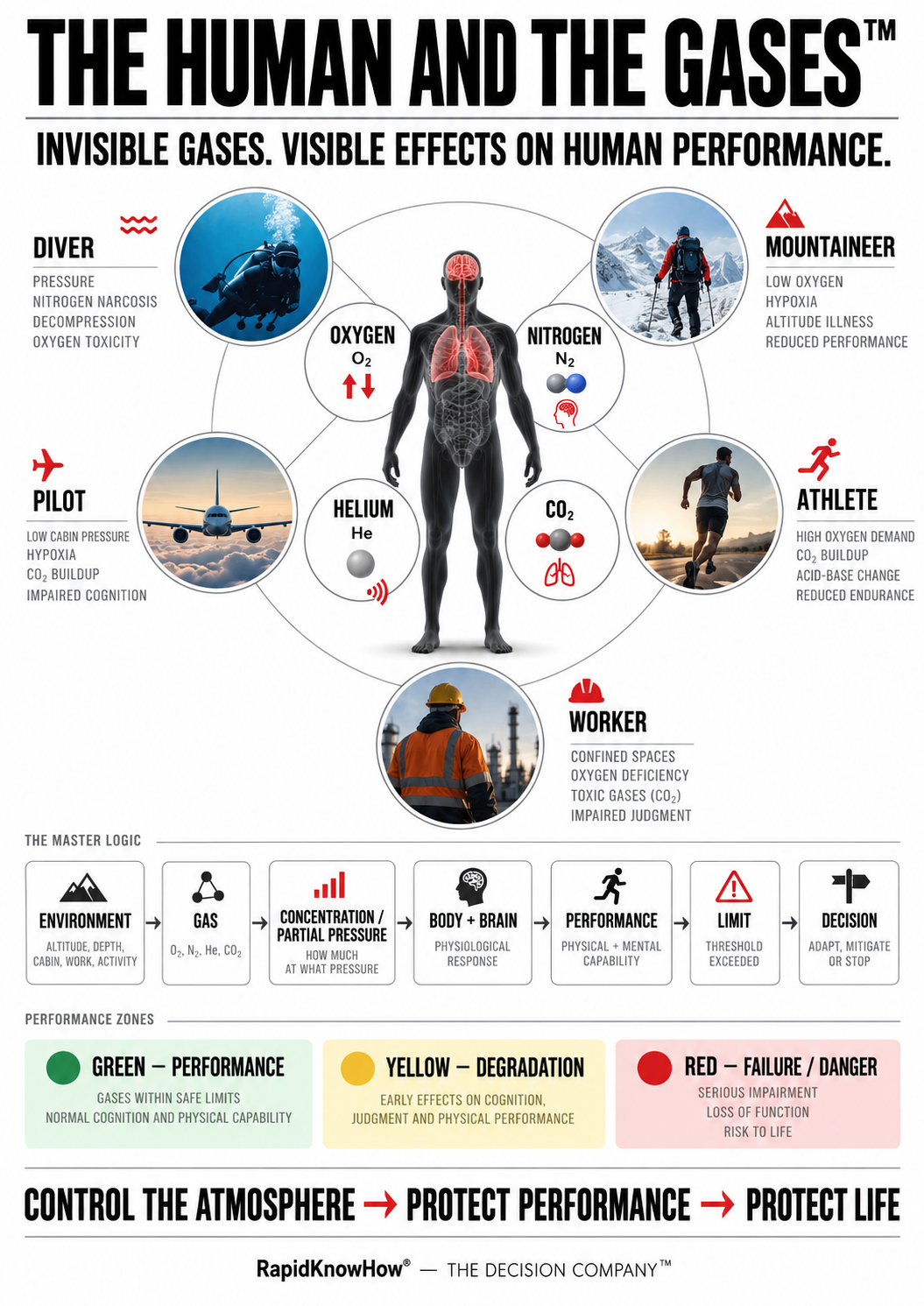
INVISIBLE GASES. VISIBLE EFFECTS ON HUMAN PERFORMANCE.
Humans live, work, travel, compete and survive inside gas environments.
Most of the time we barely notice them.
Yet oxygen, nitrogen, helium, carbon dioxide and other gases can fundamentally change how the human body and brain perform when pressure, concentration, temperature, workload or exposure changes.
THE HUMAN AND THE GASES™ is a RapidKnowHow® PowerPost series that makes these invisible relationships visible.
THE MASTER LOGIC
ENVIRONMENT → GAS → CONCENTRATION / PARTIAL PRESSURE → BODY + BRAIN → PERFORMANCE → LIMIT → DECISION
The purpose is simple:
UNDERSTAND THE ATMOSPHERE → RECOGNIZE THE HUMAN EFFECT → PROTECT PERFORMANCE → PROTECT LIFE.
THE THREE PERFORMANCE ZONES
GREEN — PERFORMANCE
The gas environment supports normal human function, judgment, coordination and endurance.
YELLOW — DEGRADATION
Human performance begins to fall: judgment, reaction time, coordination, stamina or cognition deteriorate.
RED — FAILURE / DANGER
The gas environment can produce incapacitation, toxicity, loss of consciousness or life-threatening failure.
THE SERIES
01 — THE DIVER AND THE GASES
Depth changes pressure. Pressure changes gas effects.
Oxygen, nitrogen, helium and nitrox show how the same gases can behave very differently as pressure increases.
READ EPISODE 1 → THE DIVER AND THE GASES
02 — THE MOUNTAINEER AND OXYGEN
The oxygen percentage stays almost the same. The oxygen pressure does not.
Altitude shows how falling atmospheric pressure can reduce oxygen delivery and degrade human performance and decision quality.
READ EPISODE 2 → THE MOUNTAINEER AND OXYGEN
03 — THE PILOT AND THE ATMOSPHERE
Human judgment can deteriorate before the pilot realizes it.
Cabin altitude, oxygen deficiency, decompression and cognition.
READ EPISODE 3 → THE PILOT AND THE ATMOSPHERE
04 — THE ATHLETE AND OXYGEN + CO₂
Performance requires both oxygen delivery and carbon-dioxide removal.
Exercise, ventilation, workload, fatigue and recovery.
READ EPISODE 4 → THE ATHLETE AND OXYGEN + CO₂
05 — THE PATIENT AND MEDICAL GASES
Controlled gases become therapeutic tools.
Oxygen, medical air, nitrous oxide and clinical gas delivery.
READ EPISODE 5 → THE PATIENT AND MEDICAL GASES
06 — THE WORKER AND NITROGEN
An inert gas can create a dangerous atmosphere without smell or warning.
Confined spaces, inerting, oxygen displacement and industrial safety.
READ EPISODE 6 → THE WORKER AND NITROGEN
07 — THE WELDER AND SHIELDING GASES
The gas that protects the process can threaten the person if the environment is uncontrolled.
Argon, carbon dioxide, helium, ventilation and exposure.
READ EPISODE 7 → THE WELDER AND SHIELDING GASES
08 — THE FIREFIGHTER AND TOXIC GASES
The atmosphere can become more dangerous than the flames.
Carbon monoxide, carbon dioxide, hydrogen cyanide and smoke exposure.
READ EPISODE 8 → THE FIREFIGHTER AND TOXIC GASES
09 — THE SUBMARINE / SPACE CREW AND THE CLOSED ATMOSPHERE
When humans cannot leave, atmosphere control becomes a life-support system.
Oxygen supply, CO₂ removal, pressure, contamination and closed-environment control.
READ EPISODE 9 → THE SUBMARINE / SPACE CREW
10 — THE HUMAN OPERATING ENVELOPE
One system. Many environments. One governing principle.
Bring the complete series together into a Human + Gases performance model.
READ EPISODE 10 → THE HUMAN OPERATING ENVELOPE
THE AHA MOMENT
Industrial and medical gases are not merely products in cylinders, pipelines and tanks.
They are part of the human operating environment.
The decisive question is always:
WHAT GAS → AT WHAT CONCENTRATION OR PARTIAL PRESSURE → FOR HOW LONG → UNDER WHAT WORKLOAD → WITH WHAT HUMAN EFFECT?
THE RAPIDKNOWHOW® HUMAN + GAS RULE
CONTROL THE ATMOSPHERE → PROTECT PERFORMANCE → PROTECT LIFE.
RapidKnowHow® — THE DECISION COMPANY™
FROM SERIES → POWERBOOK → POWERLICENSE
Step 1 — Read: Explore the 10 free PowerPost Episodes.
Step 2 — Apply: Use the 21-page PowerBook + Action Guide to turn the series into one decision system.
Step 3 — Scale: Apply the system across teams, training, consulting or partner organisations.
Educational series only. Gas exposure, occupational safety, medical use, diving, altitude and closed-environment operations require appropriate professional standards, training and expert guidance.
RapidKnowHow® — THE DECISION COMPANY™
Industrial Gas Leadership 2030
PROVE VALUE. THEN SCALE.
Watch the 60-second roadmap: 10 strategic actions for DACH and CEE, 2026–2030.
Start with ONE customer challenge. Use the Industrial Gas Action Guide to turn your first action into a measurable result.
RapidKnowHow® — Leading Industrial Gas Opportunity Signal Identifier in DACH & CEE