
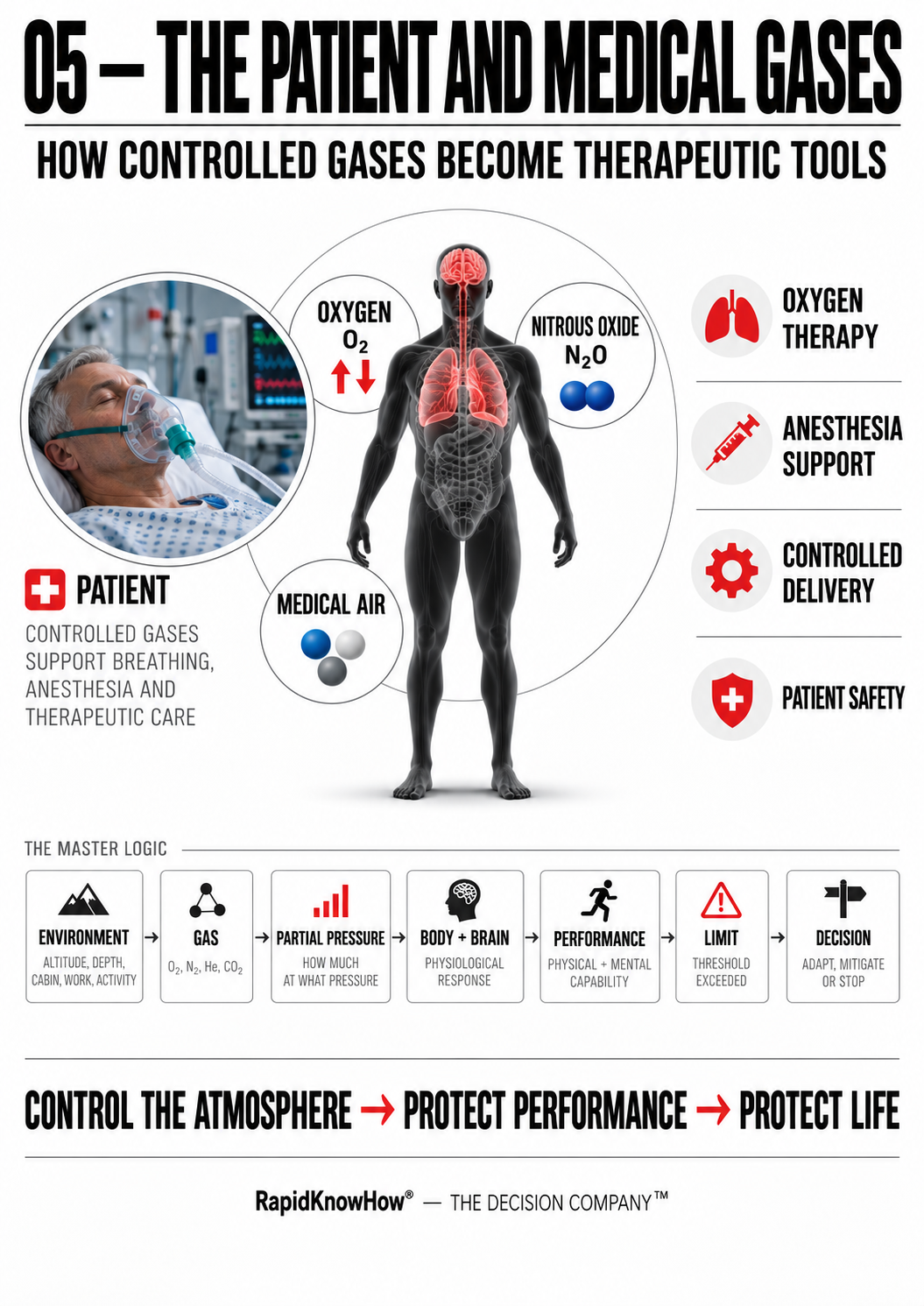
IN MEDICINE, A GAS BECOMES A THERAPEUTIC TOOL ONLY WHEN PURITY, DOSE, DELIVERY AND MONITORING ARE CONTROLLED.
A patient enters a hospital.
The surrounding air looks ordinary, yet the clinical environment may contain a carefully controlled gas system: oxygen, medical air, nitrous oxide and other medical gases delivered through cylinders, pipelines, flowmeters, ventilators and anesthesia equipment.
MEDICAL NEED → GAS SELECTION → PURITY + DOSE → DELIVERY → BODY RESPONSE → MONITORING → CLINICAL DECISION
01 — OXYGEN: LIFE-SUPPORTING, BUT STILL A DOSE
Oxygen is essential to life and one of the most familiar medical gases.
When a patient cannot maintain adequate oxygenation, supplemental oxygen can increase the oxygen available to the lungs and blood.
But medical oxygen is not simply “more is better.” It is administered according to the patient’s clinical need and monitored because inappropriate oxygen exposure can also cause harm in some circumstances.
THE CLINICAL QUESTION IS NOT “DO WE HAVE OXYGEN?”
IT IS “WHAT OXYGEN EXPOSURE DOES THIS PATIENT NEED, AND HOW DO WE VERIFY THE RESPONSE?”
02 — MEDICAL AIR: THE CONTROLLED BREATHING BASE
Medical air provides a controlled breathing-gas source for respiratory and clinical equipment.
It can be used alone or as part of mixtures and delivery systems where clinicians need a defined oxygen concentration rather than pure oxygen.
That makes medical air part of the wider therapeutic gas-control system:
KNOWN COMPOSITION → CONTROLLED DELIVERY → PREDICTABLE CLINICAL USE
03 — NITROUS OXIDE: GAS AS ANALGESIA / ANESTHESIA SUPPORT
Nitrous oxide — N₂O — is a medical gas used in controlled clinical settings for analgesic and anesthetic purposes.
Its value depends on the complete system around it:
- correct gas identity and purity
- controlled concentration and flow
- appropriate delivery equipment
- ventilation and scavenging where required
- patient monitoring
- trained clinical supervision
The lesson is fundamental:
THE GAS IS ONLY ONE COMPONENT OF THE THERAPY.
04 — THE GAS SUPPLY CHAIN IS PART OF PATIENT SAFETY
A medical gas begins far before the patient interface.
It must be manufactured, packaged, labeled, stored and distributed correctly.
The U.S. FDA treats several gases — including oxygen, nitrogen, nitrous oxide, carbon dioxide, helium and medical air — as designated medical gases and applies requirements tailored to their manufacture, packaging, labeling, storage and distribution.
This turns the medical-gas system into a chain:
PRODUCTION → QUALITY → IDENTIFICATION → STORAGE → DISTRIBUTION → DELIVERY DEVICE → PATIENT → MONITORING
Failure at any link can become a patient-safety problem.
05 — OXYGEN ALSO CHANGES THE FIRE ENVIRONMENT
Oxygen itself does not burn, but oxygen-enriched environments can intensify combustion.
That is why oxygen systems require disciplined controls around ignition sources, equipment compatibility and handling.
The FDA’s medical-gas labeling rules include specific no-smoking and no-vaping warnings on oxygen containers to reduce fire risk.
THE HUMAN OPERATING ENVELOPE
GREEN — CONTROLLED THERAPY
Correct gas, correct purity, correct delivery, appropriate monitoring and clinical response.
YELLOW — DEGRADATION / CONTROL LOSS
Uncertain concentration, delivery problems, poor monitoring, equipment malfunction or an evolving patient condition.
RED — FAILURE / DANGER
Wrong gas, wrong dose, failed delivery, serious hypoxia, excessive exposure, fire risk or other life-threatening failure.
THE AHA MOMENT
The patient does not simply “receive a gas.”
The patient receives a controlled therapeutic atmosphere.
GAS QUALITY + GAS SELECTION + GAS DOSE + DELIVERY + MONITORING = CLINICAL PERFORMANCE.
Therefore:
CONTROL THE GAS → CONTROL THE DELIVERY → VERIFY THE RESPONSE → PROTECT THE PATIENT.
THE RAPIDKNOWHOW® HUMAN + GAS RULE
CONTROL THE ATMOSPHERE → PROTECT PERFORMANCE → PROTECT LIFE.
RapidKnowHow® — THE DECISION COMPANY™
NEXT → THE HUMAN AND THE GASES™ POWERBOOK
Turn the 10-episode series into one practical 21-page PowerBook + Action Guide with the Human + Gases MASTER, decision worksheet, 10-day plan and action checklist.
POWERLICENSE — Apply THE HUMAN AND THE GASES™ beyond one reader
For organisational, training, consulting or partner use, explore the RapidKnowHow® licensing route. Scope, rights and fees are agreed separately.
THE HUMAN AND THE GASES™ — SERIES HUB
← Episode 04 — The Athlete and Oxygen + CO₂
Educational overview only. Medical gases are clinical products that require appropriate prescription, equipment, professional supervision, monitoring and applicable regulatory controls.
Authoritative References
FDA — Requirements for Certain Medical Gases
FDA — Medical Gases Current Good Manufacturing Practice
RapidKnowHow® — THE DECISION COMPANY™
Industrial Gas Leadership 2030
PROVE VALUE. THEN SCALE.
Watch the 60-second roadmap: 10 strategic actions for DACH and CEE, 2026–2030.
Start with ONE customer challenge. Use the Industrial Gas Action Guide to turn your first action into a measurable result.
RapidKnowHow® — Leading Industrial Gas Opportunity Signal Identifier in DACH & CEE