
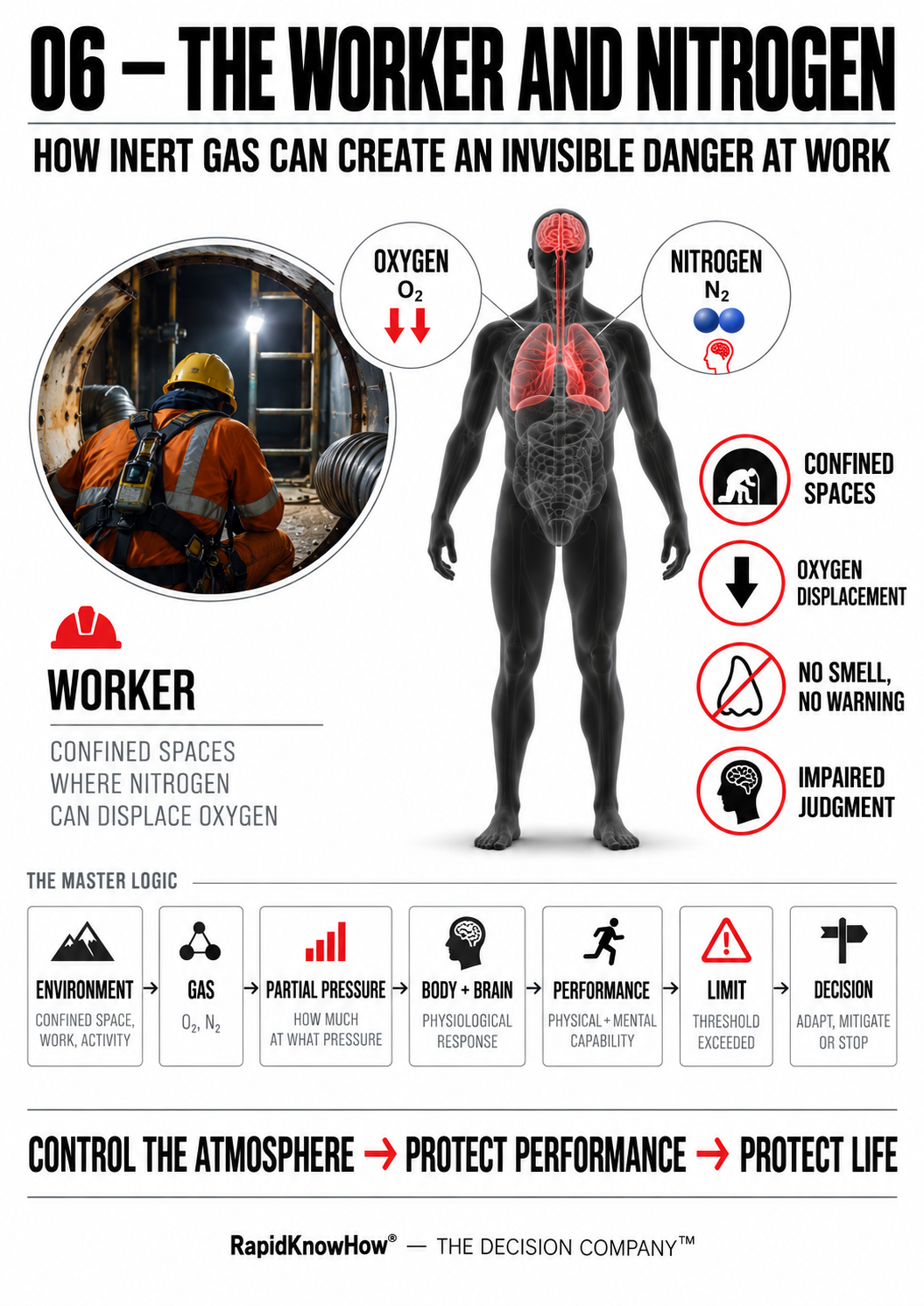
NITROGEN CAN BE CHEMICALLY INERT AND STILL CREATE A LETHAL HUMAN ENVIRONMENT.
A worker approaches a tank, vessel, pit or process enclosure.
Nothing smells unusual.
Nothing looks unusual.
Yet nitrogen may have displaced enough oxygen to turn the space into an atmosphere that cannot support normal human performance or life.
NITROGEN RELEASE → OXYGEN DISPLACEMENT → OXYGEN PARTIAL PRESSURE ↓ → BRAIN + BODY FAILURE → ASPHYXIATION RISK
01 — THE DANGER IS NOT NITROGEN TOXICITY
Nitrogen is a normal part of the atmosphere and is not toxic in the ordinary chemical sense.
The workplace danger appears when enough nitrogen enters an enclosed or poorly ventilated area to dilute the oxygen concentration.
OSHA classifies gases such as nitrogen, argon and helium as simple asphyxiants when they displace atmospheric oxygen below the level needed for normal tissue respiration.
THE HUMAN DOES NOT NEED TO BE “POISONED.”
THE HUMAN ONLY NEEDS TO LOSE ACCESS TO ENOUGH OXYGEN.
02 — INERTING CAN DELIBERATELY REMOVE OXYGEN
Industry uses nitrogen because its inert properties are valuable.
It can reduce fire or oxidation risk in tanks, vessels, pipelines and processes by replacing oxygen-containing air.
But the process benefit creates a human hazard.
OSHA explicitly notes that inerting a permit-required confined space with a noncombustible gas such as nitrogen can produce an immediately dangerous to life or health oxygen-deficient atmosphere.
The gas has done exactly what the process required — while creating an environment humans cannot safely breathe.
03 — THE HUMAN SENSES ARE POOR DETECTORS
Nitrogen gives the worker no reliable sensory warning of oxygen displacement.
There may be no distinctive smell, color or irritation.
As oxygen falls, cognition, coordination and consciousness can deteriorate.
The worker may become less capable of recognizing the danger precisely when rapid recognition and escape are most important.
INVISIBLE CHANGE → IMPAIRED JUDGMENT → REDUCED ESCAPE CAPABILITY → RAPID FAILURE
04 — CONFINED SPACES MULTIPLY THE RISK
The risk is particularly severe in tanks, pits, vessels, process equipment and other enclosed spaces where gases can accumulate and ventilation may be limited.
OSHA defines an oxygen-deficient atmosphere as one containing less than 19.5% oxygen by volume.
This is why confined-space systems rely on controls such as:
- hazard identification
- isolation of the space
- atmospheric testing
- ventilation where appropriate
- permit procedures
- trained attendants and entrants
- rescue planning
05 — RESCUE CAN CREATE A SECOND VICTIM
An unconscious worker inside an oxygen-deficient vessel creates an instinctive urge to enter and help.
That can be fatal if the rescuer enters the same atmosphere without the required protection and rescue system.
The correct response is therefore not improvised heroism.
It is a planned confined-space rescue system appropriate to the hazard.
ONE UNCONTROLLED ENTRY MUST NOT BECOME TWO CASUALTIES.
THE HUMAN OPERATING ENVELOPE
GREEN — CONTROLLED ENVIRONMENT
Atmosphere verified, oxygen within safe limits, process isolated and appropriate controls active.
YELLOW — DEGRADATION / UNCERTAINTY
Changing process conditions, uncertain ventilation, incomplete monitoring or potential nitrogen accumulation.
RED — FAILURE / DANGER
Oxygen-deficient atmosphere, uncontrolled entry, impaired escape capability, unconsciousness or asphyxiation.
THE AHA MOMENT
Nitrogen can make a process safer and a workplace atmosphere more dangerous at the same time.
FOR THE PROCESS: REMOVE OXYGEN.
FOR THE HUMAN: OXYGEN IS NON-NEGOTIABLE.
This is the industrial-gas paradox.
Therefore:
CONTROL THE PROCESS GAS → VERIFY THE ATMOSPHERE → CONTROL ENTRY → PROTECT THE WORKER.
THE RAPIDKNOWHOW® HUMAN + GAS RULE
CONTROL THE ATMOSPHERE → PROTECT PERFORMANCE → PROTECT LIFE.
RapidKnowHow® — THE DECISION COMPANY™
NEXT → THE HUMAN AND THE GASES™ POWERBOOK
Turn the 10-episode series into one practical 21-page PowerBook + Action Guide with the Human + Gases MASTER, decision worksheet, 10-day plan and action checklist.
POWERLICENSE — Apply THE HUMAN AND THE GASES™ beyond one reader
For organisational, training, consulting or partner use, explore the RapidKnowHow® licensing route. Scope, rights and fees are agreed separately.
THE HUMAN AND THE GASES™ — SERIES HUB
← Episode 05 — The Patient and Medical Gases
Educational overview only. Confined-space entry, inerting, atmospheric testing, respiratory protection and rescue require site-specific procedures, trained personnel and applicable occupational-safety standards.
Authoritative References
OSHA — Permit-Required Confined Spaces
OSHA — Inert Gases and Oxygen-Displacement Hazards
RapidKnowHow® — THE DECISION COMPANY™
Industrial Gas Leadership 2030
PROVE VALUE. THEN SCALE.
Watch the 60-second roadmap: 10 strategic actions for DACH and CEE, 2026–2030.
Start with ONE customer challenge. Use the Industrial Gas Action Guide to turn your first action into a measurable result.
RapidKnowHow® — Leading Industrial Gas Opportunity Signal Identifier in DACH & CEE