
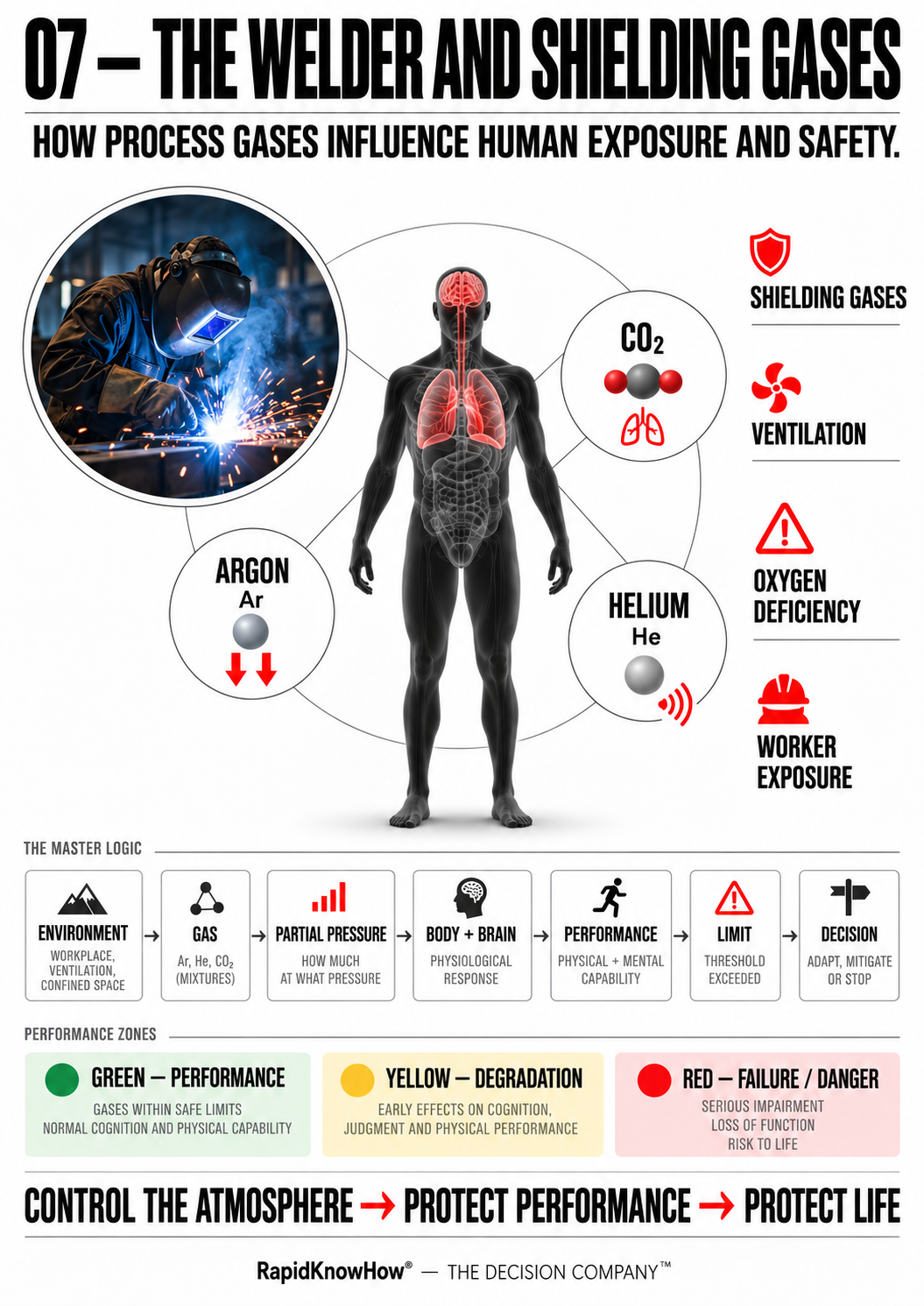
THE GAS THAT PROTECTS THE WELD CAN ENDANGER THE WELDER IF THE ATMOSPHERE IS NOT CONTROLLED.
A welder strikes an arc.
The shielding gas has a clear job: protect the molten weld pool from the surrounding atmosphere and help create a stable, high-quality process.
Argon, helium, carbon dioxide and mixtures of these gases are widely used for this purpose.
But the welder is also breathing inside the same working environment.
PROCESS GAS → WORKPLACE ATMOSPHERE → OXYGEN / CONTAMINANTS → LUNGS + BRAIN → HUMAN PERFORMANCE → SAFETY DECISION
01 — SHIELDING THE PROCESS
Gas-shielded welding depends on a controlled local atmosphere around the arc.
Common shielding gases include:
- Argon — Ar
- Helium — He
- Carbon dioxide — CO₂
- mixtures tailored to the welding process and material
These gases can improve arc stability, penetration, heat transfer and weld quality.
For the process, this is value.
For the human, however, the question is different:
WHERE DOES THE GAS GO AFTER IT LEAVES THE TORCH?
02 — OXYGEN DISPLACEMENT: THE INVISIBLE RISK
NIOSH notes that shielding gases such as argon, nitrogen, helium and carbon dioxide can displace oxygen-containing air in confined spaces.
Because these gases may be colorless and odorless, oxygen deficiency may develop without an obvious sensory warning.
This is particularly important in tanks, vessels, pits and other locations with restricted air movement.
SHIELDING GAS ACCUMULATION → OXYGEN DISPLACEMENT → HYPOXIC ATMOSPHERE → IMPAIRED HUMAN PERFORMANCE
03 — WELDING ALSO CREATES CONTAMINANTS
The shielding gas is only one part of the atmosphere around a welder.
The welding process itself can produce metal fumes, gases and smoke.
Depending on the process and materials, workplace contaminants can include carbon monoxide, nitrogen oxides, ozone, metal fumes and other substances.
OSHA emphasizes adequate ventilation, particularly where welding or cutting is performed in confined or enclosed areas.
THE HUMAN EXPOSURE SYSTEM IS THEREFORE:
SHIELDING GAS + PROCESS FUMES + VENTILATION + SPACE GEOMETRY + EXPOSURE TIME.
04 — CONFINED SPACE CHANGES THE RISK
In open, well-controlled work areas, ventilation can disperse gases and contaminants.
Inside a confined space, the same release can behave very differently.
OSHA requires attention to oxygen deficiency, toxic contaminants and ventilation when welding in confined spaces. In shipyard confined-space rules, atmospheric testing follows a defined sequence: oxygen content, flammability, then toxicity.
This creates a simple operating rule:
DO NOT ASSUME THE ATMOSPHERE IS SAFE BECAUSE THE PROCESS GAS IS “INERT.”
05 — VENTILATION IS A PERFORMANCE CONTROL
Ventilation is not merely a comfort measure.
It is a control that helps keep oxygen within a safe range and remove harmful airborne contaminants from the welder’s breathing zone.
The complete system can include:
- general ventilation
- local exhaust ventilation
- atmospheric testing
- process isolation
- confined-space procedures
- appropriate respiratory protection where required
- trained workers and supervision
THE HUMAN OPERATING ENVELOPE
GREEN — PERFORMANCE
Adequate oxygen, effective ventilation, controlled fumes and gases, appropriate PPE and safe work procedures.
YELLOW — DEGRADATION
Poor ventilation, increasing fume exposure, uncertain oxygen concentration or changing process conditions.
RED — FAILURE / DANGER
Oxygen-deficient atmosphere, hazardous contaminant concentration, uncontrolled confined-space exposure or incapacitation risk.
THE AHA MOMENT
The welder controls two atmospheres at the same time.
ONE ATMOSPHERE PROTECTS THE WELD.
THE OTHER MUST PROTECT THE HUMAN.
A gas can be excellent for the process and dangerous for the worker when the workplace atmosphere is not controlled.
Therefore:
CONTROL THE PROCESS GAS → CONTROL THE WORKPLACE ATMOSPHERE → PROTECT THE WELDER.
THE RAPIDKNOWHOW® HUMAN + GAS RULE
CONTROL THE ATMOSPHERE → PROTECT PERFORMANCE → PROTECT LIFE.
RapidKnowHow® — THE DECISION COMPANY™
NEXT → THE HUMAN AND THE GASES™ POWERBOOK
Turn the 10-episode series into one practical 21-page PowerBook + Action Guide with the Human + Gases MASTER, decision worksheet, 10-day plan and action checklist.
POWERLICENSE — Apply THE HUMAN AND THE GASES™ beyond one reader
For organisational, training, consulting or partner use, explore the RapidKnowHow® licensing route. Scope, rights and fees are agreed separately.
THE HUMAN AND THE GASES™ — SERIES HUB
← Episode 06 — The Worker and Nitrogen
Educational overview only. Welding ventilation, confined-space entry, atmospheric testing and respiratory protection must follow applicable workplace standards, site procedures and professional training.
Authoritative References
OSHA — Hot Work / Welding Safety
NIOSH — Criteria for a Recommended Standard: Welding, Brazing, and Thermal Cutting
OSHA — Confined and Enclosed Space Atmospheric Testing
RapidKnowHow® — THE DECISION COMPANY™
Industrial Gas Leadership 2030
PROVE VALUE. THEN SCALE.
Watch the 60-second roadmap: 10 strategic actions for DACH and CEE, 2026–2030.
Start with ONE customer challenge. Use the Industrial Gas Action Guide to turn your first action into a measurable result.
RapidKnowHow® — Leading Industrial Gas Opportunity Signal Identifier in DACH & CEE