
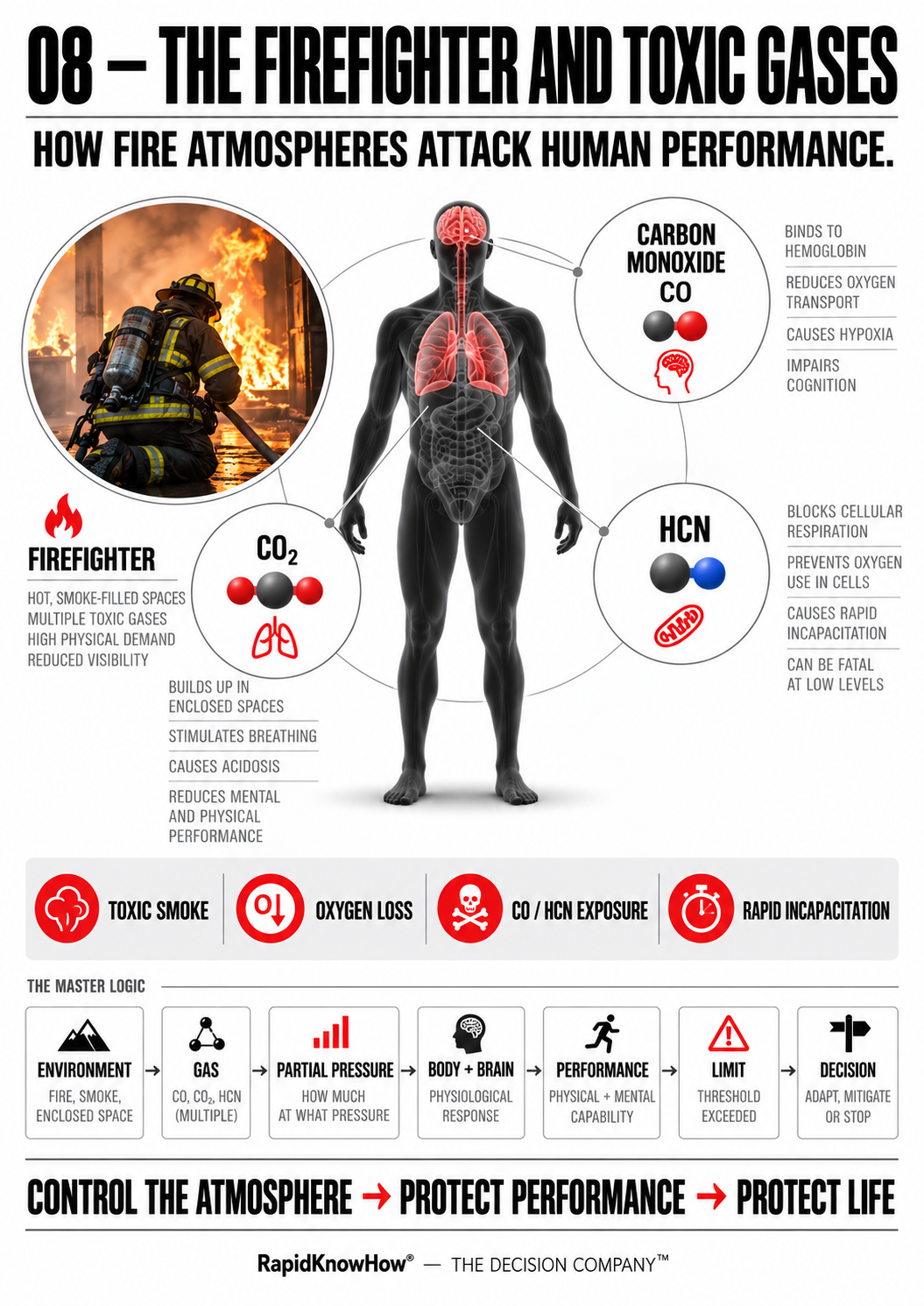
IN A FIRE, THE ATMOSPHERE CAN BECOME AS DANGEROUS AS THE FLAMES.
A firefighter enters a smoke-filled structure.
The environment is hot, visibility is poor and physical demand is high.
At the same time, combustion can create a complex mixture of gases, vapors and particles.
Among the critical toxic gases are carbon monoxide — CO and hydrogen cyanide — HCN.
FIRE → COMBUSTION PRODUCTS → OXYGEN TRANSPORT / CELLULAR RESPIRATION → BRAIN + MUSCLE → PERFORMANCE → SURVIVAL
01 — CARBON MONOXIDE ATTACKS OXYGEN TRANSPORT
Carbon monoxide is produced by incomplete combustion of carbon-containing materials.
It is colorless and odorless.
CO binds strongly to hemoglobin in red blood cells, reducing the blood’s ability to transport oxygen effectively to tissues.
The result can include headache, dizziness, confusion, weakness, impaired judgment, unconsciousness and death depending on exposure.
CO EXPOSURE → OXYGEN TRANSPORT IMPAIRED → BRAIN + MUSCLE PERFORMANCE FALLS.
02 — HYDROGEN CYANIDE ATTACKS OXYGEN USE
Hydrogen cyanide can be generated when nitrogen-containing materials burn.
Its mechanism is different from carbon monoxide.
Cyanide interferes with cellular respiration, meaning cells can become unable to use oxygen effectively even when oxygen is present in the blood.
This creates a powerful distinction:
CO CAN REDUCE OXYGEN DELIVERY.
CYANIDE CAN DISRUPT OXYGEN USE INSIDE CELLS.
NIOSH identifies both carbon monoxide and hydrogen cyanide as important toxic gases found in fire environments.
03 — FIRE SMOKE IS A MIXTURE, NOT ONE GAS
Firefighters are not exposed to one isolated compound.
NIOSH describes fire smoke as a complex exposure that can include carbon monoxide, hydrogen cyanide, carbon dioxide, irritant gases, particulates and many other combustion products depending on what is burning.
The exact mixture changes with:
- fuel and building contents
- temperature
- oxygen availability
- ventilation
- stage of the fire
- location within the structure
THE ATMOSPHERE IS DYNAMIC.
04 — CO₂, HEAT AND WORKLOAD ADD TO THE HUMAN LOAD
Carbon dioxide can accumulate in enclosed fire environments and stimulate breathing while contributing to physiological stress.
At the same time, the firefighter may be:
- working at high physical intensity
- wearing heavy protective equipment
- experiencing heat stress
- operating with limited visibility
- making high-consequence decisions
The gas hazard therefore interacts with the physical workload.
TOXIC EXPOSURE + HEAT + WORKLOAD + TIME PRESSURE = RAPIDLY SHRINKING PERFORMANCE MARGIN.
05 — RESPIRATORY PROTECTION PRESERVES THE OPERATING ENVELOPE
In an immediately dangerous fire atmosphere, the firefighter cannot depend on ordinary breathing air.
Self-contained breathing apparatus creates an independent breathing-gas supply and separates the respiratory system from the toxic environment when used correctly.
This is not merely personal protective equipment.
It is a portable life-support system.
Removing respiratory protection in a dangerous atmosphere can expose the firefighter directly to oxygen deficiency and toxic combustion products.
THE HUMAN OPERATING ENVELOPE
GREEN — PROTECTED PERFORMANCE
Effective respiratory protection, controlled entry, adequate air supply, coordinated team operations and monitored conditions.
YELLOW — DEGRADATION
Increasing heat load, high work rate, falling air reserve, changing fire conditions or suspected contaminant exposure.
RED — FAILURE / DANGER
Respiratory-protection failure or removal in an IDLH atmosphere, severe toxic exposure, oxygen deficiency, incapacitation or loss of consciousness.
THE AHA MOMENT
The firefighter is not merely fighting flames.
The firefighter is operating inside a rapidly changing chemical atmosphere.
CO ATTACKS OXYGEN TRANSPORT.
CYANIDE ATTACKS CELLULAR OXYGEN USE.
HEAT AND WORKLOAD INCREASE THE HUMAN DEMAND.
Therefore:
ISOLATE THE BREATHING SYSTEM → CONTROL EXPOSURE → PRESERVE HUMAN PERFORMANCE → PROTECT LIFE.
THE RAPIDKNOWHOW® HUMAN + GAS RULE
CONTROL THE ATMOSPHERE → PROTECT PERFORMANCE → PROTECT LIFE.
RapidKnowHow® — THE DECISION COMPANY™
NEXT → THE HUMAN AND THE GASES™ POWERBOOK
Turn the 10-episode series into one practical 21-page PowerBook + Action Guide with the Human + Gases MASTER, decision worksheet, 10-day plan and action checklist.
POWERLICENSE — Apply THE HUMAN AND THE GASES™ beyond one reader
For organisational, training, consulting or partner use, explore the RapidKnowHow® licensing route. Scope, rights and fees are agreed separately.
THE HUMAN AND THE GASES™ — SERIES HUB
← Episode 07 — The Welder and Shielding Gases
Educational overview only. Structural firefighting, respiratory protection, hazardous-atmosphere entry and medical treatment of smoke inhalation require professional training, approved equipment and applicable fire-service procedures.
Authoritative References
NIOSH — Firefighter Safety, Health and Well-Being
NIOSH — CBRN Respiratory Protection Handbook
NIOSH — Firefighter Smoke Inhalation Investigation
RapidKnowHow® — THE DECISION COMPANY™
Industrial Gas Leadership 2030
PROVE VALUE. THEN SCALE.
Watch the 60-second roadmap: 10 strategic actions for DACH and CEE, 2026–2030.
Start with ONE customer challenge. Use the Industrial Gas Action Guide to turn your first action into a measurable result.
RapidKnowHow® — Leading Industrial Gas Opportunity Signal Identifier in DACH & CEE