
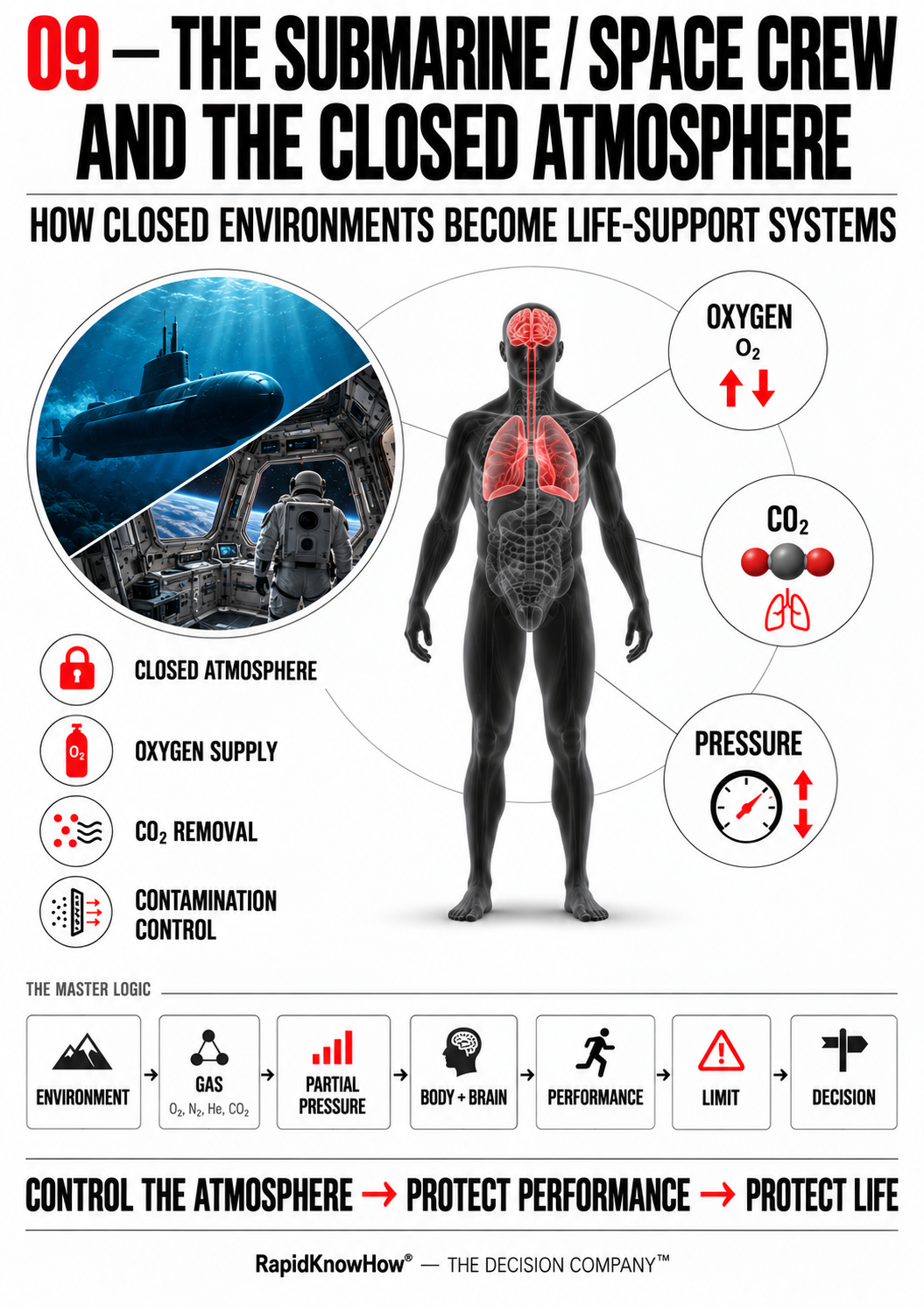
WHEN HUMANS CANNOT SIMPLY STEP OUTSIDE, THE ATMOSPHERE BECOMES A LIFE-SUPPORT SYSTEM.
A submarine dives beneath the sea.
A spacecraft leaves Earth.
In both cases, the crew enters a closed environment where breathing conditions can no longer be left to nature.
CLOSED ENVIRONMENT → OXYGEN SUPPLY + CO₂ REMOVAL + PRESSURE CONTROL + VENTILATION + CONTAMINANT CONTROL → HUMAN PERFORMANCE → SURVIVAL
01 — THE ATMOSPHERE MUST BE BUILT AND MAINTAINED
On Earth, the surrounding atmosphere is continuously renewed by the environment.
Inside a submarine or spacecraft, the crew depends on engineered systems to keep the atmosphere within a usable operating range.
NASA’s Environmental Control and Life Support System — ECLSS — controls critical functions including atmospheric pressure, oxygen levels, ventilation, carbon-dioxide removal and trace-contaminant control.
This creates the first closed-environment rule:
THE CREW DOES NOT SIMPLY BREATHE THE ATMOSPHERE.
THE SYSTEM MUST CONTINUOUSLY CREATE AND MAINTAIN IT.
02 — OXYGEN MUST BE SUPPLIED
Humans continuously consume oxygen.
In a closed habitat, that oxygen must be replenished from stored supplies, generated onboard or otherwise maintained through the life-support architecture.
NASA’s spacecraft systems use oxygen-generation and pressure-control technologies so that crew members can continue to breathe and work safely.
CREW METABOLISM → OXYGEN CONSUMPTION → OXYGEN REPLACEMENT REQUIRED.
03 — CARBON DIOXIDE MUST BE REMOVED
At the same time, humans continuously exhale carbon dioxide.
In an open environment it disperses.
In a closed environment it can accumulate unless actively removed.
NASA’s Air Revitalization System uses dedicated carbon-dioxide removal systems because CO₂ management is essential to maintaining a habitable cabin atmosphere.
OXYGEN IN IS ONLY HALF THE SYSTEM.
CARBON DIOXIDE OUT IS THE OTHER HALF.
04 — TRACE CONTAMINANTS ALSO MATTER
People, electronics, plastics, equipment and processes can release small quantities of other gases and vapors.
NASA identifies trace-contaminant control as part of atmosphere revitalization because substances that would disperse outdoors can build up in an enclosed cabin.
The closed-atmosphere problem is therefore broader than oxygen and CO₂:
O₂ + CO₂ + HUMIDITY + TRACE CONTAMINANTS + PARTICLES + TEMPERATURE + PRESSURE + VENTILATION.
05 — PRESSURE IS PART OF THE HUMAN ENVIRONMENT
Humans require not only the right gas composition but also a suitable total pressure and gas partial pressures.
Pressure control therefore becomes part of the life-support system.
A change in pressure changes the partial pressure of gases and can change the physiological operating envelope even if gas percentages do not change.
This connects the closed environment directly back to the diver, mountaineer and pilot.
06 — RELIABILITY IS A HUMAN-PERFORMANCE ISSUE
In a closed habitat, atmosphere control is mission-critical infrastructure.
The crew’s ability to think, work, communicate and make decisions depends on the life-support system continuing to function.
This means that:
ATMOSPHERE CONTROL = HUMAN PERFORMANCE CONTROL.
THE HUMAN OPERATING ENVELOPE
GREEN — CONTROLLED LIFE SUPPORT
Oxygen, CO₂, pressure, ventilation and contaminants remain within controlled limits.
YELLOW — DEGRADATION
Rising CO₂, changing oxygen availability, ventilation problems, pressure deviation or contaminant accumulation begin to reduce crew performance.
RED — FAILURE / DANGER
Life-support failure, severe oxygen deficiency, excessive CO₂, unsafe pressure or toxic contamination threatens consciousness, mission capability and life.
THE AHA MOMENT
The submarine or spacecraft is not simply a vehicle.
It is a mobile human atmosphere.
THE HULL KEEPS THE ENVIRONMENT OUT.
THE LIFE-SUPPORT SYSTEM KEEPS THE HUMAN ENVIRONMENT IN.
Therefore:
CONTROL OXYGEN → REMOVE CO₂ → CONTROL PRESSURE → REMOVE CONTAMINANTS → PROTECT THE CREW.
THE RAPIDKNOWHOW® HUMAN + GAS RULE
CONTROL THE ATMOSPHERE → PROTECT PERFORMANCE → PROTECT LIFE.
RapidKnowHow® — THE DECISION COMPANY™
NEXT → THE HUMAN AND THE GASES™ POWERBOOK
Turn the 10-episode series into one practical 21-page PowerBook + Action Guide with the Human + Gases MASTER, decision worksheet, 10-day plan and action checklist.
POWERLICENSE — Apply THE HUMAN AND THE GASES™ beyond one reader
For organisational, training, consulting or partner use, explore the RapidKnowHow® licensing route. Scope, rights and fees are agreed separately.
THE HUMAN AND THE GASES™ — SERIES HUB
← Episode 08 — The Firefighter and Toxic Gases
Educational overview only. Submarine and spacecraft atmosphere control requires specialized engineering, operational procedures, environmental monitoring and trained crews.
Authoritative References
NASA — Environmental Control and Life Support Systems
NASA — Crew Systems / Atmosphere Revitalization and Pressure Control
NASA — Life Support Subsystems
RapidKnowHow® — THE DECISION COMPANY™
Industrial Gas Leadership 2030
PROVE VALUE. THEN SCALE.
Watch the 60-second roadmap: 10 strategic actions for DACH and CEE, 2026–2030.
Start with ONE customer challenge. Use the Industrial Gas Action Guide to turn your first action into a measurable result.
RapidKnowHow® — Leading Industrial Gas Opportunity Signal Identifier in DACH & CEE