
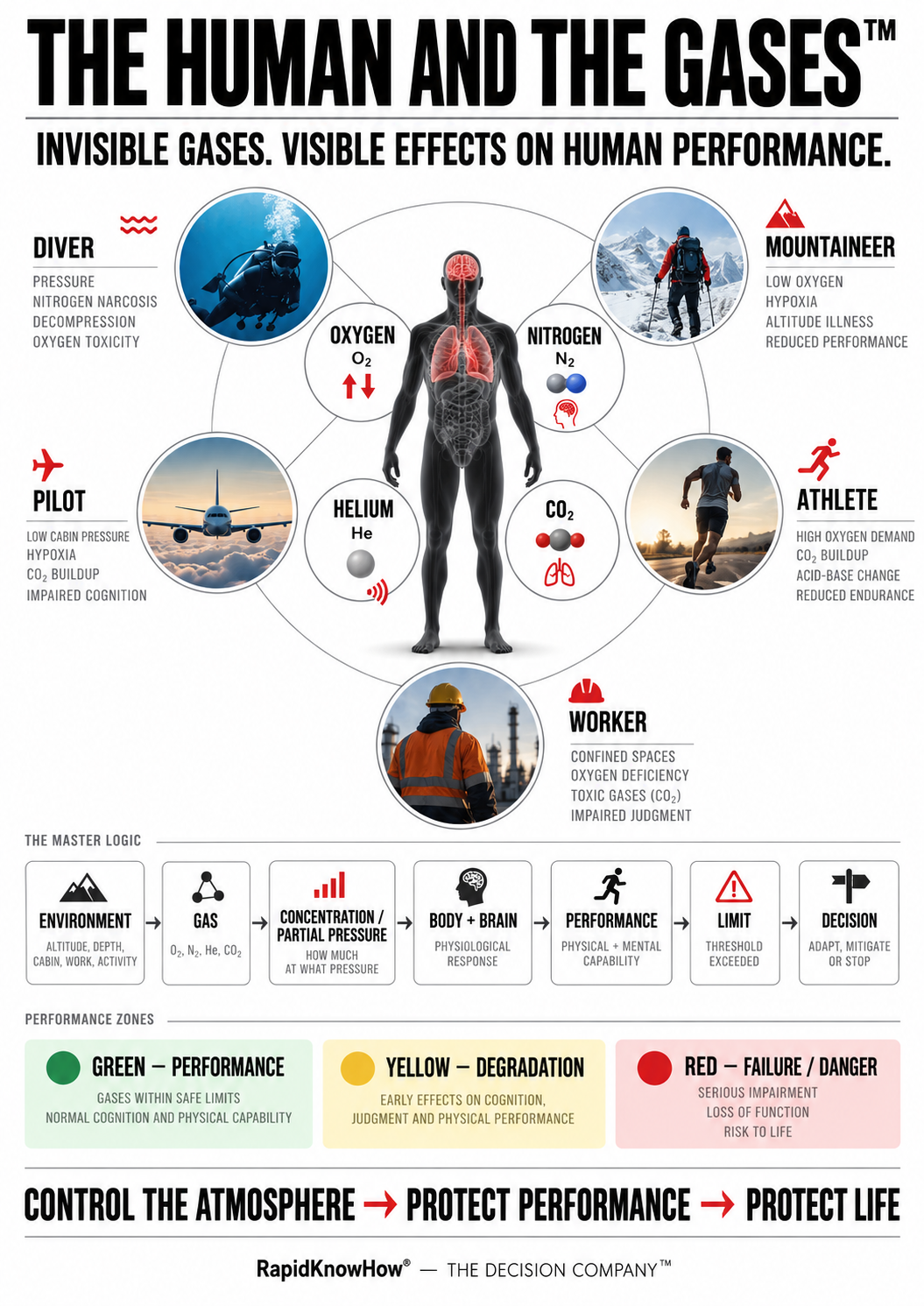
HUMAN PERFORMANCE IS NOT INDEPENDENT OF THE ATMOSPHERE. IT EXISTS INSIDE AN OPERATING ENVELOPE DEFINED BY GAS, PRESSURE, TIME, WORKLOAD AND HUMAN RESPONSE.
Across this series, the human has been placed in radically different environments:
Diving. Mountains. Aviation. Sport. Medicine. Industry. Welding. Fire. Submarines. Space.
The environments change.
The governing logic does not.
ENVIRONMENT → GAS → CONCENTRATION / PARTIAL PRESSURE → BODY + BRAIN → PERFORMANCE → LIMIT → DECISION
01 — THE SAME GAS CAN PRODUCE DIFFERENT HUMAN EFFECTS
Oxygen sustains life.
Yet too little oxygen produces hypoxia, while excessive oxygen partial pressure can become toxic.
Nitrogen is normally harmless in air, yet at pressure it contributes to narcosis and decompression loading, while in industrial systems it can displace oxygen and create an asphyxiation hazard.
Carbon dioxide is a normal product of metabolism, yet excessive accumulation can degrade performance and become dangerous.
Helium can reduce gas density and nitrogen narcosis in deep diving, yet still changes decompression and thermal considerations.
THE GAS NAME ALONE DOES NOT DEFINE THE EFFECT.
02 — THE HUMAN EFFECT DEPENDS ON THE OPERATING CONDITIONS
The critical variables are:
- gas identity
- concentration
- partial pressure
- total pressure
- exposure time
- workload
- temperature
- ventilation
- individual physiology
Change one variable and the human operating envelope can change with it.
03 — THE BODY AND BRAIN ARE THE PERFORMANCE INTERFACE
Atmospheric conditions matter because they change physiology.
The body must continuously:
DELIVER OXYGEN → REMOVE CO₂ → MAINTAIN ACID-BASE BALANCE → SUPPORT THE BRAIN → SUPPORT THE MUSCLES → MAINTAIN DECISION CAPABILITY.
When the gas environment pushes physiology outside its sustainable range, performance begins to deteriorate.
04 — PERFORMANCE OFTEN DEGRADES BEFORE FAILURE
Many gas hazards are dangerous because the first consequence is not immediate collapse.
The first consequence may be:
- slower thinking
- poorer judgment
- reduced coordination
- fatigue
- confusion
- shortened endurance
- reduced situational awareness
This is the critical transition zone.
THE HUMAN MAY STILL BE FUNCTIONING — BUT NO LONGER FUNCTIONING WELL.
05 — THE THREE-ZONE PERFORMANCE MODEL
GREEN — PERFORMANCE
Gas conditions remain within the intended operating range. Cognition and physical capability are preserved.
YELLOW — DEGRADATION
Early physiological effects begin to reduce judgment, coordination, endurance or cognition.
RED — FAILURE / DANGER
Serious impairment, loss of function, incapacitation or life-threatening exposure.
The management objective is simple:
DETECT THE MOVE FROM GREEN TOWARD YELLOW BEFORE THE HUMAN REACHES RED.
06 — MONITORING TURNS THE INVISIBLE INTO A DECISION
Gas hazards are often invisible.
That makes measurement critical.
Depending on the environment, control may involve:
- oxygen monitoring
- CO₂ monitoring
- toxic-gas detection
- pressure measurement
- ventilation control
- physiological monitoring
- equipment alarms
- exposure-time limits
The purpose of measurement is not data collection.
It is decision support.
SIGNAL → INTERPRET → DECIDE → ACT.
07 — THE TEN HUMAN + GAS ENVIRONMENTS
01 — Diver: pressure changes gas effects.
02 — Mountaineer: altitude reduces oxygen partial pressure.
03 — Pilot: cabin pressure affects cognition and decision quality.
04 — Athlete: performance requires oxygen delivery and CO₂ removal.
05 — Patient: gases become therapeutic tools when dose and delivery are controlled.
06 — Worker: inert nitrogen can create an oxygen-deficient atmosphere.
07 — Welder: process gases can protect the weld while changing worker exposure.
08 — Firefighter: toxic gases can attack oxygen transport and cellular respiration.
09 — Submarine / Space Crew: the atmosphere itself becomes an engineered life-support system.
10 — Human Operating Envelope: all of these environments follow the same control logic.
THE AHA MOMENT
The atmosphere is not background.
It is part of the human performance system.
THE HUMAN DOES NOT OPERATE IN ISOLATION.
THE HUMAN OPERATES INSIDE AN ATMOSPHERE.
Therefore:
CONTROL THE ENVIRONMENT → CONTROL THE GAS → PROTECT THE BODY + BRAIN → PROTECT THE DECISION → PROTECT LIFE.
THE RAPIDKNOWHOW® HUMAN + GAS MASTER
ENVIRONMENT → GAS → PARTIAL PRESSURE / CONCENTRATION → BODY + BRAIN → PERFORMANCE → LIMIT → DECISION
GREEN → YELLOW → RED
CONTROL THE ATMOSPHERE → PROTECT PERFORMANCE → PROTECT LIFE.
RapidKnowHow® — THE DECISION COMPANY™
NEXT → THE HUMAN AND THE GASES™ POWERBOOK
Turn the 10-episode series into one practical 21-page PowerBook + Action Guide with the Human + Gases MASTER, decision worksheet, 10-day plan and action checklist.
POWERLICENSE — Apply THE HUMAN AND THE GASES™ beyond one reader
For organisational, training, consulting or partner use, explore the RapidKnowHow® licensing route. Scope, rights and fees are agreed separately.
THE HUMAN AND THE GASES™ — SERIES HUB
← Episode 09 — The Submarine / Space Crew and the Closed Atmosphere
Educational overview only. Gas exposure, aviation, diving, medicine, occupational safety, firefighting and closed-environment operations each require their own professional standards, training and operating procedures.
Authoritative Reference Framework
NASA — Environmental Control and Life Support Systems
OSHA — Oxygen-Deficient and Enclosed Atmospheres
FAA — Hypoxia and Aviation Human Performance
RapidKnowHow® — THE DECISION COMPANY™
Industrial Gas Leadership 2030
PROVE VALUE. THEN SCALE.
Watch the 60-second roadmap: 10 strategic actions for DACH and CEE, 2026–2030.
Start with ONE customer challenge. Use the Industrial Gas Action Guide to turn your first action into a measurable result.
RapidKnowHow® — Leading Industrial Gas Opportunity Signal Identifier in DACH & CEE