
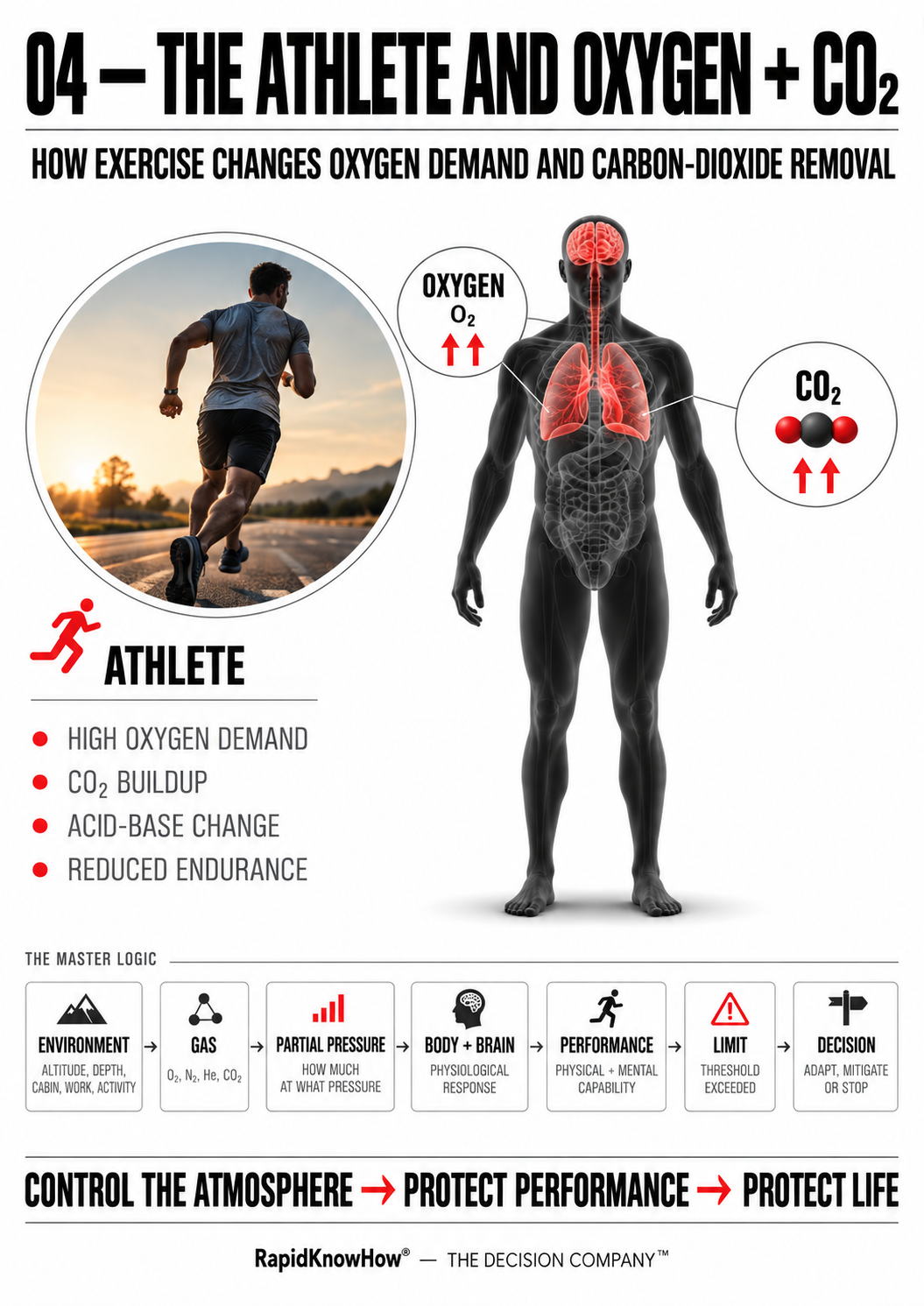
HUMAN PERFORMANCE DEPENDS ON A CONTINUOUS GAS FLOW: OXYGEN IN — CARBON DIOXIDE OUT.
An athlete begins to move.
Muscles require more energy. Oxygen consumption rises. Carbon dioxide production rises. Heart rate, blood flow and ventilation increase to match the metabolic demand.
WORKLOAD → OXYGEN DEMAND ↑ → CO₂ PRODUCTION ↑ → VENTILATION + CIRCULATION ↑ → PERFORMANCE
01 — OXYGEN POWERS AEROBIC WORK
Endurance exercise depends heavily on oxidative metabolism.
Oxygen must move through an integrated chain:
ATMOSPHERE → LUNGS → BLOOD → HEART → WORKING MUSCLE → MITOCHONDRIA
If any link becomes limiting, aerobic performance can fall.
This is why maximal oxygen uptake — VO₂max — is widely used as an expression of aerobic capacity.
02 — CO₂ IS NOT SIMPLY “WASTE”
Working muscles also produce more carbon dioxide.
The healthy body normally responds by increasing ventilation so that CO₂ can be transported to the lungs and exhaled while blood-gas and acid-base balance are regulated.
So the performance equation is not just:
GET MORE OXYGEN.
It is:
DELIVER OXYGEN + TRANSPORT CO₂ + VENTILATE EFFECTIVELY.
03 — THE SYSTEM MUST STAY MATCHED
Exercise performance requires coordination between several systems:
- lungs — gas exchange
- heart — blood flow
- blood — oxygen and CO₂ transport
- muscles — oxygen use and energy production
- brain — motor control and effort regulation
In healthy exercise, pulmonary ventilation rises with metabolic demand. Carbon dioxide production increases, but arterial CO₂ is generally regulated rather than simply accumulating without control.
PERFORMANCE = MATCHING DEMAND WITH DELIVERY AND REMOVAL.
04 — HIGHER INTENSITY CHANGES THE CHEMISTRY
As intensity rises, the metabolic environment changes.
Above certain exercise intensities, lactate and hydrogen-ion production increase. Buffering reactions generate additional CO₂, and ventilation rises disproportionately.
This contributes to the familiar transition from controlled breathing to very heavy breathing during hard exercise.
The athlete is approaching a different operating zone.
05 — FATIGUE IS A SYSTEM RESULT
Reduced endurance is not caused by one gas alone.
It can emerge from limitations across the oxygen-delivery and energy systems:
OXYGEN DELIVERY + CARDIAC OUTPUT + MUSCLE METABOLISM + VENTILATION + TEMPERATURE + HYDRATION + WORKLOAD
The athlete therefore operates inside a dynamic physiological envelope.
THE HUMAN OPERATING ENVELOPE
GREEN — PERFORMANCE
Oxygen delivery, circulation, ventilation and metabolic demand remain well matched.
YELLOW — DEGRADATION
Rising ventilatory strain, metabolic stress and fatigue reduce sustainable performance.
RED — FAILURE / DANGER
The athlete can no longer maintain the required workload safely or effectively. Symptoms such as severe breathlessness, chest pain, faintness or collapse require stopping and appropriate medical evaluation.
THE AHA MOMENT
The athlete is not simply using muscles.
The athlete is operating a gas-transport and energy-conversion system.
OXYGEN MUST REACH THE WORKING MUSCLE.
CARBON DIOXIDE MUST BE TRANSPORTED AND EXHALED.
VENTILATION AND CIRCULATION MUST MATCH METABOLIC DEMAND.
Therefore:
CONTROL THE GAS FLOW → SUPPORT THE METABOLISM → SUSTAIN PERFORMANCE.
THE RAPIDKNOWHOW® HUMAN + GAS RULE
CONTROL THE ATMOSPHERE → PROTECT PERFORMANCE → PROTECT LIFE.
RapidKnowHow® — THE DECISION COMPANY™
NEXT → THE HUMAN AND THE GASES™ POWERBOOK
Turn the 10-episode series into one practical 21-page PowerBook + Action Guide with the Human + Gases MASTER, decision worksheet, 10-day plan and action checklist.
POWERLICENSE — Apply THE HUMAN AND THE GASES™ beyond one reader
For organisational, training, consulting or partner use, explore the RapidKnowHow® licensing route. Scope, rights and fees are agreed separately.
THE HUMAN AND THE GASES™ — SERIES HUB
← Episode 03 — The Pilot and the Atmosphere
Educational overview only. Exercise capacity and breathlessness can be affected by many physiological and medical factors. Symptoms that are severe, new or unusual require appropriate medical assessment.
Scientific References
Exercise Physiology and Cardiopulmonary Exercise Testing
Measurement and Interpretation of Exercise Ventilatory Efficiency
Cardiopulmonary Exercise Testing: Basics of Methodology and Measurements
RapidKnowHow® — THE DECISION COMPANY™
Industrial Gas Leadership 2030
PROVE VALUE. THEN SCALE.
Watch the 60-second roadmap: 10 strategic actions for DACH and CEE, 2026–2030.
Start with ONE customer challenge. Use the Industrial Gas Action Guide to turn your first action into a measurable result.
RapidKnowHow® — Leading Industrial Gas Opportunity Signal Identifier in DACH & CEE