
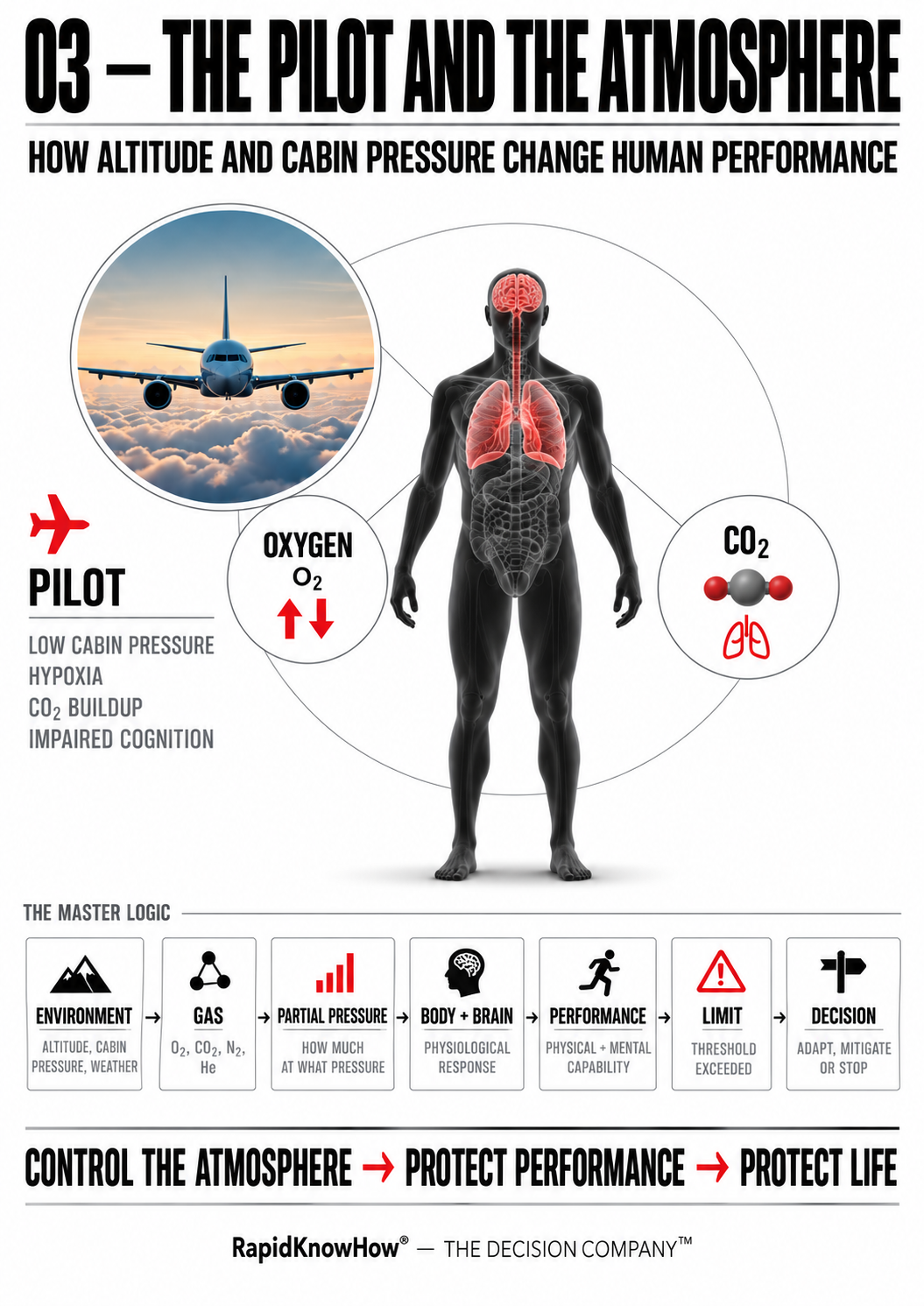
THE PILOT MAY LOSE PERFORMANCE BEFORE REALIZING THAT PERFORMANCE IS BEING LOST.
A pilot climbs.
The percentage of oxygen in the atmosphere remains close to 21%, but atmospheric pressure falls with altitude. As total pressure falls, the partial pressure of oxygen falls too.
That changes the human operating environment.
ALTITUDE → LOWER PRESSURE → LOWER OXYGEN PARTIAL PRESSURE → LOWER OXYGEN DELIVERY → LOWER HUMAN PERFORMANCE
01 — THE INVISIBLE AVIATION RISK
In normal flight, the pilot sees instruments, weather, traffic and aircraft systems.
Hypoxia is different. It can develop gradually and without pain. The person affected may not immediately recognize the deterioration.
The FAA identifies reduced oxygen pressure at altitude, rapid decompression, pressurization malfunction and oxygen-system malfunction among the principal aviation causes of hypoxia.
02 — THE BRAIN IS THE CRITICAL SYSTEM
The brain depends continuously on oxygen.
As oxygen availability decreases, aviation performance can deteriorate through:
- reduced judgment
- slower reaction
- poorer memory and calculation
- reduced coordination
- fatigue and headache
- visual impairment, especially night vision
- euphoria or unjustified confidence
THE CRITICAL PARADOX:
THE PILOT WHO NEEDS TO RECOGNIZE THE PROBLEM MAY BE THE SAME PILOT WHOSE ABILITY TO RECOGNIZE IT IS DETERIORATING.
03 — CABIN ALTITUDE MATTERS
A pressurized aircraft does not maintain sea-level pressure at every cruising altitude. Instead, the cabin is kept within a controlled pressure range.
If cabin pressure becomes too low, the oxygen percentage may remain similar while the oxygen partial pressure falls.
The result is a smaller physiological safety margin.
CABIN PRESSURE → OXYGEN PARTIAL PRESSURE → BLOOD OXYGEN → BRAIN PERFORMANCE → FLIGHT DECISION QUALITY
04 — RAPID DECOMPRESSION CHANGES THE CLOCK
A slow reduction in oxygen availability and a rapid decompression are not the same operating event.
At high altitude, a sudden loss of cabin pressure can sharply reduce the time available for useful action.
That is why aviation uses the concept of Time of Useful Consciousness / Effective Performance Time: the interval between oxygen interruption or exposure to an oxygen-poor environment and the point at which effective action is no longer possible.
The higher the altitude, the smaller that window can become.
05 — OXYGEN IS A PERFORMANCE SYSTEM
Supplemental oxygen is not simply an emergency commodity.
In aviation it is part of a controlled human-performance system involving:
- cabin pressure
- oxygen supply
- oxygen-delivery equipment
- crew awareness
- altitude
- exposure time
- workload and fatigue
Failure in any part of the chain can degrade the pilot’s ability to fly the aircraft safely.
THE HUMAN OPERATING ENVELOPE
GREEN — PERFORMANCE
Adequate cabin pressure and oxygen delivery. Normal cognition, coordination and situational awareness.
YELLOW — DEGRADATION
Early hypoxia: fatigue, visual changes, slower thinking, weaker judgment or impaired coordination.
RED — FAILURE / DANGER
Severe hypoxia: major cognitive impairment, incapacitation or loss of consciousness.
THE AHA MOMENT
The pilot does not merely manage an aircraft.
The pilot is also operating inside a human life-support envelope.
THE OXYGEN PERCENTAGE MAY STAY THE SAME.
THE PRESSURE DRIVING OXYGEN INTO THE HUMAN SYSTEM DOES NOT.
Therefore:
CONTROL CABIN PRESSURE → CONTROL OXYGEN AVAILABILITY → PROTECT COGNITION → PROTECT THE DECISION.
THE RAPIDKNOWHOW® HUMAN + GAS RULE
CONTROL THE ATMOSPHERE → PROTECT PERFORMANCE → PROTECT LIFE.
RapidKnowHow® — THE DECISION COMPANY™
NEXT → THE HUMAN AND THE GASES™ POWERBOOK
Turn the 10-episode series into one practical 21-page PowerBook + Action Guide with the Human + Gases MASTER, decision worksheet, 10-day plan and action checklist.
POWERLICENSE — Apply THE HUMAN AND THE GASES™ beyond one reader
For organisational, training, consulting or partner use, explore the RapidKnowHow® licensing route. Scope, rights and fees are agreed separately.
THE HUMAN AND THE GASES™ — SERIES HUB
← Episode 02 — The Mountaineer and Oxygen
Educational overview only. Aviation oxygen use, pressurization procedures and emergency response must follow applicable aircraft procedures, aviation regulations and professional training.
Authoritative References
Federal Aviation Administration — Hypoxia / Airman Education
Federal Aviation Administration — Introduction to Aviation Physiology
RapidKnowHow® — THE DECISION COMPANY™
Industrial Gas Leadership 2030
PROVE VALUE. THEN SCALE.
Watch the 60-second roadmap: 10 strategic actions for DACH and CEE, 2026–2030.
Start with ONE customer challenge. Use the Industrial Gas Action Guide to turn your first action into a measurable result.
RapidKnowHow® — Leading Industrial Gas Opportunity Signal Identifier in DACH & CEE