
Rebuilding National Competitiveness Through Orchestrated Execution
Applying the RapidKnowHow Model:
Signal → Prioritize → Act → Capture → Reinforce
Executive Summary (5-Minute Board Read)
Austria is not in crisis — but it is losing competitive velocity.
Compared to high-performance small nations such as Switzerland and Denmark, Austria’s weakness is not innovation capability or institutional stability. It is execution speed, regulatory friction, and slow diffusion of productivity-enhancing technologies.
Between 2026 and 2030, Austria’s competitiveness will depend on:
- Regulatory acceleration
- AI-driven SME productivity
- Energy price predictability
- Capital efficiency improvement
- Skilled workforce modernization
If implemented with sprint-based governance, Austria can shift from a high-cost administrative economy to a high-efficiency innovation economy.
1️⃣ SIGNAL (2026): Structural Diagnosis
Macro Signals
- Sluggish GDP growth vs EU innovation leaders
- Industrial margin compression
- Increasing wage pressure without proportional productivity growth
- Energy volatility impacting manufacturing competitiveness
Competitive Signals
- Switzerland: capital efficiency + innovation depth
- Denmark: digital governance + labor flexibility
- CEE: lower cost base + faster permitting
Core Diagnosis
Austria’s system is stable but slow.
Capital flows to speed.
Without acceleration, Austria risks:
- Gradual FDI stagnation
- Talent outflow
- Declining industrial ROCE
2️⃣ PRIORITIZE: Five National Levers (High ROICE Focus)
Lever 1 – Regulatory Speed Reform
- Legally binding 90-day permit cap
- Digital unified submission platform
- Sunset clauses for outdated regulations
Expected Impact: +10–15% investment velocity
Lever 2 – AI-Driven SME Acceleration
- National AI diagnostic program for SMEs
- 90-day AI implementation sprint subsidy
- Tax incentives for productivity-enhancing automation
Expected Impact: +5–10% productivity per employee
Lever 3 – Energy Predictability
- Long-term industrial energy contracts
- Faster renewable permitting
- Strategic hydrogen corridor expansion
Expected Impact: Stabilized export margins
Lever 4 – Capital Market Deepening
- SME IPO simplification
- Pension fund allocation incentives
- Venture capital co-investment fund
Expected Impact: Higher domestic capital retention
Lever 5 – Talent & Skills 2.0
- AI + data literacy in vocational schools
- Dual education modernization
- Fast-track skilled migration
Expected Impact: Workforce productivity multiplier
3️⃣ ACT: Governance Architecture
Austria must shift from political negotiation cycles to sprint governance cycles.
Proposal: National Competitiveness Orchestrator Board
Composition:
- Industry CEOs
- SME representatives
- AI experts
- Independent fiscal analysts
Mandate:
- 90-day reform sprints
- Public KPI reporting
- Cross-ministry acceleration authority
4️⃣ CAPTURE: Economic Impact Projection (2028–2030)
If reforms succeed:
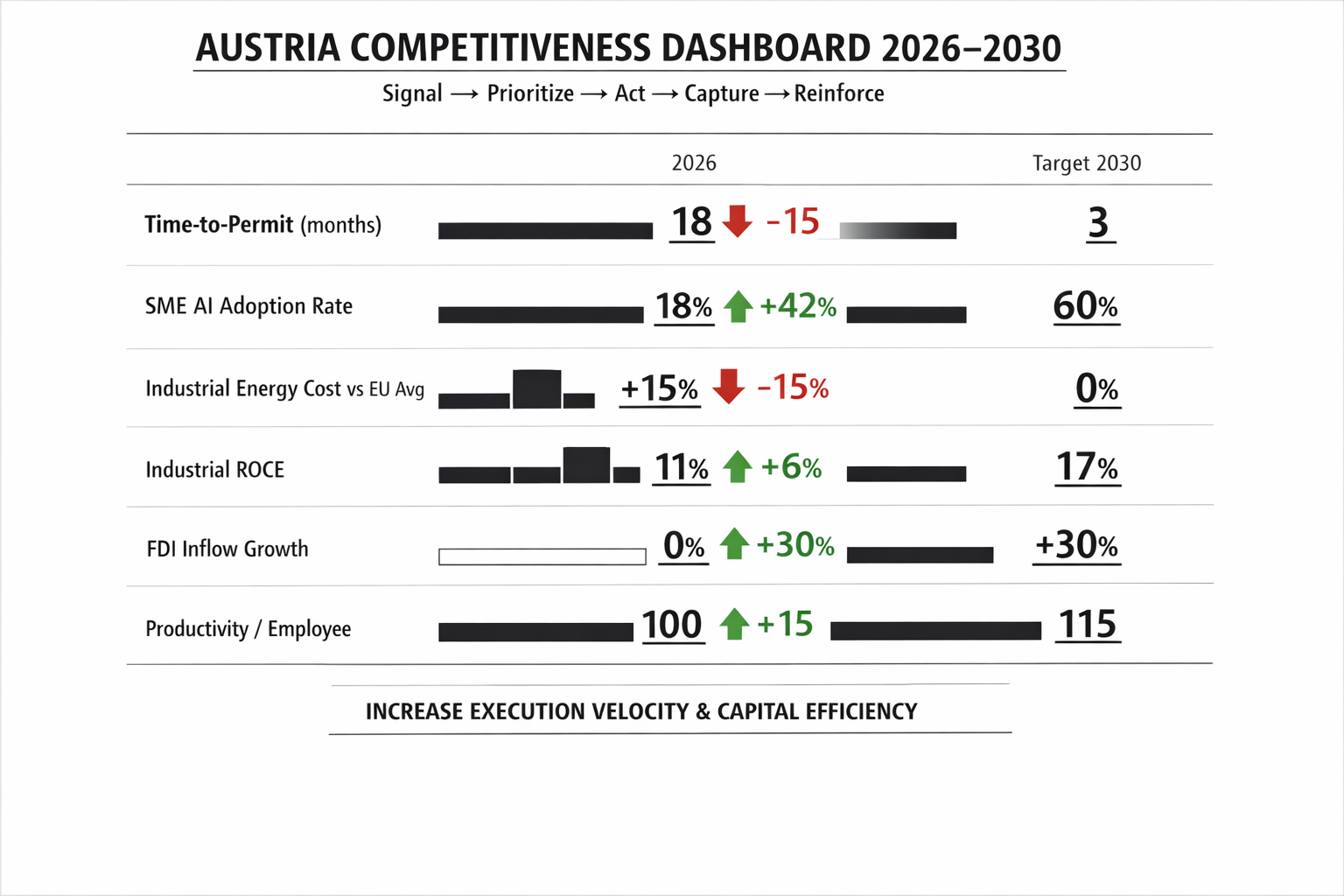
- Industrial ROCE increases from ~11% → 16–18%
- FDI inflow +25–35%
- Productivity index +15%
- Tax base expansion without tax increases
The economic compounding effect:
Higher productivity →
Higher corporate profits →
Higher reinvestment →
Higher innovation →
Higher competitiveness.
5️⃣ REINFORCE: Institutional Lock-In
Most reform programs fail in reinforcement.
Austria must:
- Tie ministerial budgets to KPI performance
- Maintain public transparency dashboards
- Continue AI integration into public services
- Prevent regulatory re-inflation
Reinforcement converts reform into structural advantage.
Geopolitical Lens (2026–2030)
Austria’s role within the EU depends on:
- Maintaining neutrality while enhancing economic strength
- Acting as a CEE gateway innovation hub
- Avoiding dependency on slower reform states
Competitiveness equals sovereignty.
Strategic Conclusion
Austria does not need ideological change.
It needs operational acceleration.
The RapidKnowHow Model applied nationally creates:
Signal clarity
Priority focus
Action velocity
Capital capture
Structural reinforcement
If Austria increases execution speed by 30% and productivity by 15%, it can regain top-tier small-nation competitiveness by 2030. – Josef David
Leave a Reply