
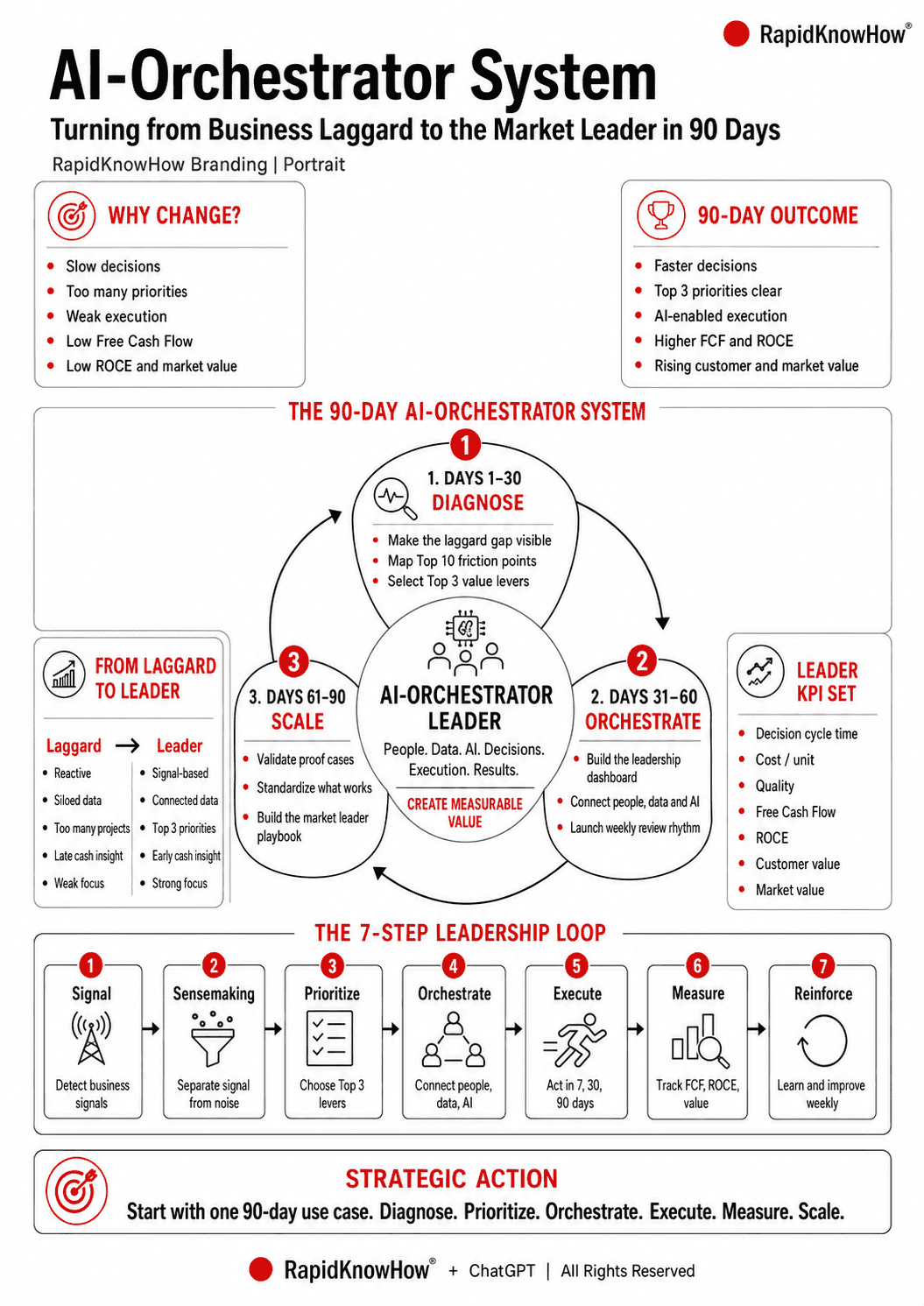
From Business Laggard to AI-Orchestrator Market Leader in the B2B Sector — Step-by-Step in 2026
Most B2B companies do not fail because they lack people, products or technology. They fall behind because they cannot orchestrate complexity fast enough.
They have data, but no clarity.
They have teams, but weak alignment.
They have AI tools, but no AI operating system.
They have strategies, but slow execution.
They have KPIs, but limited value impact.
The new B2B winner in 2026 is not simply the company that “uses AI.”
The winner is the company that uses AI to orchestrate decisions, people, processes, customers, operations and capital allocation into measurable business results.
That is the purpose of the AI-Orchestrator Leadership 90-Day Sprint.
The 90-Day Transformation System
Phase 1: Days 1–30
Diagnose the Laggard Position
Goal: Make the performance gap visible.
The first 30 days are not about launching many AI projects. They are about identifying where the business is losing time, money, quality, cash and market value.
Key Questions
What makes us a laggard today?
Where are decisions too slow?
Where is execution weak?
Where do we lose Free Cash Flow?
Where is ROCE below potential?
Where do customers experience friction?
Where are people working hard but not creating enough value?
Core Actions
- Map the current business performance.
- Identify the Top 10 friction points.
- Rank them by impact on time, cost, quality, FCF, ROCE and customer value.
- Select the Top 3 value levers.
- Create the first AI-Orchestrator Performance Baseline.
Output after 30 Days
AI-Orchestrator Diagnostic Map
| Area | Current Weakness | Value Impact | AI-Orchestrator Opportunity |
|---|---|---|---|
| Sales | Slow opportunity qualification | Lost margin | AI lead scoring |
| Operations | Poor visibility on bottlenecks | High working capital | AI signal dashboard |
| Supply Chain | Reactive planning | Delivery delays | Predictive planning |
| Finance | Late cash-flow insight | Weak FCF control | FCF early-warning system |
| Leadership | Too many priorities | Slow execution | Top-3 decision rhythm |
Result:
The company clearly sees where it is losing value and where AI-Orchestration can create measurable improvement.
Phase 2: Days 31–60
Build the AI-Orchestrator Operating System
Goal: Connect people, data, AI and execution into one leadership system.
In this phase, the company moves from diagnosis to orchestration. AI is no longer treated as an isolated tool. It becomes part of the leadership operating system.
The 7-Step AI-Orchestrator Loop
1. Signal
Detect relevant business signals early.
2. Sensemaking
Separate important patterns from noise.
3. Prioritize
Select the Top 3 actions with the strongest value impact.
4. Orchestrate
Connect people, data, AI tools, processes and decisions.
5. Execute
Translate decisions into 7-, 30- and 90-day actions.
6. Measure
Track impact on time, cost, quality, FCF, ROCE and customer value.
7. Reinforce
Learn weekly and improve the system continuously.
Core Actions
- Build a weekly AI-Orchestrator Leadership Dashboard.
- Define the Top 3 strategic priorities.
- Assign clear owners for each priority.
- Use AI for analysis, scenario comparison and action planning.
- Install a weekly 30-minute leadership review.
- Stop low-value activities.
- Reinforce what creates measurable value.
Output after 60 Days
AI-Orchestrator Leadership Dashboard
| Priority | Owner | AI Support | 30-Day Target | KPI |
|---|---|---|---|---|
| Improve FCF | CFO / Operations | Cash-flow early warning | Reduce cash leakage | FCF |
| Improve Sales Conversion | Sales Leader | AI opportunity ranking | Focus on top accounts | Win rate |
| Improve Delivery Reliability | Supply Chain Leader | Predictive bottleneck signals | Reduce delays | OTIF |
| Improve Margin | Commercial Leader | Price/mix analysis | Improve contribution | Gross margin |
| Improve Decision Speed | CEO / Board | Weekly signal review | Faster decisions | Decision cycle time |
Result:
The company now has a working AI-Orchestrator Leadership System that connects analysis with action.
Phase 3: Days 61–90
Scale from Laggard to Market Leader
Goal: Turn the AI-Orchestrator system into a repeatable value engine.
The final 30 days focus on scaling. The company now moves from first proof to leadership position.
Key Questions
Which AI-Orchestrator use case created the strongest impact?
Which process can be scaled across the business?
Which KPI improved visibly?
Which leadership behavior changed?
Which customer benefit became measurable?
Which value story can be communicated to the market?
Core Actions
- Validate the Top 3 proof cases.
- Measure before-and-after improvement.
- Create the AI-Orchestrator Value Case.
- Standardize the leadership rhythm.
- Package the system for internal scaling.
- Communicate the transformation to stakeholders.
- Build the next 90-day leadership sprint.
Output after 90 Days
AI-Orchestrator Market Leader Proof Case
| Before | After 90 Days | Strategic Effect |
|---|---|---|
| Slow decisions | Weekly signal-based decision rhythm | Faster leadership response |
| Fragmented data | AI-supported performance dashboard | Better transparency |
| Too many projects | Top-3 value priorities | Stronger focus |
| Weak FCF visibility | Early-warning cash-flow signals | Better cash control |
| Reactive operations | Predictive bottleneck management | Higher reliability |
| Low AI adoption | AI embedded in leadership system | Scalable capability |
Result:
The business has moved from scattered AI experimentation to an integrated AI-Orchestrator Leadership System with measurable value creation.
The 90-Day Roadmap
| Timeframe | Focus | Main Output | Business Result |
|---|---|---|---|
| Days 1–10 | Performance Baseline | Laggard Diagnosis | Value gap visible |
| Days 11–20 | Signal Mapping | Business Signal Radar | Key risks and opportunities visible |
| Days 21–30 | Top-3 Value Levers | AI-Orchestrator Sprint Plan | Clear priorities |
| Days 31–45 | System Build | AI Leadership Dashboard | People, data and AI connected |
| Days 46–60 | Execution Rhythm | Weekly AI-Orchestrator Review | Faster implementation |
| Days 61–75 | Proof Cases | Measured improvement | Value evidence |
| Days 76–90 | Scaling Model | Market Leader Playbook | Repeatable AI value system |
The Strategic Value Formula
The AI-Orchestrator Leader does not measure success by AI activity.
Success is measured by business value:
AI-Orchestrator Value = Better Signals × Faster Decisions × Stronger Execution × Measurable Results
For B2B companies, the most important result metrics are:
Free Cash Flow.
ROCE.
Gross Margin.
Working Capital.
Sales Conversion.
Delivery Reliability.
Customer Value.
Employee Productivity.
Market Multiple.
Market Value.
The Core Message for B2B Leaders
A B2B company becomes an AI-Orchestrator Market Leader when it can prove five things:
- It detects relevant business signals earlier than competitors.
- It makes better decisions faster.
- It connects people, data and AI into one execution system.
- It measures value creation clearly.
- It improves the system every week.
That is the shift:
From tool usage to value orchestration.
From isolated AI experiments to leadership operating system.
From laggard to AI-Orchestrator Market Leader.
Strategic Call-to-Action Recommendation
Start with one serious 90-day use case.
Do not begin with “AI transformation” as a vague program. Begin with one measurable business result:
Improve Free Cash Flow.
Increase ROCE.
Reduce working capital.
Improve sales conversion.
Reduce delivery delays.
Accelerate decision speed.
Improve customer value.
Then apply the 90-day system:
Diagnose → Prioritize → Orchestrate → Execute → Measure → Scale
RapidKnowHow Strategic Value Statement:
Give B2B Leaders a 90-Day AI-Orchestrator System that turns business laggards into market leaders by transforming complexity into clarity, decisions into execution, and execution into measurable value. -Josef David