Assessment through the RapidKnowHow IP AI-Orchestrator B2B Leader Lens
Energy Management + Industrial Automation + AI Data Centers + Compounding Market Value
Author: Josef David
RapidKnowHow + ChatGPT
Executive Summary
Schneider Electric is one of the strongest B2B transformation cases for the AI age. The company sits exactly where the next global growth wave is emerging: electrification, energy management, automation, data centers, grid resilience, AI infrastructure, industrial efficiency and sustainability.
Through the RapidKnowHow IP AI-Orchestrator B2B Leader Lens, Schneider Electric should be seen not only as an energy management company, but as an AI-era infrastructure orchestrator.
The strategic logic is:
Electrification → Energy Intelligence → Data Center Growth → Industrial Automation → Free Cash Flow → ROCE / ROICE → Multiple → Compounding Market Value
Schneider’s recent performance supports this positioning. In Q1 2026, the company reported record quarterly revenue of about €9.8 billion, up 11.2% organically, with Energy Management growing 12.8% organically, led by strength in data centers. Industrial Automation grew 4.4% organically, and the company reaffirmed its 2026 target.
The investment case is powerful: Schneider Electric benefits from the collision of two megatrends — AI infrastructure demand and energy efficiency pressure. This makes it an ideal RapidKnowHow B2B transformation case.
1. Why Schneider Electric Matters
Schneider Electric is strategically positioned at the center of the new energy-intelligence economy.
AI, cloud computing, industrial automation, electrification, smart buildings, EV infrastructure, grid modernization and energy resilience all require more intelligent power management.
The old B2B question was:
How do we supply energy and equipment?
The new B2B question is:
How do we orchestrate energy, automation, digital systems and customer operations into measurable efficiency, resilience and Free Cash Flow?
This is where Schneider Electric becomes highly relevant.
It does not only sell components. It provides systems, software, services and energy-management architecture for mission-critical environments.
That makes Schneider a strong candidate for the role of AI-Orchestrator B2B Leader.
2. The RapidKnowHow AI-Orchestrator Lens
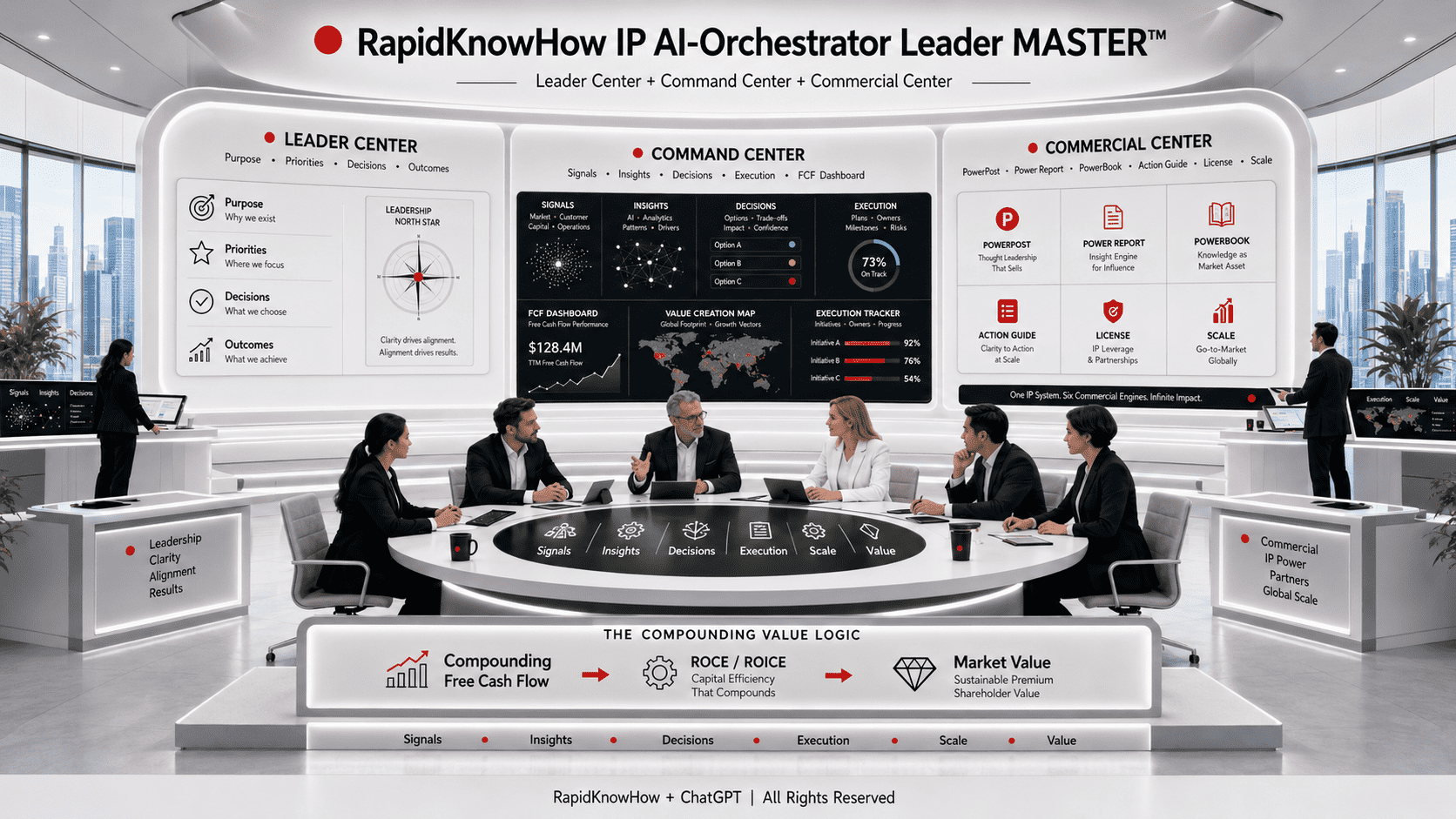
The RapidKnowHow lens assesses Schneider through six questions:
- Signal Radar – Does Schneider detect the strongest market signals early?
- Insight Engine – Does Schneider convert those signals into strategic direction?
- Decision Board – Does Schneider allocate capital and management focus to the strongest value pools?
- Execution Tracker – Does Schneider convert strategy into growth, margin and customer value?
- FCF / ROCE Logic – Does Schneider turn transformation into cash and capital productivity?
- Commerce Center – Does Schneider package capabilities into scalable offers, platforms and recurring value?
The answer is broadly positive. Schneider has a strong transformation platform. Its main challenge is not lack of opportunity. Its challenge is disciplined orchestration at scale.
3. Leader Center Assessment
The Leader Center of Schneider Electric is strong because the company has a clear strategic direction: become a leading global player in energy management and automation for a more electric, digital and sustainable world.
The strongest leadership signals are:
- Data center demand is accelerating.
- AI workloads require high-density power and cooling systems.
- Industrial customers need energy efficiency and automation.
- Buildings and infrastructure need electrification and resilience.
- Customers increasingly demand integrated solutions, not isolated products.
Schneider’s announced strategic collaboration with Foxconn to develop and scale next-generation AI data center infrastructure is a strong example of Leader Center logic: Schneider brings power, cooling and energy-management technology; Foxconn brings manufacturing and AI systems expertise; together they aim to deliver ready-to-deploy AI data center solutions, with production expected later in 2026.
RapidKnowHow assessment:
Leader Center Score: 9/10
Schneider has clarity of direction, strong market relevance and excellent timing. The key leadership challenge is prioritization: avoiding complexity while scaling across data centers, industry, infrastructure and sustainability.
4. Command Center Assessment
The Command Center is where Schneider’s transformation becomes operational.
Schneider can monitor and optimize:
- Power demand
- Cooling demand
- Energy efficiency
- Data center uptime
- Industrial automation performance
- Building energy systems
- Grid interaction
- Asset reliability
- Sustainability indicators
- Customer operating costs
This is Schneider’s core strength: it can connect physical infrastructure with digital intelligence.
In AI data centers, this becomes especially important. Schneider’s AI data center solutions include power, cooling, software, pod and rack systems, lifecycle services, maintenance and optimization for high-performance workloads.
Through the RapidKnowHow lens, Schneider’s Command Center value proposition becomes:
See energy. Control infrastructure. Optimize performance. Reduce risk. Improve customer Free Cash Flow.
This is not only technology. It is operational intelligence.
RapidKnowHow assessment:
Command Center Score: 9/10
Schneider has excellent command-center potential because its systems sit close to the customer’s critical operations. The strategic risk is dashboard overload. The winning model must connect data directly to decisions and customer outcomes.
5. Commerce Center Assessment
The Commerce Center is where Schneider converts technical strength into scalable revenue and market value.
Schneider’s commercial advantage is that its products and systems are tied to urgent customer problems:
- AI data center capacity
- Energy cost pressure
- Cooling bottlenecks
- Reliability and uptime
- Industrial productivity
- Decarbonization
- Grid constraint
- Resilient infrastructure
- Lifecycle service needs
The strongest Commerce Center opportunities are:
- AI-ready data center infrastructure packages
- Modular power and cooling systems
- Energy optimization services
- Digital twin and simulation tools
- Smart building performance systems
- Industrial automation upgrades
- Lifecycle service contracts
- Software-enabled energy management
- Customer efficiency programs
- Partner-based infrastructure ecosystems
The Foxconn partnership is commercially important because it suggests Schneider can move from selling systems to delivering scalable, ready-to-deploy AI infrastructure solutions. Reuters reported that the collaboration aims to combine Foxconn’s manufacturing and AI systems expertise with Schneider’s power, cooling and energy-management technology.
RapidKnowHow assessment:
Commerce Center Score: 8.5/10
The opportunity is large. The key challenge is packaging offers clearly enough that customers see not only equipment value, but full business-case value.
6. Free Cash Flow Lens
Schneider’s transformation must be judged by Free Cash Flow quality.
The company’s 2025 key figures show revenues of €40 billion, 9% organic growth, adjusted EBITA margin of 18.7%, and net income of €4.2 billion. Its full-year 2025 materials also highlighted record performance and strong free cash flow conversion.
For Schneider, FCF can compound through:
- Higher data center demand
- Better margin mix
- Software and lifecycle services
- Modular infrastructure packages
- Recurring service revenue
- Energy-management platforms
- Stronger pricing power
- Installed-base monetization
- Partner ecosystem leverage
The RapidKnowHow question is:
Can Schneider turn AI infrastructure demand into repeatable, high-quality, cash-generating solution packages?
If yes, Schneider’s FCF quality improves.
FCF Potential Score: 8.5/10
7. ROCE / ROICE Lens
Schneider’s ROCE / ROICE improvement depends on capital productivity.
The strategic goal is not only to grow revenue. The goal is to grow high-quality revenue with attractive returns on capital.
The AI-Orchestrator logic is:
Energy Management + Automation + Software + Services + Partner Ecosystem = Better Capital Productivity
Schneider improves capital productivity when it:
- Scales software-enabled offerings
- Uses partners for manufacturing scale
- Converts installed base into service revenue
- Builds modular, repeatable solutions
- Improves operational efficiency
- Prioritizes higher-margin segments
- Avoids overextension into low-return complexity
The Foxconn collaboration is relevant here because partner-based scaling can potentially support faster growth without Schneider carrying all manufacturing burden itself.
ROCE / ROICE Potential Score: 8.5/10
8. Multiple and Market Value Lens
Schneider’s valuation multiple can improve if the market increasingly sees the company as:
- A critical AI infrastructure supplier
- A global energy-intelligence platform
- A data center growth beneficiary
- A software-enabled automation leader
- A sustainability and electrification compounder
- A high-quality FCF generator
The most important narrative shift is:
From electrical equipment company to AI-era energy and infrastructure orchestrator.
Market value can compound if Schneider proves four things:
- Data center growth is durable.
- Energy management margins remain strong.
- Software and lifecycle services increase revenue quality.
- Capital productivity remains disciplined.
Schneider’s Q1 2026 results strengthen this narrative because growth was led by Energy Management and data center strength, while all business models contributed.
Market Value Potential Score: 9/10
9. Strategic Risks
Schneider’s opportunity is strong, but several risks must be managed.
Risk 1: AI Infrastructure Overheating
AI data center demand is powerful, but the sector can overbuild capacity.
Risk 2: Grid Constraints
Power availability may limit data center expansion in some regions.
Risk 3: Execution Complexity
Schneider operates across many regions, segments and technologies.
Risk 4: Margin Pressure
Large infrastructure projects can become competitive and execution-heavy.
Risk 5: Partner Dependency
Strategic partnerships create speed but also require clear governance.
Risk 6: Customer Payback Pressure
Customers will demand proof of energy savings, uptime improvement and FCF impact.
The RapidKnowHow warning:
Schneider wins if orchestration stays stronger than complexity.
10. Strategic Recommendation
Schneider should be assessed through the following RapidKnowHow value chain:
Leader Center → Command Center → Commerce Center → Free Cash Flow → ROCE / ROICE → Multiple → Compounding Market Value
Leader Center
Own the strategic position: AI-era energy intelligence and infrastructure orchestration.
Command Center
Turn power, cooling, automation and software data into real-time customer decision systems.
Commerce Center
Package solutions into repeatable AI data center, smart infrastructure and industrial automation offers.
Free Cash Flow
Measure success by customer and Schneider cash impact.
ROCE / ROICE
Use software, services, modularity and partnerships to improve capital productivity.
Multiple
Earn a stronger valuation through durable growth, recurring revenue, strategic relevance and cash quality.
Compounding Market Value
Convert electrification, automation, AI infrastructure and energy intelligence into long-term enterprise value.
Final Strategic Fazit
Schneider Electric is one of the strongest B2B transformation cases for 2026 because it sits at the strategic intersection of AI, energy, infrastructure, automation and sustainability.
The company’s opportunity is not simply to provide equipment. Its opportunity is to orchestrate intelligent infrastructure for the AI economy.
Through the RapidKnowHow IP AI-Orchestrator B2B Leader Lens, Schneider Electric can be summarized in one sentence:
Schneider Electric wins if it turns energy intelligence into customer outcomes, customer outcomes into Free Cash Flow, Free Cash Flow into ROCE / ROICE, and ROCE / ROICE into compounding market value.-Josef David