
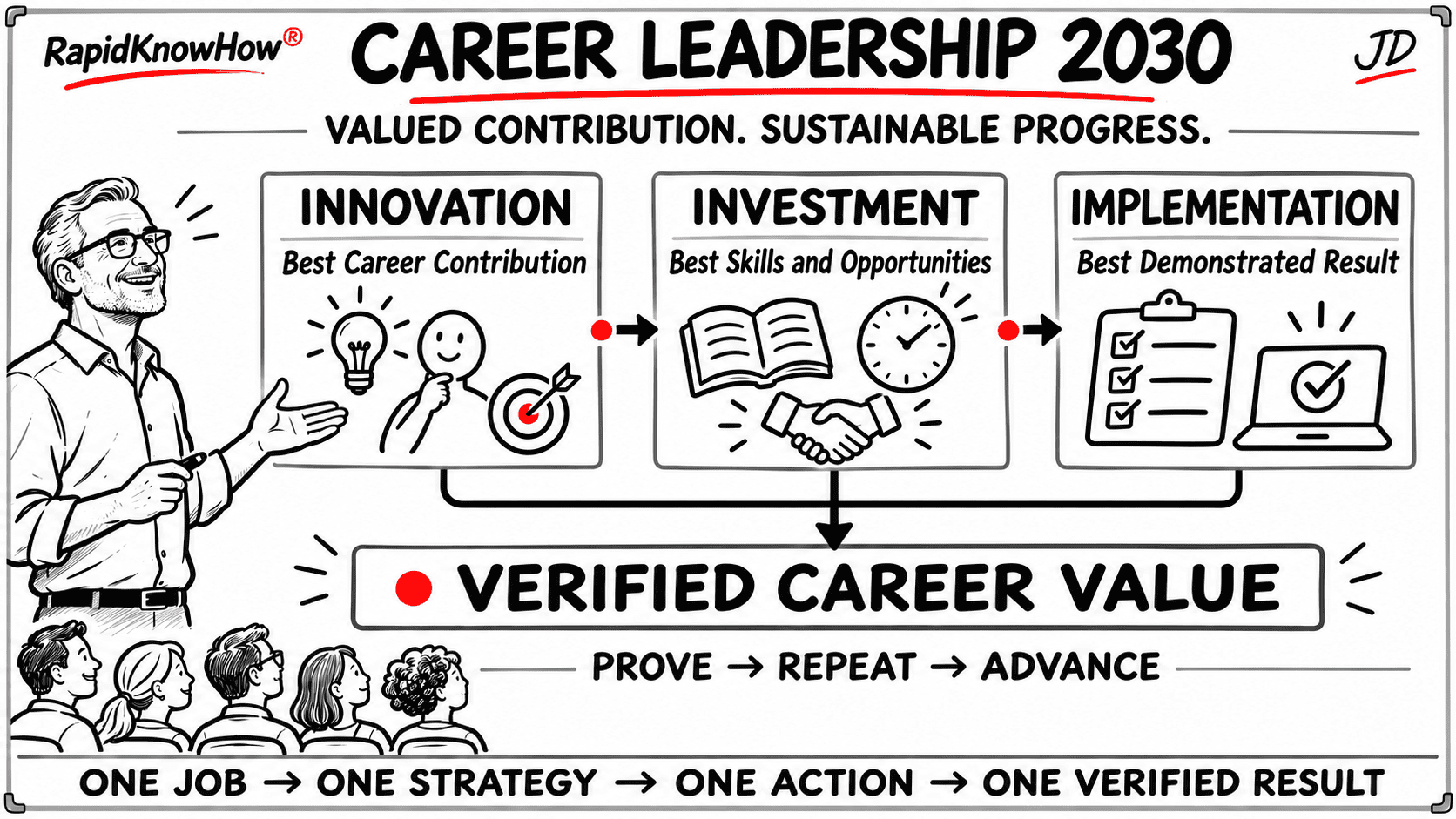
Career leadership means choosing where you can contribute most, finding the right opportunity and support, and demonstrating results that create future options.
The MASTER connects three decisions:
INNOVATION → INVESTMENT → IMPLEMENTATION → VERIFIED CAREER VALUE
| Leadership decision | Leading question | Required result |
|---|---|---|
| Innovation | Which valuable problem am I best positioned to solve? | ONE relevant career proposition |
| Investment | Which capabilities, relationships and opportunities deserve my resources? | ONE focused development commitment |
| Implementation | How will I demonstrate my contribution? | ONE documented result |
Career value includes contribution, income, employability, autonomy and personal fit. Progress should be assessed against the individual’s circumstances and priorities.
1. Innovation to Career Leadership — Find the best Career Contribution Model
The leading question is:
“Who needs my capabilities, which problem can I solve, and why should they choose me?”
Start with the work that needs doing. Connect your experience and strengths to a specific employer, customer or community need.
| Career situation | Contribution model to evaluate | Evidence to develop |
|---|---|---|
| Entering a profession | Solve a clearly defined task reliably | Work sample and credible feedback |
| Developing expertise | Solve a difficult, recurring specialist problem | Documented examples of useful results |
| Moving into leadership | Help others deliver through better decisions and coordination | Team outcomes and stakeholder feedback |
| Changing direction | Apply transferable capabilities to a new problem | Relevant project or supervised assignment |
| Building a portfolio career | Offer expertise through selected assignments | Repeat demand and sustainable delivery economics |
Recommended model: build your career proposition around ONE important problem and evidence that you can help solve it.
Complete this sentence:
“I help [specific organization or customer] achieve [valuable outcome] by applying [relevant capabilities], demonstrated through [evidence].”
For example:
“I help industrial companies improve project delivery by clarifying responsibilities, resolving dependencies and reviewing progress against agreed milestones.”
This becomes stronger when supported by documented results and references.
🔴 Intervention point: Your experience is extensive, but its relevance is difficult to understand.
🔴 Leverage point: Translate that experience into ONE clear contribution proposition.
2. Investment to Career Leadership — Find the best Capability and Opportunity Match
The leading question is:
“Which investment will close the most important gap between my current capability and my intended contribution?”
Career investment includes time, money, attention, relationships and practical experience.
| Current constraint | Investment to evaluate | Evidence that it helped |
|---|---|---|
| Missing essential knowledge | Focused learning tied to a real task | Better performance on that task |
| Limited practical experience | A suitable project or assignment | Completed work and useful feedback |
| Unclear market relevance | Conversations with potential employers or customers | Clearer requirements and credible interest |
| Weak visibility | A concise portfolio of relevant work | More substantive discussions about opportunities |
| Limited leadership experience | Responsibility for a bounded team outcome | Improved coordination and delivery |
| Unsustainable workload | Better boundaries and role design | A workload compatible with reliable performance |
Recommended principle: connect each development investment to an opportunity to apply it.
Before committing to a course, qualification or career move, establish:
- Which requirement does it address?
- Who values that capability?
- Where can you practise it?
- What will it cost in money and time?
- What evidence would justify continuing?
A qualification may be essential for access to a profession or role. In other situations, a relevant work sample, assignment or reference may provide more useful evidence.
🔴 Intervention point: Learning and networking consume resources without improving career options.
🔴 Leverage point: Connect ONE development activity to ONE practical application and review its value.
3. Implementor to Career Leadership — Find the best Contribution-to-Result Model
The leading question is:
“Which assignment will allow me to demonstrate useful work within an agreed scope?”
Choose an implementation approach that fits your experience, authority and access.
| Situation | Implementation model | Result to verify |
|---|---|---|
| Exploring a new field | Bounded project or work sample | Relevance and quality of the work |
| Establishing yourself in a role | Ownership of a clearly defined task | Reliable completion and stakeholder acceptance |
| Seeking greater responsibility | Cross-functional improvement assignment | Agreed operational or customer improvement |
| Developing as a leader | Lead a team toward one shared objective | Team delivery and quality of collaboration |
| Offering independent expertise | Paid pilot with clear terms | Customer acceptance and actual payment |
Recommended model: ONE assignment, ONE accountable contribution, ONE agreed outcome and ONE evidence record.
Agree the scope before starting:
- The problem and baseline.
- Your responsibilities and decision authority.
- The resources and support available.
- The intended outcome and review date.
- Who will assess the work.
🔴 Intervention point: You work hard, but your contribution remains difficult to assess.
🔴 Leverage point: Agree what success means before doing the work, then document the result.
4. Verify Career Value — Separate Activity, Contribution and Reward
Applications submitted, courses completed and meetings attended show activity. Career progress requires examining what those activities produced.
| Level | Question | Possible evidence |
|---|---|---|
| Activity | Did I carry out the planned action? | Completed learning, applications or project work |
| Capability | Can I now perform the relevant task better? | Work samples, assessment and feedback |
| Contribution | Did my work help achieve the agreed outcome? | Accepted deliverable or documented improvement |
| Career opportunity | Did this create a credible next step? | Interview, expanded responsibility, offer or repeat assignment |
| Personal value | Does the opportunity meet my priorities? | Income, workload, autonomy, learning and personal fit |
A successful assignment does not automatically produce a promotion, contract or higher income. Those outcomes also depend on organizational needs, available opportunities and decisions by others.
Where commercial results matter, distinguish your contribution from the work of the wider team. Claim only what the evidence supports.
Illustrative example: You lead a project that reduces an agreed reporting cycle from five days to three. The verified result is the shorter cycle, subject to maintained quality. The next career step is to use that evidence in a discussion about responsibilities or opportunities. A salary increase remains a separate outcome.
5. AI-Assisted Career Leadership 2030
AI can help you:
- Translate experience into a clear contribution proposition.
- Compare role requirements with your demonstrated capabilities.
- Structure learning and prepare practice exercises.
- Improve applications and interview preparation.
- Organize evidence from completed work.
You remain responsible for accuracy, judgment and delivery. Describe your capabilities honestly, protect confidential information and distinguish your own work from AI assistance.
The strongest career evidence remains work you can explain, substantiate and repeat.
6. ONE 90-Day Career Leadership Experiment
| Period | ONE priority | Output |
|---|---|---|
| Days 1–15 | Select a target contribution | Clear problem, audience and capability gap |
| Days 16–30 | Secure a suitable practical opportunity | Agreed assignment and success criteria |
| Days 31–75 | Deliver and review | Work evidence and stakeholder feedback |
| Days 76–90 | Assess the result and next step | Documented outcome and career decision |
At the review, decide:
CONTINUE → BUILD SKILL → REPOSITION → PURSUE OPPORTUNITY → STOP
If access to a suitable assignment remains the constraint, revise the route—for example, through a smaller work sample or a supervised project.
ONE prioritized action: Write your contribution proposition and identify ONE person who can assess whether it addresses a real need.
“Over the next 90 days, I will demonstrate my ability to solve ______ for ______ through ______, assessed against ______.”
RapidKnowHow® MASTER Principle
ONE JOB → ONE STRATEGY → ONE ACTION → ONE VERIFIED RESULT
PROVE → REPEAT → ADVANCE
SEE EARLIER • DECIDE BETTER • ACT FASTER.