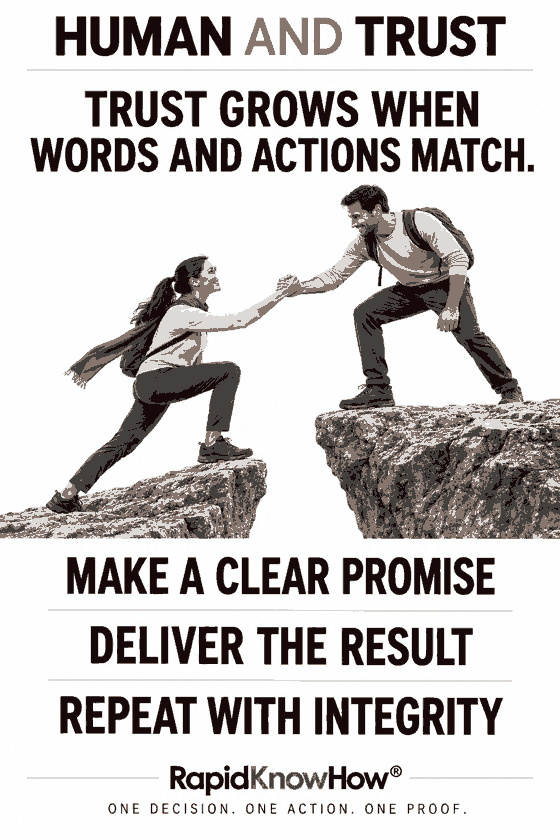
TRUST GROWS WHEN WORDS AND ACTIONS MATCH.
The central question
What makes a person trustworthy?
The problem
We often confuse warmth, confidence, status or familiarity with trustworthiness. A persuasive person may still fail to deliver. A quiet person may be highly dependable. The practical question is what someone can safely be relied upon to do.
The insight
Trust is willingness to accept vulnerability based on an expectation of responsible behaviour. Treat trust as specific: trust in someone’s honesty, skill or discretion may differ. Build it from relevant evidence, clear commitments and proportionate exposure.
A practical example
A customer needs a supplier to deliver an essential item on Friday. Instead of saying “Trust us,” the supplier confirms the specification, names the owner, agrees the delivery window and explains how delays will be reported. The customer can now assess a concrete promise.
ONE decision
Replace a vague request for trust with one clear, verifiable commitment.
TOP 3 actions
- Choose one relationship and identify exactly what the other person needs to rely on.
- Agree the result, responsible person, deadline and acceptable evidence.
- Deliver and ask the other person whether the commitment was fulfilled.
30-day result
Within 30 days, record the commitments due, the commitments delivered as agreed, and exceptions communicated before the deadline.
Your reflection
Where am I asking for trust without providing enough evidence?
Action checklist
Write: “You can rely on me to deliver ___ by ___. We will verify it through ___.” Keep the promise small enough to fulfil, but important enough to matter.
PASS: the commitment is clear, feasible and verifiable. REVIEW: remove the one obstacle preventing delivery before adding more rules.
Put the complete system into practice
Get all ten episodes, the Trust Decision Canvas and the 30-day Action Guide in the HUMAN AND TRUST PowerBook – €29.
PowerLicense for organisations
Want to use the HUMAN AND TRUST system in team workshops, leadership development or client programmes? Explore the RapidKnowHow® PowerLicense offer. Organisational reuse, adaptation and distribution require a separately agreed licence; buying the PowerBook does not include those rights.
RapidKnowHow® — One decision. One action. One proof.

