
RAPIDKNOWHOW® · YOUR NEXT COMMERCIAL STEP
START SMALL. PROVE VALUE. SCALE WHAT WORKS.
1 — START: Get the matching PowerProduct
RapidKnowHow® PowerBook — Total Cost of Ownership Management across Company Borders — €29
Review the contents and current checkout total before buying. This is a self-guided PDF; implementation support and licensing are separate.
Confirmed payment → PDF download access + order email. Bank transfer requires payment confirmation.
2 — PROVE: Build your real cash case
Agree a shared supplier–customer cost baseline and verify the net benefit for both parties. Scope, fees, baseline and verification criteria are agreed before any mandate begins.
REQUEST MY VALUE-PROOF FIT CHECK →
Start your message: TCO CASH CASE · your business problem · desired 30–90 day result. Avoid confidential information.
3 — SCALE: Repeat through an annual licence
After verified value, explore repeat use across teams, sites or partners. Rights, support, fees and renewal terms require a written agreement.
Choose the route that fits your need. An enquiry creates no payment commitment. Business outcomes depend on implementation and evidence.
RapidKnowHow® — THE BALANCER SYSTEM™
CREATE MORE CASH TOGETHER — AND ENSURE BOTH PARTIES BENEFIT.
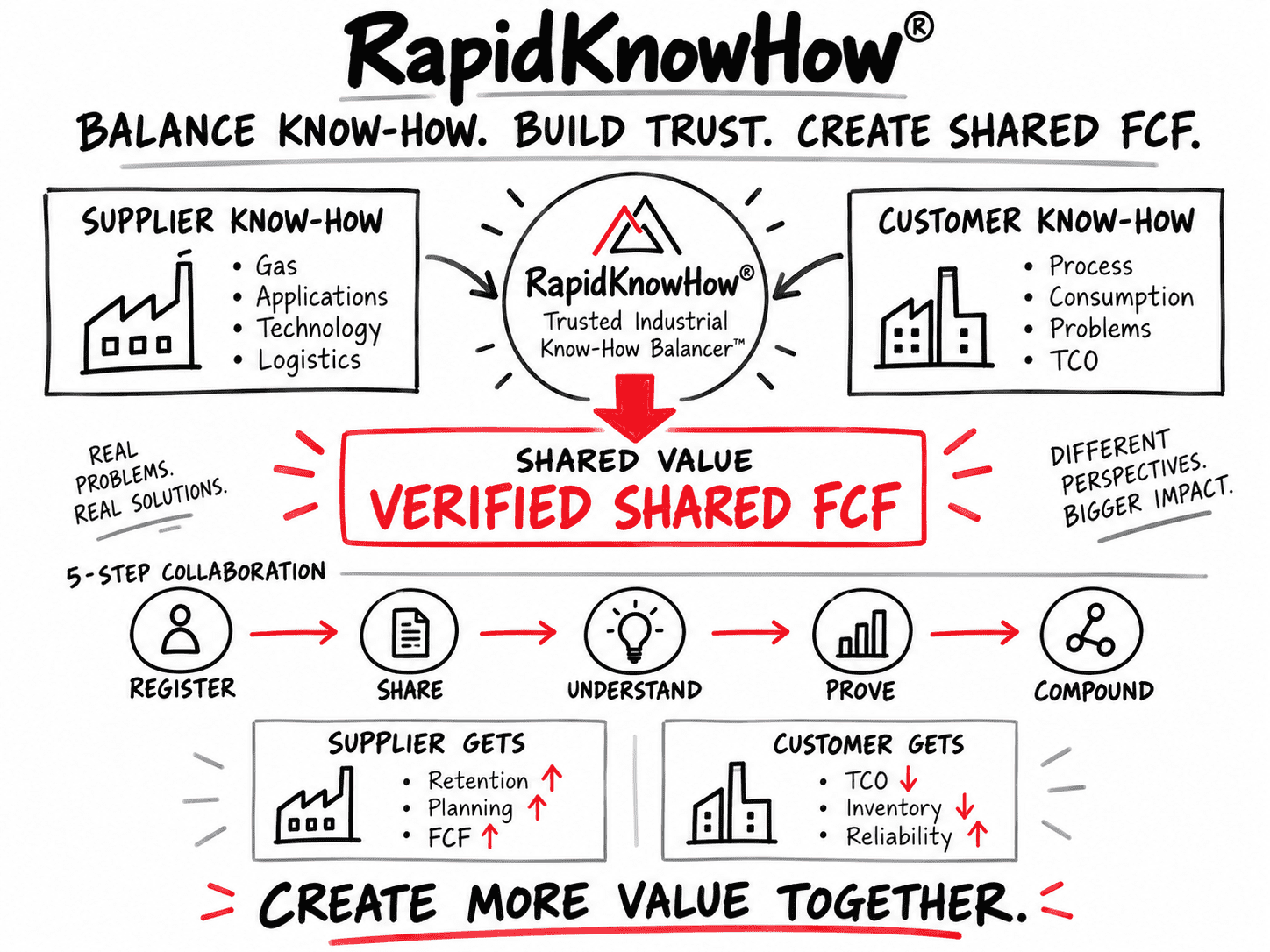
The game shows how an industrial gas supplier and its manufacturing customer can combine their knowledge to improve total cash flow, then share the resulting value.
The rule of the game
Your mission is to achieve:
- At least €130,000 combined additional cash in year one.
- A positive year-one cash result for both supplier and customer.
Reducing the customer’s gas bill alone does not guarantee success: the supplier may lose income. You win by improving the joint operating result and agreeing how to share it.
All figures are illustrative, incremental, pre-tax cash estimates, not verified free cash flow.
Step 1 — Choose your perspective
Select Supplier, Customer, or Joint team.
The supplier contributes gas, application, technology and logistics knowledge. The customer contributes process, consumption, operating problems and cost information.
The role button changes your perspective and guidance. It does not change the calculation.
Step 2 — Select the improvements
You can select one, two or all three:
| Improvement | Customer benefit | Supplier impact |
|---|---|---|
| Stop gas losses | Lower gas consumption and expenditure | Lower sales contribution from reduced volume |
| Replenish intelligently | Less inventory and better replenishment | More efficient deliveries and less inventory |
| Improve the process | Lower scrap and processing costs | Additional net contribution from application services |
Each choice includes its assumed operating benefits, investment and any inventory cash release.
Step 3 — Set realistic execution
Move the year-one realization slider between 50% and 100%.
This represents how much of the annual operating benefit you achieve during the first year. At 50%, you receive half the annual benefit, while the game still charges the full investment and includes the full inventory release.
Step 4 — Agree the supplier’s service fee
Move the annual customer-to-supplier service fee slider.
This compensates the supplier for its contribution to the joint improvement.
The fee shares value; it does not create additional combined cash. Every euro paid by the customer becomes one euro received by the supplier. The game applies the realization percentage to this fee as well.
Step 5 — Read the result
The game displays customer cash, supplier cash and their combined total.
It gives one of three results:
- UNBALANCED: one party has zero or negative year-one cash.
- BOTH GAIN: both benefit, but combined cash remains below €130,000.
- SCENARIO PASS: both benefit and combined cash reaches at least €130,000.
A successful example
Select all three improvements, set realization to 100%, and agree an annual service fee of €50,000.
| Year-one calculation | Customer | Supplier | Combined |
|---|---|---|---|
| Annual operating benefit before fee | €185,000 | €25,000 | €210,000 |
| Service fee transferred | −€50,000 | +€50,000 | €0 |
| One-time investment | −€80,000 | −€40,000 | −€120,000 |
| One-time inventory cash release | +€30,000 | +€20,000 | +€50,000 |
| Additional year-one cash | €85,000 | €55,000 | €140,000 |
Outcome: SCENARIO PASS. Both parties gain, and the joint target is exceeded by €10,000.
The €50,000 inventory release happens once. It must not be counted as recurring annual cash.
Step 6 — Turn the scenario into verified value
The game produces a proposed business case. To establish an actual result:
- SHARE: agree a baseline using consumption, inventory, deliveries, costs and cash records.
- ACT: assign owners, approve investments and the sharing agreement, and run a 90-day pilot.
- PROVE: compare actual results with the baseline, adjusting for production volume and mix. Include actual costs and avoid counting the same benefit twice.
The commercial next step is Find the Cash Gap™ — €299, leading through WooCommerce checkout to the customer PDF Action Guide.
The final outcome
A successful game ends with one joint improvement decision, a positive cash case for each party, and a clear plan to verify it.
Scaling follows verified results—not the simulation alone.
ACTION CHECKLIST
☐ Select the improvements.
☐ Set a realistic realization percentage.
☐ Agree a fee that leaves both parties better off.
☐ Check the €130,000 combined target.
☐ Assign owners and establish the baseline.
☐ Run the pilot and verify actual cash.
☐ Fix the largest obstacle before scaling.
RapidKnowHow® · THE BALANCER SYSTEM™
Optimize Total Cash Flow
Industrial Gas Game
CREATE MORE CASH TOGETHER.
Balance supplier know-how with customer process knowledge. Select improvements, share the gains and build a case both parties can support.
Illustrative manufacturing-site case. All results are incremental, pre-tax cash estimates in euros, not verified FCF. No information is submitted or saved.
1 · Choose your perspective
Joint team: optimize combined cash and keep both parties better off.
2 · Choose joint improvements
Mission: achieve at least €130,000 combined year-one cash, with a positive result for each party. Prices alone redistribute cash; operating improvements create it.
3 · Balance execution and reward
The fee is a transfer: it reduces customer cash and increases supplier cash equally. The realization factor applies to benefits and fee; investment and inventory release occur fully in year one.
4 · Read the total cash result
Choose an improvement to begin.
Combined annual operating cash at full realization:
€0
One-time investment:
€0
One-time inventory cash release:
€0
See assumptions and calculation
Amounts below are €000. Annual benefits are net of recurring operating costs. No maintenance capex, tax, financing, inflation or terminal value is modeled. All benefits are assumed additive and must be checked for overlap in a real case.
| Improvement | Customer annual | Supplier annual | Customer investment | Supplier investment | Customer stock release | Supplier stock release |
|---|---|---|---|---|---|---|
| Gas losses | 70 | −30 | 20 | 0 | 0 | 0 |
| Replenishment | 20 | 50 | 10 | 20 | 30 | 20 |
| Process | 95 | 5 | 50 | 20 | 0 | 0 |
Customer year one = (annual benefit − fee) × realization − investment + stock release.
Supplier year one = (annual benefit + fee) × realization − investment + stock release.
Combined cash = customer + supplier. Internal payments cancel.
Cash released from inventory is counted once. Payment-term changes are excluded: one party’s receivable reduction can become the other party’s cash outflow. A real proof needs matched periods, scope, cash records and an agreed baseline.
5 · Turn the scenario into cash proof
- SHARE: agree gas consumption, losses, stock, deliveries and avoidable costs for the same site and period.
- ACT: assign an owner and a 90-day pilot for the selected improvements; agree investment and the service fee.
- PROVE: reconcile actual cash changes for both parties, adjust for production volume and mix, then decide whether to scale.
Next step: Find the Cash Gap™ · €299
Move from an illustrative scenario to your own cash-gap assessment.
Product page → WooCommerce checkout → automatic customer PDF delivery → action → measurable cash proof. Internal editable IP masters are not customer downloads.
Action checklist · before scaling
- SETUP — agree the baseline and data owners.
- CORE — reconcile supplier and customer calculations.
- RESULT — verify actual incremental cash, including costs.
- JOURNEY — complete checkout and open the customer PDF without help.
- DEVICE — test the game and purchase path on laptop and iPhone.
- UX — check readable labels and a clear next action.
- COMMERCIAL — confirm the offer, price and PDF delivery.
- KPI — track offer clicks, purchases and verified cases separately.
- TRUST — agree data use and distinguish estimates from evidence.
- PASS / FAIL — scale only when both parties accept the verified result.
- REVIEW — fix the single largest obstacle before adding features.
Leave a Reply