

COUNT HEADS → CUT HEADS → COMPOUND VALUE
| Counting Heads | Cutting Heads | Compounding Knowledge |
|---|---|---|
| How many people do we employ? | How many jobs can we remove? | How can people’s knowledge create lasting value? |
| Measure workforce size. | Reduce payroll costs. | Share, apply and improve proven know-how. |
| Focus on numbers. | Focus on cuts. | Focus on better results. |
Industrial Gas Application
Capture an operator’s proven improvement → apply it across sites → reduce gas losses and downtime → release free cash flow → repeat.
People create knowledge. Shared knowledge improves operations. Repeated improvements compound value. – Josef David
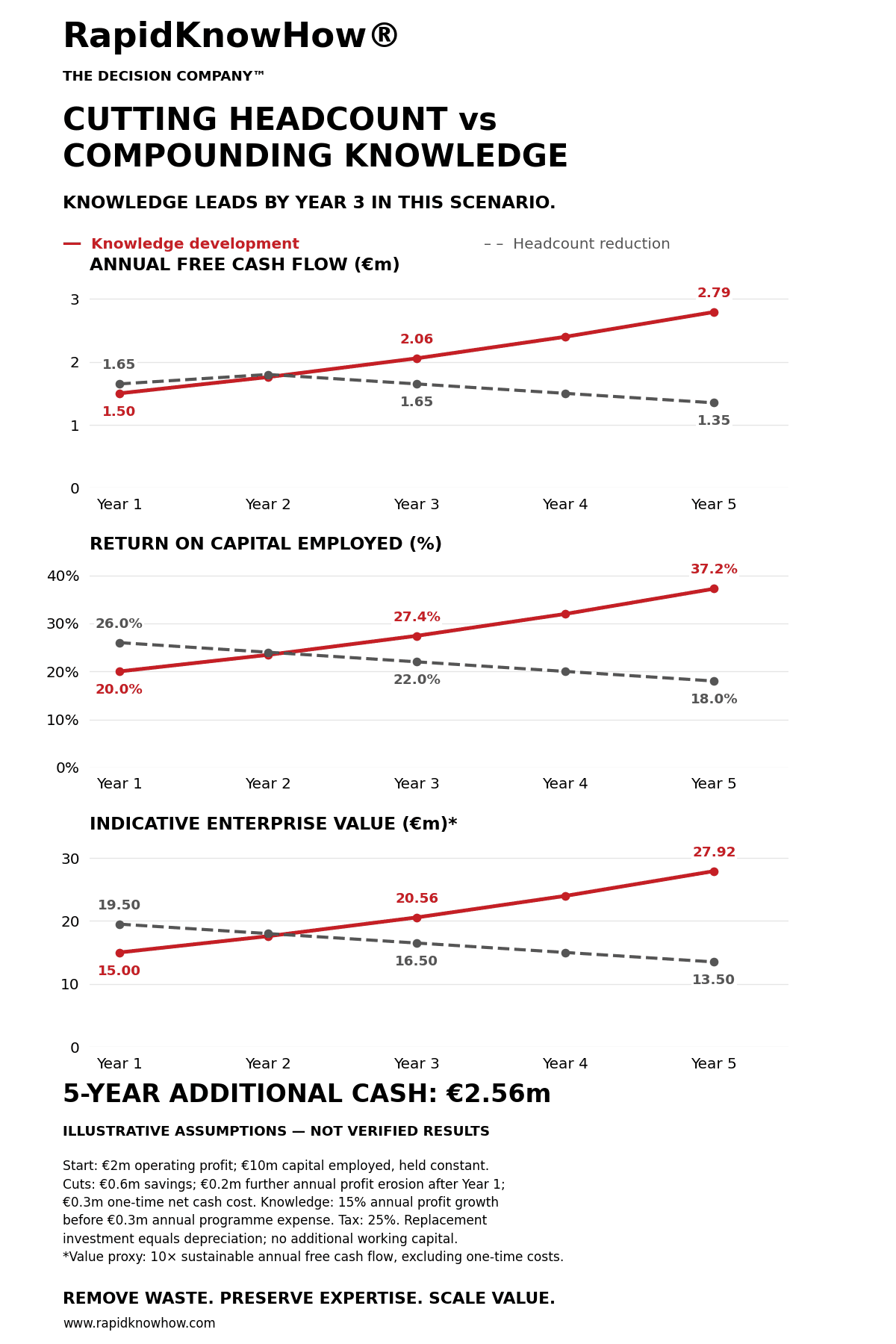
RapidKnowHow® — Cutting Headcount versus Compounding Knowledge
CUT COSTS ONCE. REUSE KNOWLEDGE REPEATEDLY.
The following is an illustrative industrial gas business case. The results follow from the assumptions; they are not verified company results.
Both approaches start with €2 million annual operating profit and €10 million capital employed.
| Assumption | Headcount reduction | Compounding knowledge development |
|---|---|---|
| Management action | Remove positions | Capture, share and reuse expertise |
| Initial benefit | €600,000 annual savings | Operating profit before programme costs grows 15% annually |
| Ongoing effect | Lost capability reduces annual profit by another €200,000 each year after Year 1 | Improvements compound through better pricing, deliveries and customer service |
| Implementation cost | €300,000 net cash cost in Year 1 | €300,000 annual programme expense |
Common assumptions: 25% cash tax; replacement investment equals depreciation; no additional working capital; capital employed stays at €10 million.
Calculated results — money figures in € million
| Measure | Approach | Year 1 | Year 3 | Year 5 |
|---|---|---|---|---|
| Annual free cash flow | Headcount reduction | 1.65 | 1.65 | 1.35 |
| Knowledge development | 1.50 | 2.06 | 2.79 | |
| Return on capital employed | Headcount reduction | 26.0% | 22.0% | 18.0% |
| Knowledge development | 20.0% | 27.4% | 37.2% | |
| Indicative enterprise value* | Headcount reduction | 19.50 | 16.50 | 13.50 |
| Knowledge development | 15.00 | 20.56 | 27.92 |
Return on capital employed equals operating profit divided by capital employed. Free cash flow here means cash available to all capital providers after tax and reinvestment. ACCA Global
*Enterprise value uses an assumed 10 times sustainable annual free cash flow, excluding the one-time restructuring payment. This is a comparison shortcut. A full valuation discounts expected future cash flows and reflects risk. pages.stern.nyu.edu
Five-year outcome
- Total cash generated: €10.51m from knowledge development versus €7.95m from headcount reduction.
- Additional cash: €2.56m.
- Year 5 enterprise-value advantage: €14.42m under the same assumed multiple.
Headcount reduction leads initially; knowledge development leads by Year 3 in this scenario. The decisive test is whether knowledge reuse produces measurable gains—and whether staff reductions actually damage capability.
Board decision: Remove unnecessary work. Preserve critical expertise. Scale what demonstrably creates cash. – Josef David
Other Sources on Value Management
| Source | Relevant finding | Value for our comparison |
|---|---|---|
| McKinsey — The Economic Potential of Generative AI | Productivity gains require investment in people and changes to how work is performed. | Supports developing people’s capabilities alongside technology. McKinsey |
| BCG — Cost Transformations in Turbulent Times | Narrow cost cutting can undermine growth. BCG describes combining process improvements with reinvestment in growth. | Supports removing waste while preserving valuable expertise. BCG |
| Harvard–BCG experiment — Navigating the Jagged Technological Frontier | In an experiment involving 758 consultants, AI users completed suitable tasks 25.1% faster and completed 12.2% more tasks. Performance worsened on a task outside AI’s capabilities. | Supports testing where AI improves knowledge work and retaining expert judgment. Organization Science |
| Brynjolfsson, Li & Raymond — Generative AI at Work | The working paper reports 14% higher productivity across 5,179 support agents, with evidence suggesting AI spreads experienced workers’ best practices. | The strongest direct evidence for capturing expertise and sharing it across an organisation. NBER |
For our PNG, the source note should read:
“Research context: McKinsey; BCG; Dell’Acqua et al.; Brynjolfsson, Li & Raymond. Financial projections: RapidKnowHow® illustrative scenario.”
The distinction matters: these studies support the underlying approach. They do not establish our assumed 15% annual profit growth, declining benefits from staff cuts, or calculated enterprise values. Productivity gains must first become measurable savings, additional sales or released capital before they increase free cash flow.
“In my 30 years of experience, companies too often overlook people as strategic assets whose knowledge and capabilities compound in value through sustained, purposeful investment.” – Josef David