
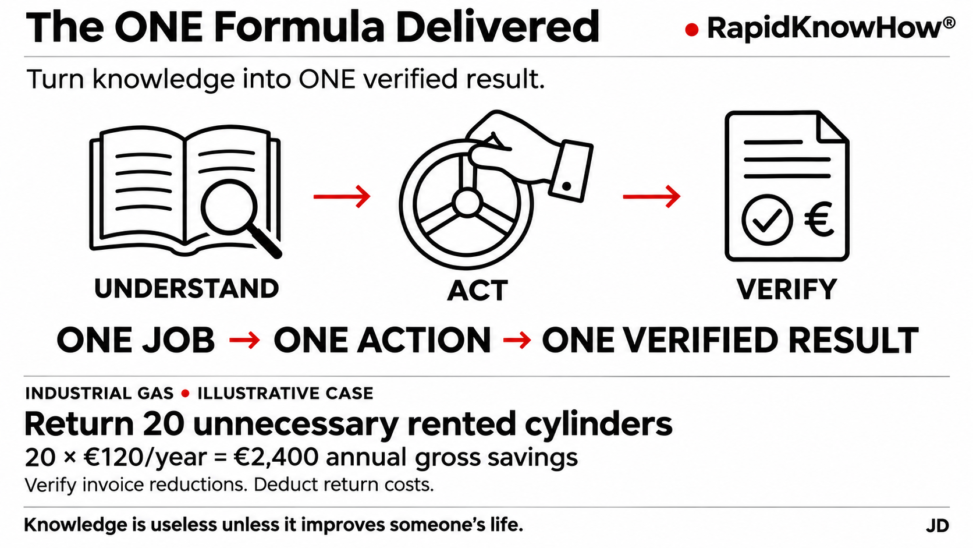
Knowledge becomes useful when someone applies it and can show what improved.
A good explanation creates understanding. A useful tool enables action. Evidence shows whether the action delivered the intended result.
The RapidKnowHow® formula connects these elements:
ONE JOB → ONE ACTION → ONE VERIFIED RESULT
Its objective is to help people find and test a reliable relationship that improves their business, life or career.
1. ONE JOB — Define what needs to improve
Start with a specific problem that matters to someone.
“Improve our business” is too broad to guide an immediate action. “Reduce unnecessary cylinder rental charges at ONE site” gives the user a clear starting point.
Define:
- The problem and who experiences it.
- The outcome you want to improve.
- The metric that will show the change.
- The baseline, scope and review period.
The baseline answers: What is happening before we act?
Without it, an improvement can be difficult to distinguish from an impression.
2. Find ONE testable relationship
Before choosing an action, explain why you expect it to work.
Use this sentence:
If we change X, Y should improve because Z—provided these conditions hold.
For example:
“If we return eligible empty cylinders sooner, rental charges should fall because fewer rental days are billed—provided the contract stops those charges after accepted returns.”
This is a prediction to test.
It identifies the factor you can influence, the outcome you expect and the conditions required. It also helps you recognise when the proposed action is unlikely to work.
A reliable relationship earns confidence through evidence and repeated use. ONE successful case provides a starting point; further comparable tests strengthen it.
3. ONE ACTION — Make the prediction practical
Choose ONE action that the user can carry out and review.
Specify what will happen, who owns it, when it will happen and what evidence must be retained.
For the cylinder example:
Arrange ONE scheduled collection of eligible empty cylinders and retain the supplier’s acceptance receipts.
For a recurring administrative task:
Create ONE short checklist and use it for the next comparable task.
The action should be small enough to execute and meaningful enough to test the relationship.
RapidKnowHow® provides the business case, know-how and tools. The user implements the action and records what happens.
4. ONE VERIFIED RESULT — Show what changed
After the action, measure the same outcome using a consistent scope and measurement basis.
Ask:
- What changed compared with the baseline?
- Which records support the change?
- What else could explain it?
- What additional effort or cost was required?
- Were quality, safety and service maintained?
For this model, “verified” means the result has supporting evidence and has been reviewed by an identified person. Independent verification should be stated separately when it occurs.
A completed action is an implementation milestone. A verified result shows its outcome.
An illustrative industrial gas business case
A customer introduces a scheduled return collection at ONE site.
Before the action, monthly rental charges are €600 and collection costs are €100. The combined cost is €700.
In a comparable month after the action, rental charges are €450 and collection costs are €140. The combined cost is €590.
The calculation is:
€150 lower rental charges − €40 additional collection costs = €110 net monthly cost reduction.
Return receipts, invoices and collection records must support the figures. The review must also consider demand, contractual terms, other changes and service performance.
The figures illustrate the method; they are not a customer result or a guaranteed saving. A cost reduction becomes a verified cash benefit only when the relevant cash movements and timing are established.
Apply the same formula beyond industrial gas
The model is versatile because the job, action and evidence can change while the logic remains consistent.
In business, the result might be fewer billing errors, lower losses or faster payment.
In daily life, it might be less time spent searching for documents or completing a recurring task.
In a career, it might be demonstrating a new skill through a completed assignment that meets agreed acceptance criteria.
In every case, define the outcome before choosing the action.
Review, improve and repeat
The result determines the next step.
When the action works, document the conditions and test whether the improvement continues.
When it partly works, identify the obstacle and adjust ONE element.
When it fails, review the prediction, implementation and evidence. A failed test can still provide useful knowledge.
When it creates an unacceptable downside, change or stop the action.
The learning cycle is:
ACT → RECORD EVIDENCE → REVIEW → IMPROVE
The RapidKnowHow® role
RapidKnowHow® turns know-how into practical business cases and tools that help users act.
The user takes ownership of implementation. The evidence determines whether the result deserves to be repeated.
Each documented case should give the next user enough information to understand the starting conditions, apply the action and verify their own outcome.
YOUR ONE ACTION TODAY
Choose ONE recurring problem. Record its baseline. Write ONE testable relationship. Take ONE action. Review the evidence.
ONE JOB → ONE ACTION → ONE VERIFIED RESULT
“Knowledge is useless unless it improves someone’s life.” – Josef David
RapidKnowHow® — THE DECISION COMPANY™
Industrial Gas Leadership 2030
PROVE VALUE. THEN SCALE.
Watch the 60-second roadmap: 10 strategic actions for DACH and CEE, 2026–2030.
Start with ONE customer challenge. Use the Industrial Gas Action Guide to turn your first action into a measurable result.
RapidKnowHow® — Leading Industrial Gas Opportunity Signal Identifier in DACH & CEE