
The leadership opportunity
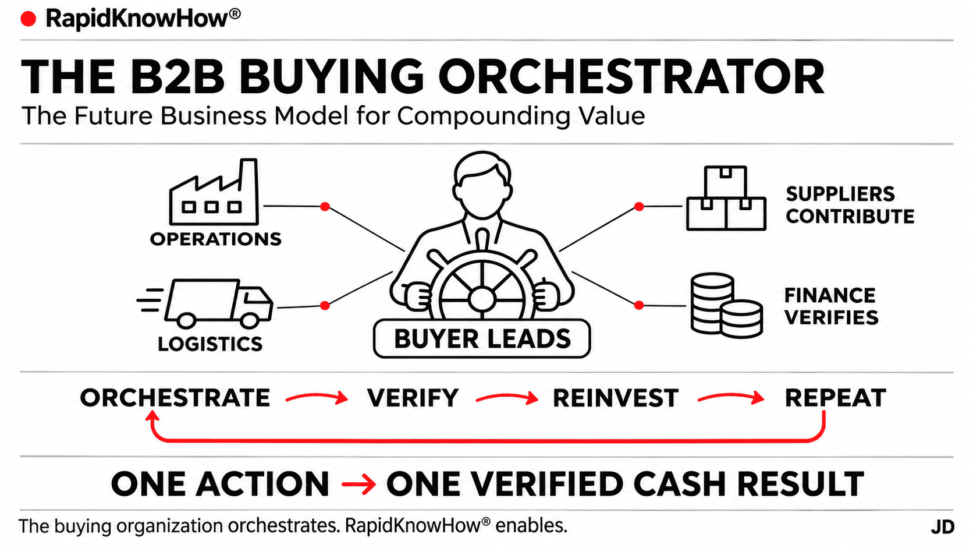
The buying organization can become the leader of its value chain by connecting customer requirements, operations, suppliers, assets, logistics and finance around ONE measurable outcome.
Annual price negotiation remains useful. Buyer-led orchestration extends the opportunity to consumption, asset productivity, delivery reliability, working capital and sustained free cash flow. This builds on established strategic-sourcing principles: total cost of ownership, supplier collaboration and continuous performance review. CIPS
The buying organization orchestrates. Suppliers contribute. Finance verifies. RapidKnowHow® enables.
The buyer owns the objective and approves decisions. Suppliers contribute technical expertise. Operations protects availability, quality and safety. Finance determines whether improvements have produced incremental cash.
RapidKnowHow® provides neutral know-how, methods and implementation guidance.
How the model creates value
The orchestrator establishes a repeatable operating cycle:
- Define ONE customer outcome.
- Establish the operational and financial baseline.
- Identify ONE opportunity across the value chain.
- Implement ONE controlled action.
- Verify the actual cash result.
- Sustain the improvement.
- Evaluate reinvestment and repeat.
The buyer benefits from improved economics and reliable supply. Suppliers can benefit from predictable demand, fewer emergency deliveries and faster asset circulation. Each party’s benefit needs its own evidence.
Industrial gas: an illustrative business case
Assume ONE manufacturing site with €1 million in eligible annual gas spend, unchanged output and service requirements.
These are scenario assumptions, not verified customer results.
| Annual cash bridge | Price negotiation | Buyer-led orchestration |
|---|---|---|
| Price savings | €20,000 | €20,000 |
| Removal of unnecessary rentals | — | €30,000 |
| Reduced gas losses | — | €25,000 |
| Fewer emergency deliveries | — | €15,000 |
| Gross recurring savings | €20,000 | €90,000 |
| Incremental annual operating costs | −€5,000 | −€20,000 |
| Illustrative cash tax at 25% | −€3,750 | −€17,500 |
| Recurring annual incremental FCF | €11,250 | €52,500 |
The orchestration scenario also assumes:
- €40,000 one-time release of buyer-owned working capital.
- €30,000 implementation expense, equivalent to €22,500 after the assumed tax effect.
- Full-year benefits, immediate tax effects and no incremental capital expenditure.
Year 1 incremental FCF:
€52,500 + €40,000 − €22,500 = €70,000
If recurring benefits remain constant, five-year undiscounted cash totals €280,000, compared with €56,250 for price negotiation: an illustrative difference of €223,750.
Rental savings and working-capital release must remain separate. Returning supplier-owned cylinders can stop rental charges; it does not automatically release buyer-owned working capital. Cash-flow analysis uses the change in working capital. accaglobal.com
What makes the value compound?
Recurring savings provide the cash foundation. Productive reinvestment creates the compounding mechanism.
For illustration, reinvesting €52,500 at each year-end, earning an assumed 10% annual net return, produces approximately €320,518 after five years. Without returns, those contributions total €262,500.
The additional €58,018 represents hypothetical investment returns. This separate illustration excludes the one-time release and implementation cost. The return is an assumption; each reinvestment requires its own business case.
The commercial opportunity for RapidKnowHow®
Offer a defined proof pilot, followed by an optional licence for the methods, templates and decision support.
If performance fees are used, agree the baseline, eligible net cash benefit, attribution and verification process before implementation. Disclose commercial incentives and preserve the buyer’s final choice.
ONE recommended action
Reconcile ONE site’s cylinder-rental invoice against its physical register. Identify eligible idle cylinders, confirm return conditions, obtain rental-stop confirmation and verify subsequent invoices and payments.
That first verified result creates the basis for the next decision—and for disciplined reinvestment.
ONE JOB → ONE STRATEGY → ONE ACTION → ONE VERIFIED RESULT.
RapidKnowHow® — THE DECISION COMPANY™
Industrial Gas Leadership 2030
PROVE VALUE. THEN SCALE.
Watch the 60-second roadmap: 10 strategic actions for DACH and CEE, 2026–2030.
Start with ONE customer challenge. Use the Industrial Gas Action Guide to turn your first action into a measurable result.
RapidKnowHow® — Leading Industrial Gas Opportunity Signal Identifier in DACH & CEE