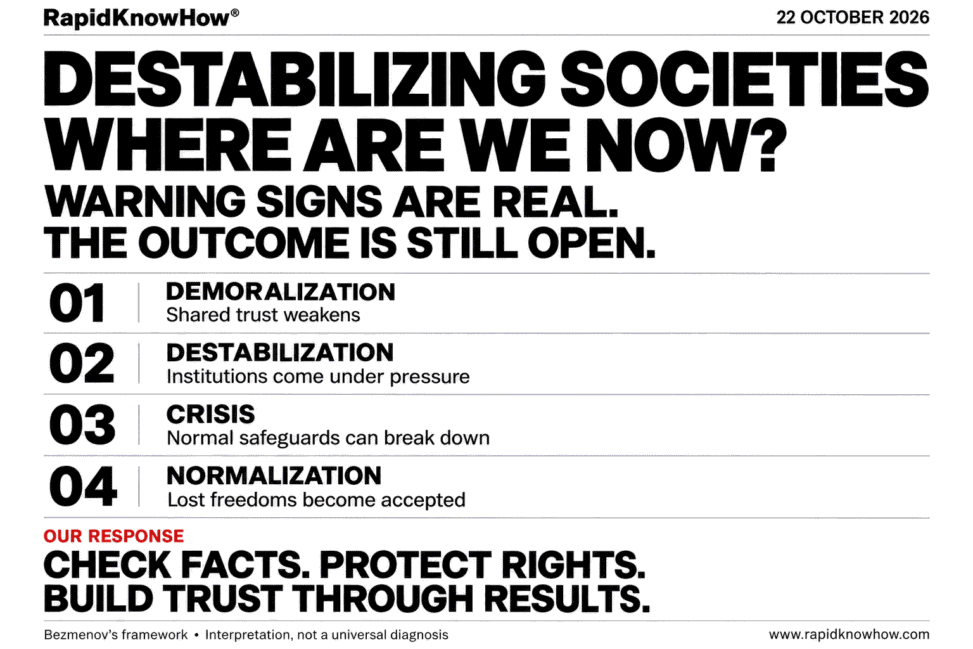
WARNING SIGNS ARE REAL. THE OUTCOME IS STILL OPEN.
RapidKnowHow® | 22 October 2026
Our original PowerPost introduced Yuri Bezmenov’s four stages: demoralization, destabilization, crisis and normalization. Today, the useful question is: which warning signs can we verify—and what should we do?
The four stages in plain language
| Stage | What it means | Warning sign to watch |
|---|---|---|
| 1. Demoralization | Shared trust weakens. | People stop believing that facts or participation matter. |
| 2. Destabilization | Institutions come under pressure. | Courts, elections and public services struggle to retain credibility. |
| 3. Crisis | Normal safeguards can break down. | Fear creates demand for unchecked power. |
| 4. Normalization | Lost freedoms become accepted. | Restrictions introduced during a crisis become permanent. |
These are simplified interpretations of Bezmenov’s framework. They do not establish that every society follows this sequence or that one hidden actor controls events.
Where are we now?
My assessment: Europe faces serious destabilization pressures, but assigning the whole continent to one stage would be misleading.
Three findings matter:
- Democratic decline is measurable. V-Dem’s 2026 report, covering 2025, identifies 44 countries undergoing autocratization—movement toward less accountable government. It also identifies 18 countries moving toward greater democracy, including Poland and Brazil. Decline is not inevitable.
- Information manipulation is an active concern. At their 15–16 October 2026 meeting, EU leaders called for stronger democratic resilience against increasing foreign information manipulation and interference.
- Societies are responding. Current European initiatives seek to protect elections, independent media and citizen participation. Their success must be judged by results and respect for rights.
These findings support concern about institutional pressure. They do not prove Bezmenov’s entire causal theory.
The decisive test
Can citizens still question leaders, investigate wrongdoing, organise peacefully and replace governments through credible elections?
Watch what happens to these freedoms. Criticism, protest and disagreement are also ways societies correct mistakes.
ONE decision: strengthen our ability to act together.
Top 3 actions
- Check before sharing. Find the original source, date and evidence. Separate facts from interpretation.
- Protect accountability. Expect transparent decisions, independent scrutiny and clear limits on emergency powers—from every political side.
- Deliver one shared result. Bring people with different views together to solve a practical problem: improve a local service, reduce waste or strengthen supply reliability.
For business leaders
Apply the same discipline to decisions: verify information, invite challenge and work with customers, employees and suppliers on measurable improvements.
This fits RapidKnowHow’s mission: create fair collaboration in which participants gain value together.
30-day result: one completed joint improvement, a recorded outcome and a clear review of what worked.
Confidence: strong evidence of democratic and information pressures; limited confidence in assigning societies to a single historical stage.
Trust grows when people can question power—and see cooperation deliver results.
RapidKnowHow® — THE DECISION COMPANY™
Further reading — understand the warning signs and take action
- The Four Stages of Destabilizing Societies — revisit the original framework.
- Who Was Yuri Bezmenov? — understand its historical background.
- Empowering Citizens — clarify your values and turn them into civic action.
- Thriving Democracy Result — strengthen participation, accountability and community cooperation.
Take the next step
Explore strategic responses to geopolitical uncertainty with the Master Global Strategy PowerBook.
🔴 VIEW THE POWERBOOK IN THE SHOP →
RapidKnowHow® — THE DECISION COMPANY™
RapidKnowHow® — THE DECISION COMPANY™
Industrial Gas Leadership 2030
PROVE VALUE. THEN SCALE.
Watch the 60-second roadmap: 10 strategic actions for DACH and CEE, 2026–2030.
Start with ONE customer challenge. Use the Industrial Gas Action Guide to turn your first action into a measurable result.
RapidKnowHow® — Leading Industrial Gas Opportunity Signal Identifier in DACH & CEE