
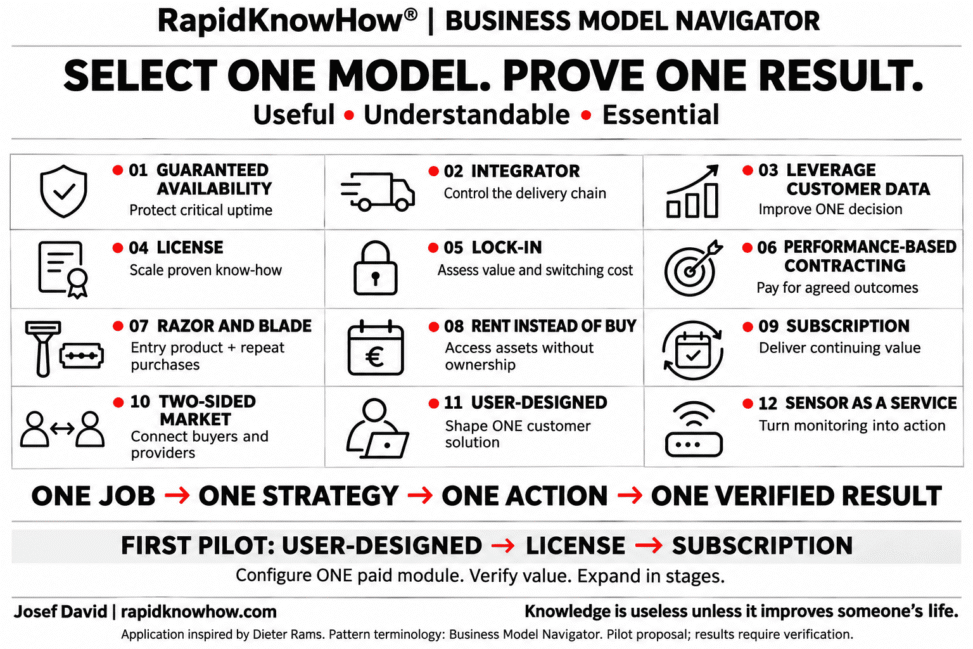
RapidKnowHow® Business Model Navigator — Select ONE Model. Prove ONE Result.
For business owners, CxOs, boards and investors, the purpose is to turn business-model knowledge into a useful customer outcome.
ONE JOB → ONE STRATEGY → ONE ACTION → ONE VERIFIED RESULT
Our application of Dieter Rams’s lessons follows three principles:
- Useful: solve ONE real customer problem.
- Understandable: make ONE next action clear.
- Essential: keep what helps deliver and verify the result.
FLOW defines the customer journey. FUNCTION provides the tools to complete the job. DESIGN makes those tools easy to understand and use.
The 12 business models applied (RKH – RapidKnowHow)
| Business model | Customer value | RKH application to test | Verify |
|---|---|---|---|
| Guaranteed Availability | Keep a critical service available. | Define ONE supported process, service level and response commitment, backed by delivery capacity. | Availability, response time, service cost and performance against the commitment. |
| Integrator | Reduce failures between delivery stages. | Control the relevant stages from diagnosis through implementation and verification. | Total delivery cost, lead time, capital required and customer outcome. |
| Leverage Customer Data | Make better decisions using existing information. | Analyse agreed customer data to identify ONE cost, inventory or service opportunity. | Data quality, decision improvement and attributable net benefit. |
| License | Apply repeatable know-how with clear usage rights. | License ONE documented module containing decision rules, tools and verification methods. | Paid licences, deployment cost, customer results and net cash. |
| Lock-In | Preserve accumulated integration and learning benefits, while recognizing switching costs. | Assess the continuing value of an embedded workflow and make exit terms clear. | Renewal, customer benefit and switching exposure. |
| Performance-Based Contracting | Link payment to an agreed outcome. | Test a fee tied to a measurable improvement against an agreed baseline. | Attribution, verified improvement, customer net benefit and payment received. |
| Razor and Blade | Use an entry product supported by recurring complementary purchases. | Test whether an entry tool creates a legitimate need for repeat paid inputs. | Repeat purchases, contribution margin, payback and customer total cost. |
| Rent instead of Buy | Access an asset without owning it. | Compare renting equipment for a pilot with purchasing it, including maintenance and ownership obligations. | Utilization, lifecycle cost, cash timing and capital return. |
| Subscription | Maintain access to a continuing service. | Provide recurring decision support, monitoring or updates when customers need ongoing value. | Usage, renewal, service cost, cancellations and net cash. |
| Two-Sided Market | Find a suitable trading or delivery partner. | Match ONE buyer need with qualified providers before investing in a platform. | Qualified matches, completed transactions, matching time and net fee income. |
| User-Designed | Shape the solution around the actual job. | Let ONE paying buyer configure a module within clear delivery boundaries. | Willingness to pay, delivery effort, adoption and usefulness. |
| Sensor as a Service | Turn measurements into timely action. | Connect ONE asset measurement to ONE alert, decision and accountable response. | Data reliability, response time, operational benefit and full service cost. |
How to select ONE model
Start with the customer’s job. Compare three candidate models using five questions:
- How urgent is the problem?
- Who pays, for which deliverable or outcome?
- Can we fulfil the delivery obligation?
- How quickly can we verify the result?
- Will the model generate positive net cash after incremental costs and investment?
Select the simplest viable model. A promising revenue mechanism cannot compensate for an undeliverable service or an unverifiable result.
Recommended RapidKnowHow starting sequence
USER-DESIGNED → LICENSE → SUBSCRIPTION
First, configure ONE paid module with ONE buyer. Use the buyer’s actual problem to establish what the module must accomplish.
Next, document the repeatable method and license its use. Define the scope, permitted users, support and verification method.
Add a subscription when customers need a continuing service worth renewing. Each stage should earn the investment in the next.
ActionGuide — ONE model decision in ONE hour
| Time | Action | Output |
|---|---|---|
| 0–10 minutes | Define ONE buyer, urgent job, baseline and success criterion. | A clear customer problem. |
| 10–20 minutes | Shortlist three relevant models. | Three plausible options. |
| 20–35 minutes | Compare price, benefit, delivery costs, investment and risk. | A comparable business case. |
| 35–45 minutes | Select ONE model and record its critical assumptions. | ONE reasoned decision. |
| 45–60 minutes | Specify the paid pilot, responsible owner, deadline and evidence required. | ONE executable next action. |
| After execution | Check the outcome and actual cash against the baseline. | Continue, revise or stop. |
ONE practical pilot: idle cylinder rentals
The customer is an industrial site paying rental charges for cylinders it may no longer need.
- ONE JOB: stop avoidable rental payments while preserving required gas availability.
- ONE STRATEGY: configure a customer-specific matching module using the User-Designed model.
- ONE ACTION: match ONE rental invoice with the physical cylinder register, then initiate approved returns.
- ONE VERIFIED RESULT: confirm returned cylinders, corrected billing and the actual net cash benefit.
RapidKnowHow’s paid deliverable would contain the matching checklist, calculation worksheet and verification record. The price and willingness to pay must be tested with the buyer.
If the module proves useful and repeatable, it becomes a candidate for licensing across further sites. Ongoing monitoring could later support a subscription.
Verify value for both parties
For the customer, measure additional cash receipts and payments avoided, less incremental fees, implementation and operating payments within the agreed period.
For RapidKnowHow, measure customer cash collected, less refunds and incremental acquisition, delivery and setup payments.
Keep projected savings separate from realized cash. When combining models, count shared benefits once.
ONE next action: configure ONE paid industrial customer module with ONE buyer and agree how its result will be verified.
This is RapidKnowHow’s application portfolio . The model terminology comes from Business Model Navigator. The applications are proposals for testing; no verified pilot outcome is claimed.
RapidKnowHow® — Knowledge is useless unless it improves someone’s life.
RapidKnowHow® — THE DECISION COMPANY™
Industrial Gas Leadership 2030
PROVE VALUE. THEN SCALE.
Watch the 60-second roadmap: 10 strategic actions for DACH and CEE, 2026–2030.
Start with ONE customer challenge. Use the Industrial Gas Action Guide to turn your first action into a measurable result.
RapidKnowHow® — Leading Industrial Gas Opportunity Signal Identifier in DACH & CEE