
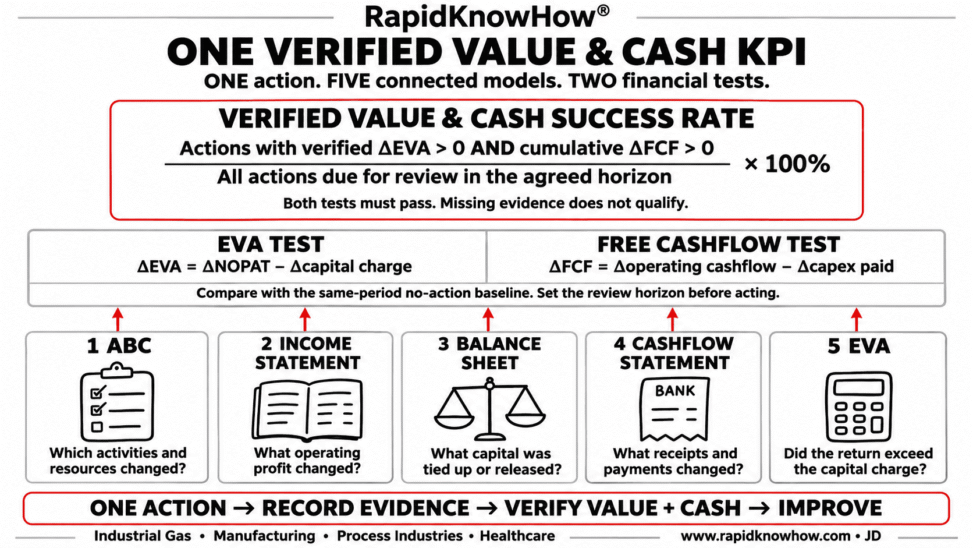
The strongest model is the RapidKnowHow® — ONE Cashflow & Economic Value Driver Model with five connected views:
ABC explains resource consumption. The Income Statement shows profit. The Balance Sheet shows capital tied up. The Cashflow Statement shows cash movements. EVA shows whether operating returns cover the cost of capital.
The financial statements are reconciled; ABC and EVA provide management views of the same underlying business.
1. The model
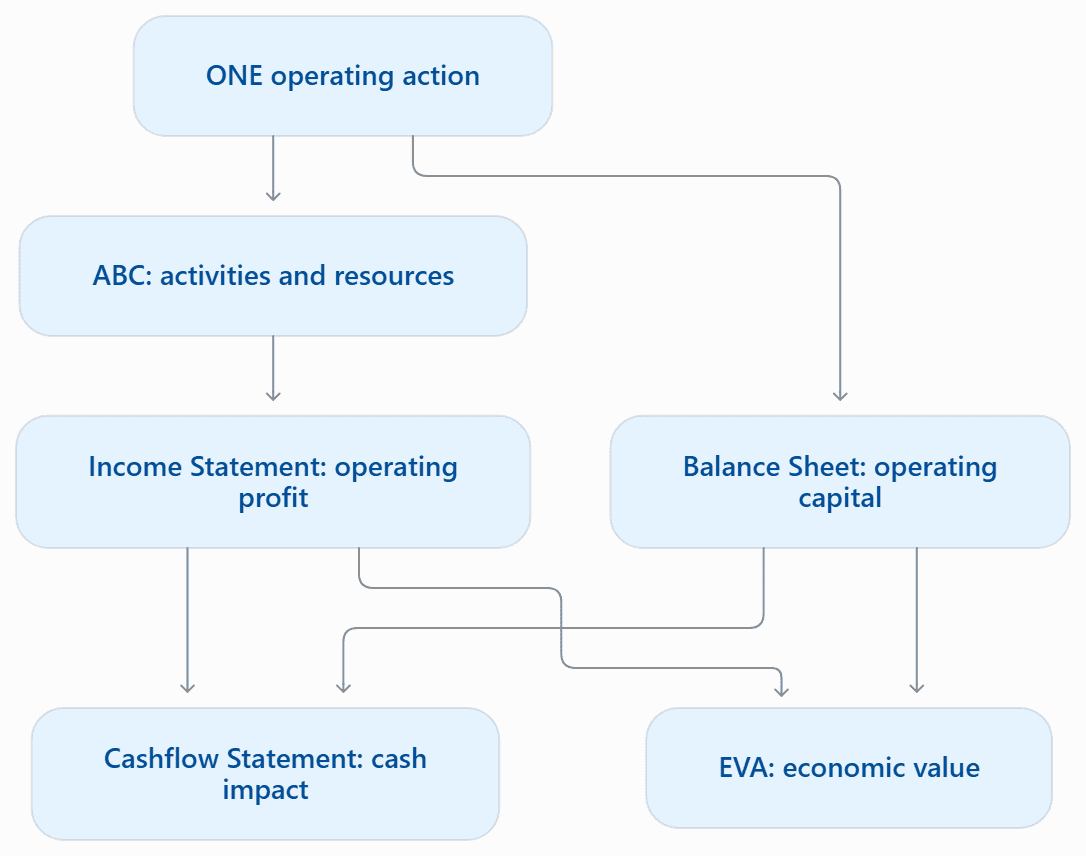
ABC assigns resource costs through activity drivers. A reduction in activity creates cash savings only when it changes actual receipts or payments. Unchanged fixed costs remain costs, even when less activity consumes them. accaglobal.com
2. The five views of ONE action
| View | Main drivers | What to measure |
|---|---|---|
| ABC | Orders, deliveries, handling events, cylinder-days, maintenance hours | Activity volume × cost per activity; separate avoidable payments from released capacity |
| Income Statement | Sales volume, price, gas consumption, energy, logistics, labour, depreciation | Change in operating profit and tax |
| Balance Sheet | Receivables, inventory, operating payables, equipment | Change in operating working capital and invested capital |
| Cashflow Statement | Collections, payments, tax timing, working capital, investment | Operating cashflow, capex paid and free cashflow |
| EVA | NOPAT, invested capital, cost of capital | Operating profit after tax less capital charge |
The model’s central rule: every claimed benefit must have an owner, a period, a baseline and evidence.
3. ONE industrial-gas example—fully reconciled
Problem: Frequent cylinder deliveries create unnecessary receiving work.
Action: Consolidate deliveries and install a small handling improvement.
The following is a new illustrative three-month case, compared with taking no action. Gas demand, revenue and service remain unchanged.
Assume:
- Deliveries fall from 100 to 70.
- Baseline ABC cost is €120 per delivery.
- Transport and paid overtime fall by €2,100.
- Implementation costs €300, expensed and paid.
- Equipment costs €4,000, paid at the start; quarterly depreciation is €400.
- Additional inventory of €800 is purchased and paid at the start.
- Tax is 25%, with the incremental tax paid during the quarter.
- Receivables, payables and financing remain unchanged.
ABC view: what activity changed?
| Item | Calculation | Result |
|---|---|---|
| Deliveries eliminated | 100 − 70 | 30 |
| Activity reduction at baseline ABC rate | 30 × €120 | €3,600 |
| Avoided transport and overtime payments | Identified separately | €2,100 |
| Remaining activity value | Unchanged internal resource payments | €1,500 released capacity |
€3,600 is the activity value reduced. It is not the cash saving.
Income Statement view: what profit changed?
| Incremental quarterly item | Impact |
|---|---|
| Lower transport and overtime expense | +€2,100 |
| Implementation expense | −€300 |
| Depreciation | −€400 |
| Operating profit improvement | +€1,400 |
| Tax | −€350 |
| NOPAT improvement | +€1,050 |
Cashflow Statement view: what cash changed?
| Incremental quarterly item | Impact |
|---|---|
| NOPAT improvement | +€1,050 |
| Add back non-cash depreciation | +€400 |
| Additional inventory funding | −€800 |
| Operating cashflow improvement | +€650 |
| Equipment purchase paid | −€4,000 |
| Free cashflow impact | −€3,350 |
Balance Sheet view: where did the money go?
| Change at quarter-end | Impact |
|---|---|
| Cash | −€3,350 |
| Inventory | +€800 |
| Equipment, net of depreciation | +€3,600 |
| Total assets | +€1,050 |
| Liabilities | €0 |
| Retained earnings | +€1,050 |
| Liabilities plus equity | +€1,050 |
The Balance Sheet reconciles: the equipment and inventory absorbed cash while the business earned additional profit.
EVA view: did the action create economic value?
EVA = NOPAT – ( Invested CAPITAL x WACC)
This measures profit after a capital charge; financing costs are incorporated in that charge. accaglobal.com
Assume 8% annual WACC, using a simple 2% quarterly charge:
| Calculation | Result |
|---|---|
| Average additional equipment capital | €3,800 |
| Additional inventory capital | €800 |
| Average additional invested capital | €4,600 |
| Quarterly capital charge | €4,600 × 2% = €92 |
| Quarterly EVA improvement | €1,050 − €92 = €958 |
ONE action produces five different, consistent results:
ABC €3,600 activity reduction → operating profit +€1,400 → operating cashflow +€650 → FCF −€3,350 → EVA +€958.
Positive EVA can coexist with an initial cash outflow. Investment decisions still require a credible future cashflow forecast and investment appraisal.
4. Apply the model across the three business areas
| Area | Start with ONE driver | Protect |
|---|---|---|
| Manufacturing | Deliveries, cylinder-days or gas consumed per good unit | Product quality and production availability |
| Process Industries | Energy or gas consumed per tonne of saleable output | Process stability and supply reliability |
| Healthcare | Handling events, emergency deliveries or unnecessary rental-days | Patient care, approved reserves and continuity |
ONE immediate action: Select ONE site and ONE activity. Record the activity change, avoidable payments, profit impact, capital movement and cash evidence in the same case record. Then calculate EVA separately.
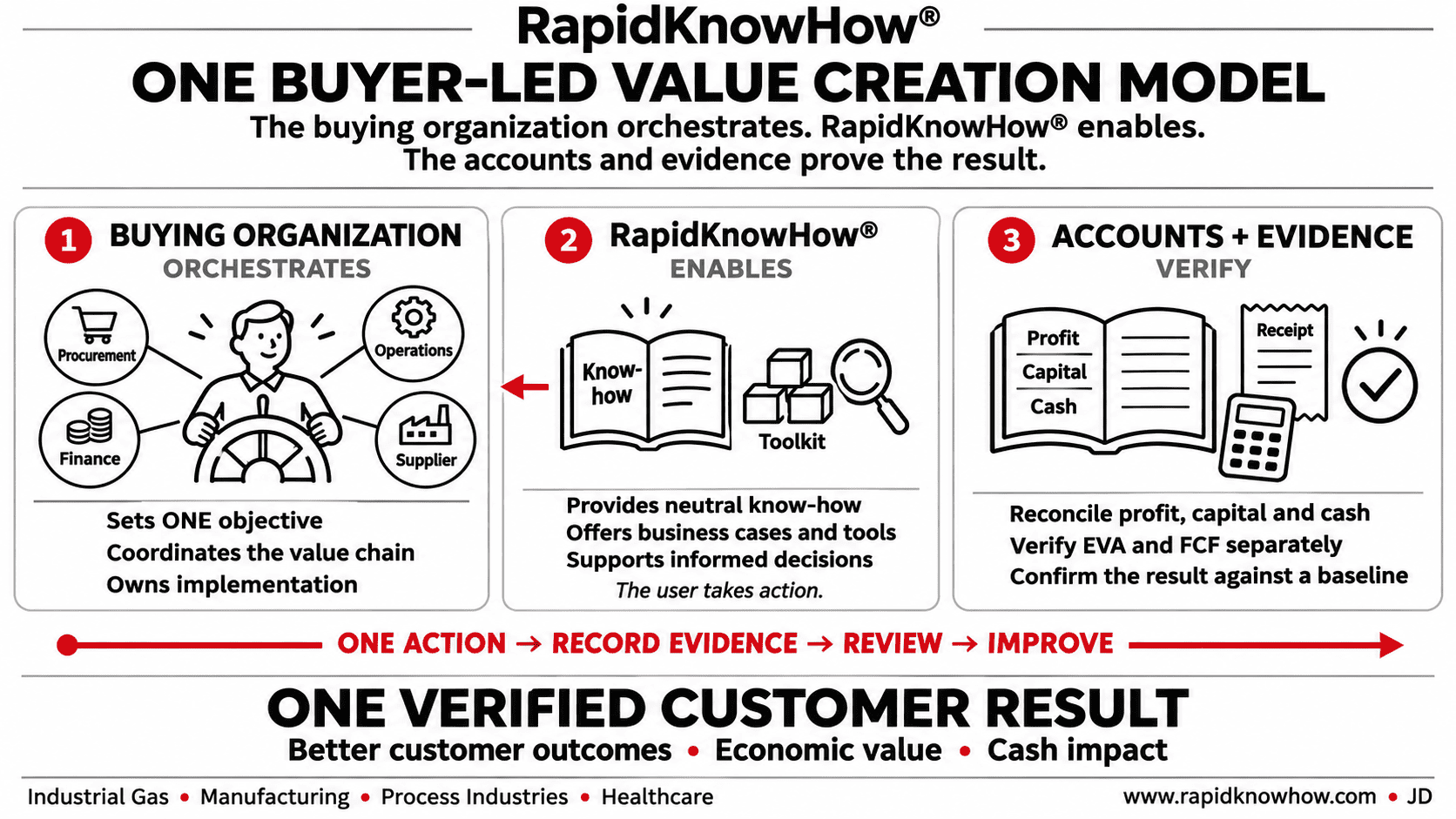
The buying organization orchestrates. RapidKnowHow® enables. The accounts and evidence prove the result. – Josef David
RapidKnowHow® — THE DECISION COMPANY™
Industrial Gas Leadership 2030
PROVE VALUE. THEN SCALE.
Watch the 60-second roadmap: 10 strategic actions for DACH and CEE, 2026–2030.
Start with ONE customer challenge. Use the Industrial Gas Action Guide to turn your first action into a measurable result.
RapidKnowHow® — Leading Industrial Gas Opportunity Signal Identifier in DACH & CEE