
PUT DECISIONS WHERE KNOWLEDGE AND ACCOUNTABILITY MEET.
EMPIRES · Episode 04 of 10
How does the centre govern the edges?
The centre needs consistency; local communities need decisions that fit local conditions. Excessive centralization can delay action and hide local problems. Delegation without accountability can let local authorities misuse power. Governance must address both difficulties.
Start with the decisions rather than the organization chart. Which decisions require a common rule? Which require local information? Who can act, who must be consulted and who reviews the result? Making those responsibilities visible reduces uncertainty without pretending that one structure fits every situation.
Administrative speed is not enough. A fast system that denies affected people a voice can efficiently impose harm. Evaluate the quality and legitimacy of decisions alongside the time taken to make them. Where officials exercise discretion, establish limits, appeal routes and consequences for abuse.
For a multi-site business, reserve decisions about shared commitments for the appropriate level while letting local teams solve defined customer problems. Escalation should have a threshold and a deadline. A manager should not need permission for every reversible improvement. Equally, a local team should not commit the whole organization to a major obligation without oversight. The objective is useful authority with visible responsibility.
HISTORICAL EVIDENCE
Art from Roman provinces shows local traditions alongside imperial forms. It provides evidence of regional variation within an extensive imperial order, rather than proof of uniform local experience.
Source: The Metropolitan Museum of Art — Art of the Roman Provinces. The decision framework and business applications below are RapidKnowHow analysis.
ONE DECISION
Assign one recurring decision to the level with the relevant knowledge and clear accountability.
TOP 3 ACTIONS
- Record who currently decides and how long the decision takes.
- Define the delegated boundary and escalation threshold.
- Review the first three decisions for speed, quality and stakeholder effects.
30-DAY RESULT TO VERIFY
A documented decision boundary and a measured reduction in avoidable waiting, without losing oversight.
ACTION CHECKLIST
Name the case and owner → establish the evidence and baseline → execute the three actions → assess benefits and burdens → review in 30 days. PASS only when the result is verified. Remove the observed chokepoint before adding another feature.
READ THE SERIES
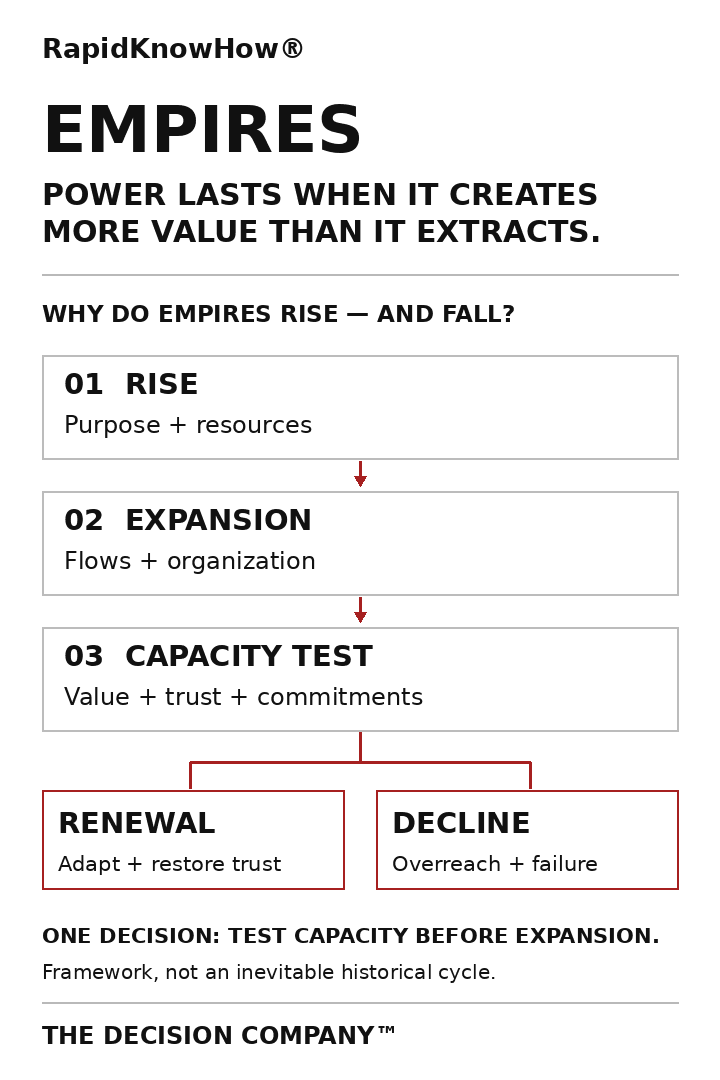
01 PURPOSE · 02 RESOURCES · 03 FLOWS · 04 ORGANIZATION · 05 TRUST · 06 VALUE · 07 OVERREACH · 08 DECLINE · 09 RENEWAL · 10 LEGACY
TURN INSIGHT INTO ONE DECISION
EMPIRES — the complete 17-page PowerBook, decision worksheet and 30-Day Action Guide. Individual use: €29.
For team use, workshops or commercial integration: Explore the separately agreed PowerLicense →
RapidKnowHow® — THE DECISION COMPANY™

